

AI Automation Budget Planning: How to Prioritize Workflows Before Next Year
- Why AI budget planning should start with workflows
- How to estimate automation value
- What costs companies often miss
- Build, buy, integrate, or customize?
- Why low-cost tools can create hidden costs
- How to choose which workflows deserve the budget first
- Build the budget in stages
- What should make it into next year’s AI automation budget?
As companies begin planning next year’s budget, AI usually moves from an interesting idea to a real investment question. By that point, most teams have already seen at least a few possible use cases. Someone has tested a tool, run a small pilot, or identified a manual workflow that feels expensive, repetitive, or difficult to scale. Leadership may be interested in what AI can do, while finance is already asking a more practical question: where does it actually make sense to spend money?
This is why AI automation budget planning matters. The challenge is not simply deciding whether AI is worth funding. It is about deciding which workflows deserve budget first, what kind of investment each one really requires, and how to avoid spending on projects that look promising but never create operational value.
For executives, founders, COOs, and CFOs, the goal should not be to approve an AI budget because the market expects it or because a vendor demo looked impressive. A stronger approach is to build the budget around workflows that involve measurable manual effort, clear business impact, realistic feasibility, and manageable risk.
Why AI budget planning should start with workflows
Many companies make the mistake of starting with tools. They compare platforms, request vendor demos, look at subscription costs, and ask which product has the best features. That comparison may be useful later, but it does not answer the most important budget question at the beginning: what work are we actually trying to improve?
A workflow-first approach creates a much stronger foundation for AI budget planning. Instead of asking which AI solution to buy, leaders should begin by looking at where operational time is being lost. Some workflows require staff to repeat the same steps every day. Others depend on manual review, spreadsheets, copying data between systems, chasing missing information, routing requests, or preparing reports by hand. These are usually better starting points for budget planning than broad goals such as “use more AI in operations.”
The difference becomes clear very quickly. “We want to use AI for support” is too vague to build a budget around. On the other hand, “We want AI to classify incoming support requests, suggest low-risk responses, and route sensitive cases to human review inside our existing support workflow” gives leadership something concrete to evaluate. The workflow is clear, the expected role of AI is clearer, and the business value can be estimated in a much more grounded way.
The same logic applies across document processing, claims follow-up, patient intake, internal knowledge search, reporting, scheduling, billing, compliance-heavy admin work, and many other operational areas. Once the workflow is defined properly, the budget conversation becomes much less abstract.
How to estimate automation value
The most obvious place to start is manual effort. If a workflow consumes a large amount of staff time every week, that alone makes it worth examining. Companies can look at how often the process occurs, how many people are involved, how much time it takes, and which parts of the work are repetitive enough for AI to support or automate. That usually gives a reasonable first estimate of potential value.
At the same time, AI automation ROI should not be reduced to time savings alone. Some workflows matter because they create delays, increase backlog, slow down response times, or generate avoidable errors. Others create hidden costs because people need to double-check work manually, follow up repeatedly, or move information from one place to another. In regulated or process-heavy environments, value may also come from better documentation, cleaner audit trails, more consistent review, or fewer missed steps.
This means the strongest business case usually connects automation to a broader operational outcome. A budget proposal becomes much more persuasive when it explains that a workflow could reduce manual review time, improve turnaround speed, help a team handle more volume without adding headcount, or reduce the risk of rework and follow-up. Those are much stronger decision-stage arguments than saying the company simply wants to “try AI.”
At the budgeting stage, estimates do not need to be perfect, but they should be specific enough to guide investment. Leadership should understand what type of value the workflow is expected to create and how that value will be measured once the system is live.
What costs companies often miss
One of the biggest problems in AI budget planning is that companies often focus on visible costs and underestimate the rest. The visible cost might be a subscription, a vendor proposal, a proof of concept, or internal development time. The harder part is everything around it.
Data preparation is a common example. A workflow may depend on approved data sources, cleaned records, structured documents, access rules, or updated knowledge bases before AI can perform reliably. If that work is ignored, the company may end up funding a tool without funding the conditions that make the tool useful.
Integration costs are another frequent blind spot. If AI outputs remain in a separate interface and someone still has to copy them into a CRM, EHR, support system, billing platform, or internal dashboard, a large part of the manual work remains. In that case, the company may be paying for AI without getting the workflow improvement it expected.
Human review also carries a cost, and it is one many teams forget to include. In real operations, especially in healthcare and other regulated environments, AI often works best when it prepares or supports work rather than making final decisions independently. That means teams still need review logic, escalation rules, monitoring, and clear ownership. These are not optional extras; they are part of what makes automation usable and safe.
On top of that, there are costs tied to AI governance, permissions, testing, user adoption, training, and ongoing maintenance. A budget that only reflects the price of the tool may look efficient, but it can give leadership a distorted view of the true investment.
For companies that want to assess these requirements more carefully before committing budget, AI automation services can help evaluate workflows, estimate feasibility, define review logic, and design automation that fits actual business operations.
Build, buy, integrate, or customize?
Once the workflow and business case are clearer, the next decision is how the company should actually implement the automation. In practice, most options fall into four categories: build, buy, integrate, or customize.
Buying an off-the-shelf tool can make sense when the workflow is relatively common, the risk level is acceptable, and the team can work within the structure the product already provides. This often applies to areas such as internal productivity, support drafting, basic knowledge search, or simpler content and document tasks.
Integration becomes more important when the AI tool has to fit into existing systems rather than sit beside them. If the workflow depends on updating records, routing tasks, triggering follow-up steps, or feeding outputs into dashboards, the implementation cost should include the work needed to connect those pieces properly.
Customization usually becomes necessary when the workflow is more specific, more regulated, or more tightly tied to internal operational logic. Many companies discover that a tool covers part of the need but not the full workflow, especially once approvals, exceptions, data controls, and human review are taken seriously.
Building from scratch is usually the most resource-intensive path, but it can be justified when the workflow is strategically important, highly specific, or central to the company’s product or service model. In these cases, a custom system may offer stronger control over data, user experience, governance, and long-term scalability.
The important thing is not to begin with the delivery model. The better sequence is to define the workflow first, then evaluate which path makes the most financial and operational sense.
Why low-cost tools can create hidden costs
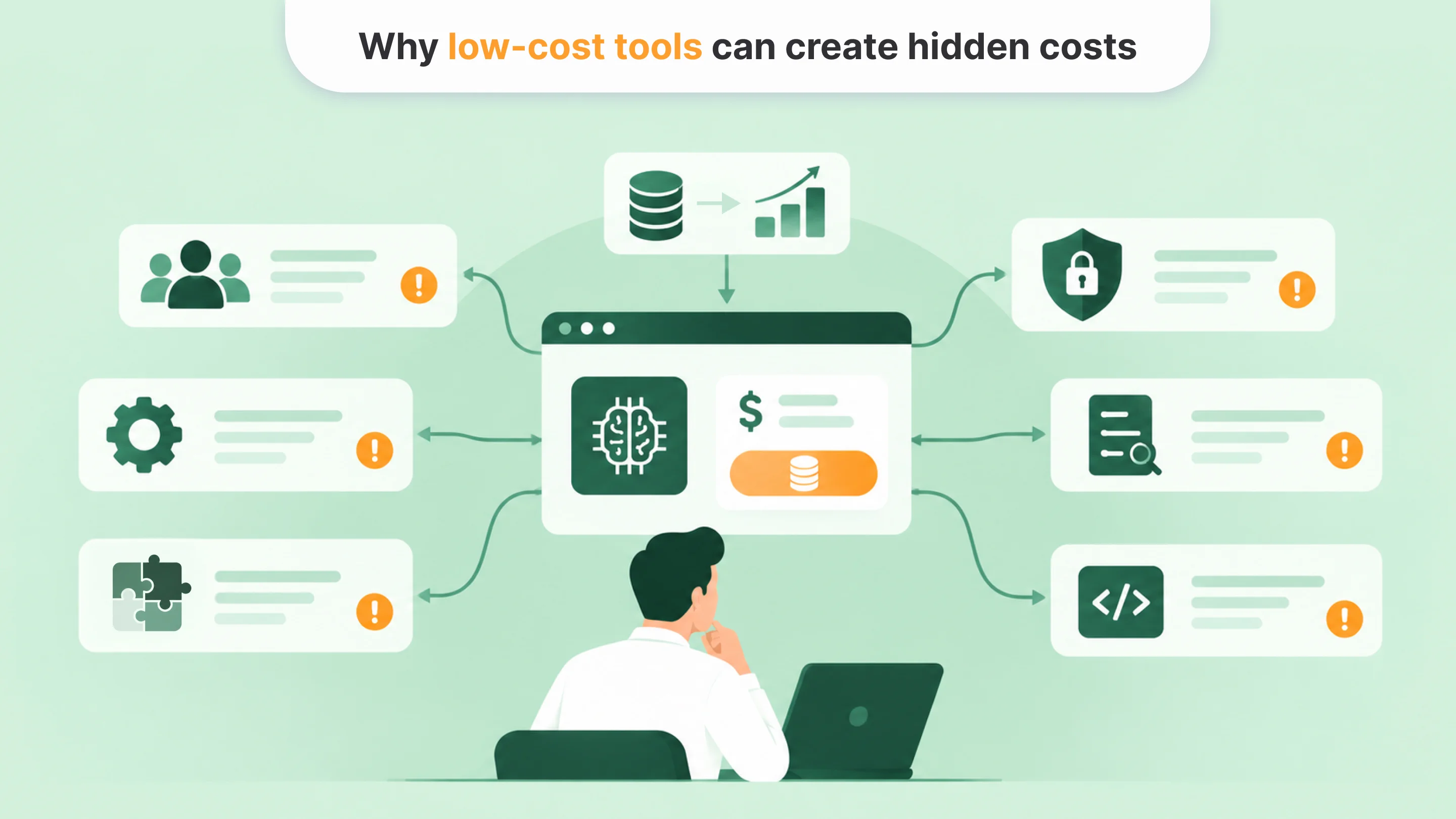
Low-cost AI tools are attractive for obvious reasons. They reduce the barrier to entry, are easy to test, and often make it possible for a team to start experimenting quickly. Sometimes that is exactly what a company needs. The trouble starts when a cheap tool is treated as a long-term workflow solution without asking what it will cost to use at scale.
A tool may be affordable while the surrounding process remains expensive. Staff may still have to move outputs manually, correct errors, verify results, and handle exceptions outside the system. Managers may have no visibility into what is being reviewed or why. Compliance teams may discover that the product does not support the level of documentation, access control, or monitoring they require. Engineering may need to build supporting integrations that were never included in the original budget estimate.
This is why budget planning should not stop at the license price. The real question is whether the tool reduces the total cost of the workflow once people, systems, review, governance, and maintenance are taken into account. In many cases, the cheapest-looking option is only cheap at the start.
That is particularly true in healthcare, finance, insurance, legal, HR, and other regulated operations, where requirements around permissions, monitoring, human review, and auditability quickly expose the limits of lightweight tools.
How to choose which workflows deserve the budget first
In most companies, the issue is not a shortage of AI ideas. It is deciding which ones should actually make it into next year’s budget. The most practical way to prioritize is to score workflows across four factors: manual effort, business impact, feasibility, and risk.
Manual effort helps determine whether the process is painful enough to matter. A workflow that happens frequently, consumes staff time, and creates repeated operational friction usually deserves attention.
Business impact shows whether solving that workflow would matter beyond the team directly involved. Some workflows affect revenue protection, cost reduction, service speed, operational visibility, patient or customer experience, or compliance readiness. Those are usually stronger budget candidates than workflows that are only mildly inconvenient.
Feasibility is just as important. A workflow may be valuable in theory, but difficult to automate next year because the data is scattered, the process is poorly defined, the systems are hard to access, or no one clearly owns the workflow. In that case, it may still deserve exploration, but not necessarily a full implementation budget yet.
Risk helps leadership understand how much control the workflow will require. Processes involving external communication, sensitive data, financial consequences, clinical context, or regulated decisions may still be good candidates, but they will require stronger governance, more careful design, and more explicit human review.
Usually, the best candidates are not the largest or most ambitious ideas. They are the workflows that are painful enough to matter, clear enough to scope, feasible enough to build, and safe enough to manage responsibly.
Build the budget in stages
A lot of AI budgets become either too small or too vague because companies treat the initiative as one line item instead of a sequence of decisions. In reality, AI projects usually move through stages: workflow discovery, value estimation, pilot or prototype, integration and production design, rollout, and ongoing monitoring.
Thinking in stages makes the budget more realistic. It prevents companies from underfunding the work that comes after a successful pilot, and it also reduces the temptation to overcommit too early. A staged approach gives leadership room to validate the business case before approving full implementation spend, while still planning for the real costs of scaling if the workflow proves worthwhile.
This is also where the budget should connect back to a broader AI implementation roadmap. Some workflows may need discovery first. Others may be ready for a controlled pilot. A few may be mature enough to move into integration and production. The budget becomes much easier to defend when it reflects that progression instead of treating every AI idea as equally ready.
What should make it into next year’s AI automation budget?
By the time next year’s budget is finalized, each proposed AI initiative should have a clear reason for being there. Leadership should be able to point to the workflow, the manual effort involved, the expected business impact, the likely implementation path, and the conditions needed for safe and effective use.
If those pieces are still unclear, the project may still be worth pursuing, but it probably belongs in a discovery or assessment budget rather than a production budget. That distinction is important because not every promising idea is ready for the same level of investment.
A sound AI automation budget does not try to fund every interesting concept at once. It prioritizes the workflows with the strongest case for measurable value, practical implementation, and sustainable use in real operations. That is the difference between AI spending and an automation investment strategy.
Faq
What is AI automation budget planning?
+AI automation budget planning is the process of deciding which AI automation initiatives deserve funding based on workflow value, manual effort, expected impact, feasibility, cost, and risk.
How should companies estimate AI automation ROI?
+Companies should estimate AI automation ROI by looking at the current manual effort in a workflow, the business outcome the automation is expected to improve, the implementation costs involved, and the metrics they will use to measure results after launch.
What costs are often missed in AI budget planning?
+The most commonly missed costs include data preparation, systems integration, workflow redesign, human review, AI governance, permissions, testing, training, monitoring, and ongoing maintenance.
Should companies build or buy AI automation tools?
+That depends on the workflow. Some processes are well suited to off-the-shelf tools, while others require integration, customization, or full custom development because of data complexity, regulatory requirements, or workflow-specific logic.
Which AI automation projects should be funded first?
+The strongest candidates are usually workflows with high manual effort, clear business impact, realistic feasibility, and manageable risk.

Tell us about your project
Fill out the form or contact us

Tell us about your project
Thank you
Your submission is received and we will contact you soon
Follow us