
AI Automation for Compliance-Heavy Operations: What Healthcare Can Teach Other Industries
- Why compliance-heavy operations are hard to automate
- What healthcare can teach regulated industries about AI automation
- Compliance workflow automation use cases
- AI for regulated industries: what should stay human-led
- Industry examples: where AI automation can help
- How to identify safe automation opportunities
- What a safe AI automation workflow looks like
- Common mistakes in compliance automation
- From faster tasks to controlled operations
Some industries cannot automate workflows the same way a typical SaaS company can.
In healthcare, insurance, legal, fintech, logistics, education, and HR compliance, operations are shaped by rules, documentation, approvals, audit trails, sensitive data, and human accountability. A process may look repetitive from the outside, but one wrong step can create financial, legal, reputational, or safety risk.
That is why AI automation for compliance operations requires a different approach. It is not enough to make a task faster. The system also needs to preserve review, traceability, permissions, escalation, and control.
Healthcare has been dealing with this challenge for years. It operates under heavy documentation requirements, privacy rules, clinical boundaries, payer processes, and human review. While other industries have different regulations, they face a similar operational question: how can AI reduce manual work without weakening compliance?
Why compliance-heavy operations are hard to automate
Compliance-heavy workflows are rarely simple. They often involve multiple teams, sensitive information, documents, approvals, exceptions, and external rules.
A healthcare team may need to review intake forms, referrals, insurance documents, consent forms, and payer letters before moving a patient forward. An insurance team may process claims, policy documents, fraud flags, and customer communications. A legal operations team may manage contracts, case files, regulatory documents, and internal reviews. A fintech company may need to verify users, monitor transactions, review risk signals, and document decisions.
These workflows are not only about completing tasks. They are about proving that the right process was followed.
That is where many automation projects struggle. A simple automation rule may move work faster, but it may not show why a decision was made, who reviewed it, what information was used, or when escalation happened.
For regulated industries, speed matters. But control matters just as much.
What healthcare can teach regulated industries about AI automation
Healthcare offers a useful model because it shows what happens when operations are both high-volume and high-risk.
Healthcare teams deal with repetitive administrative work every day: patient intake, document review, care coordination, claims follow-up, support requests, prior authorization, scheduling, and compliance checks. Many of these workflows are good candidates for AI-assisted automation.
But healthcare also shows where AI should not act alone. Clinical judgment, medical necessity, urgent concerns, privacy-sensitive communication, and compliance decisions require human oversight.
This creates a useful lesson for other industries: AI does not need to replace decision-makers to create value. It can prepare the work, summarize information, flag missing data, route tasks, draft low-risk responses, and make bottlenecks visible.
For companies exploring broader AI automation for compliance operations, the safest starting point is usually not full automation. It is structured assistance with clear human review.
Compliance workflow automation use cases
Document processing and data extraction
Compliance-heavy operations often run on documents: forms, contracts, claims, policies, invoices, reports, certificates, IDs, applications, and supporting evidence.
AI can help classify documents, extract key fields, detect missing information, summarize long files, and route exceptions to the right reviewer.
In healthcare, this may involve referrals, consent forms, insurance cards, payer letters, or claims attachments. In insurance, it may involve claims documents and policy files. In legal, it may involve contracts and case documents. In logistics, it may involve shipping documents, customs paperwork, certificates, and incident reports.
The value is not just reading documents. It is turning documents into structured workflow data.
Review and approval routing
Many regulated workflows need approvals from the right person at the right time.
AI can help identify what type of review is needed, route tasks based on rules, and flag cases that require escalation. It can also help prevent work from moving forward when required information is missing.
For example, a fintech operations team may need to route risk alerts based on transaction type. A legal team may need contract clauses reviewed by the right specialist. An HR compliance team may need specific employee documents checked before onboarding is complete.
The goal is to reduce manual sorting while keeping decision authority with humans.
Audit trail support
In regulated operations, teams need to know what happened, when it happened, who reviewed it, and what information was used.
AI can support auditability by summarizing actions, organizing case history, linking decisions to source documents, and helping teams keep records complete.
This matters across industries. Insurance teams need claim histories. Fintech teams need risk review records. Legal teams need contract version history. Healthcare teams need documentation around patient workflows, billing, and consent.
AI should not create a black box. It should make the workflow easier to trace.
Exception detection
Compliance-heavy workflows often break down around exceptions.
A missing signature, incomplete document, unusual transaction, unclear clause, expired certificate, mismatched data field, or urgent customer message can stop the process or increase risk.
AI can help flag exceptions earlier so teams do not discover issues too late. It can identify missing fields, inconsistent information, low-confidence outputs, unusual patterns, or cases that do not fit the standard workflow.
This is especially useful when teams process high volumes of similar cases but still need careful review for edge cases.
Internal knowledge and policy support
Regulated companies often have complex internal policies, SOPs, playbooks, and compliance guidance. Staff may know that rules exist but still struggle to find the right answer quickly.
AI assistants can help teams search approved internal sources, find relevant policies, summarize procedures, and answer operational questions with source references.
This is useful for healthcare teams, legal operations, HR compliance teams, financial services, and logistics companies where frontline staff often need quick but controlled access to internal guidance.
AI for regulated industries: what should stay human-led
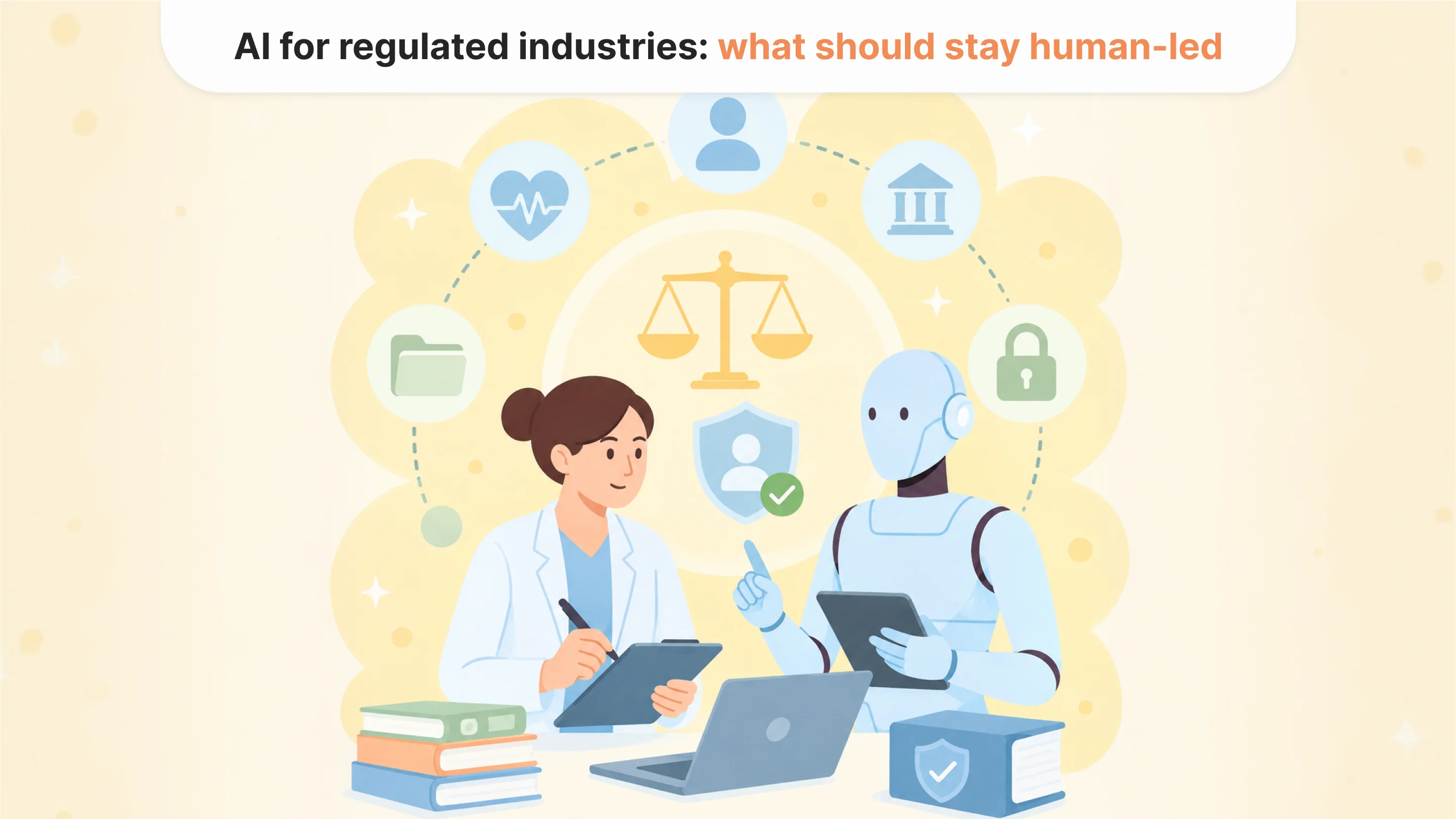
The biggest mistake in regulated automation is assuming that every repetitive task should be fully automated.
AI can support many parts of compliance-heavy work, but certain decisions should remain human-led. These include legal judgments, clinical decisions, final compliance approvals, fraud determinations, risk exceptions, employment decisions, financial approvals, and sensitive customer or patient communication.
A safe AI automation strategy should define:
what AI can do independently;
what AI can suggest;
what requires human approval;
what must be escalated;
what should never be automated;
how decisions are logged;
who can access sensitive information.
This is where healthcare offers a useful pattern: AI can prepare, organize, and flag, while qualified humans make the final decision.
Industry examples: where AI automation can help
Healthcare
Healthcare can use AI to support patient intake, document processing, care coordination, claims follow-up, internal knowledge search, and administrative support.
The priority is to reduce manual work while protecting patient safety, privacy, and human review.
Insurance
Insurance teams can use AI for claims intake, document review, policy comparison, customer request triage, fraud flag support, and claims follow-up.
The challenge is making sure AI supports adjusters and operations teams without making unsupported coverage or liability decisions.
Legal operations
Legal teams can use AI to summarize contracts, classify clauses, organize case documents, support matter intake, search internal knowledge, and route documents for review.
Human legal judgment should remain central, especially for interpretation, negotiation, and final advice.
Fintech
Fintech companies can use AI for KYC support, transaction review, customer support triage, risk signal summarization, document verification, and compliance reporting.
The key is combining automation with audit trails, escalation logic, and strong access controls.
Logistics
Logistics companies deal with shipping documents, customs forms, compliance certificates, incident reports, invoices, and partner communications.
AI can help classify documents, detect missing information, route exceptions, and make operational delays more visible.
Education
Education providers, especially in regulated or publicly funded environments, often manage student records, eligibility documents, accessibility requests, compliance reporting, and internal policies.
AI can help process documents, route requests, support staff with approved guidance, and reduce administrative backlogs.
HR and compliance teams
HR teams manage onboarding, policy acknowledgment, employee records, training requirements, incident reports, and compliance documentation.
AI can help identify missing documents, answer policy questions, route requests, and create visibility into incomplete workflows.
How to identify safe automation opportunities
The best AI automation opportunities in regulated industries usually share several traits.
The workflow is repetitive, but not fully judgment-based. The input is available in documents, forms, systems, or messages. The expected output is clear. The process has rules that can be mapped. Human review can remain in place. The impact can be measured.
Good first questions include:
Which workflows create the most manual review?
Where do teams copy information between systems?
Which documents cause delays?
Where are approvals or reviews often stuck?
Which exceptions are discovered too late?
Where do employees ask the same policy questions?
Which steps need better auditability?
Which decisions should always stay human-led?
The goal is to find workflows where AI can reduce preparation work, not remove accountability.
What a safe AI automation workflow looks like
A practical compliance workflow automation system should be designed around control.
A typical workflow may look like this:
A request, document, message, or case enters the system.
AI classifies the item and extracts key information.
The system checks required fields, rules, and risk indicators.
Low-risk cases move forward based on approved workflow logic.
Sensitive, unclear, or high-risk cases are routed to human review.
Reviewers see the source information and AI-generated summary.
Actions are logged for traceability.
Managers track bottlenecks, exception rates, and review outcomes.
This kind of structure allows AI to support speed without hiding risk.
Common mistakes in compliance automation
Many automation projects fail because they focus on tools before workflows.
One common mistake is automating a broken process instead of redesigning it first. If the workflow is unclear, AI will only move confusion faster.
Another mistake is treating AI as a decision-maker too early. In regulated operations, AI should usually begin as an assistant that prepares work and flags issues.
Teams also underestimate integration. If AI does not connect with the systems where work happens, employees may still need to copy data manually.
Finally, some companies forget to define ownership. Every AI-assisted workflow needs someone responsible for reviewing outputs, managing exceptions, and improving the process over time.
From faster tasks to controlled operations
AI can help compliance-heavy organizations move faster, but speed alone is not the goal.
For healthcare, insurance, legal, fintech, logistics, education, and HR teams, the real value comes when AI makes operations more structured, traceable, and easier to manage.
Healthcare shows that AI does not need to replace human judgment to be useful. It can reduce manual document review, summarize information, route tasks, flag missing data, support internal knowledge access, and make bottlenecks visible.
For operations leaders, the better question is not “Which process can we automate completely?” It is: “Where can AI reduce manual work while keeping the right controls in place?”
That is where AI automation for compliance operations can create sustainable value.
Faq
What is AI automation for compliance operations?
+AI automation for compliance operations means using AI to support workflows that involve rules, approvals, sensitive data, documentation, audit trails, and human review. It can help with document processing, routing, summaries, exception detection, and internal knowledge support.
How is compliance workflow automation different from regular automation?
+Regular automation often focuses mainly on speed and efficiency. Compliance workflow automation also needs traceability, access control, review rules, escalation logic, and documentation of what happened and why.
Which industries can use AI for regulated operations?
+Healthcare, insurance, legal, fintech, logistics, education, and HR/compliance teams can all use AI to reduce manual work in regulated workflows, as long as automation is designed with proper safeguards.
What should not be fully automated in compliance-heavy workflows?
+Final clinical, legal, financial, employment, fraud, or compliance decisions should usually remain human-led. AI can prepare information, flag issues, and support review, but it should not quietly replace accountable decision-makers.
How can companies choose the right workflow for AI automation?
+Companies should look for workflows that are repetitive, document-heavy, rule-based, measurable, and safe to support with human review. High-risk decisions should be handled carefully with escalation and oversight.
Why is healthcare a useful model for other regulated industries?
+Healthcare combines high-volume operations with privacy, documentation, review, and safety requirements. This makes it a useful reference point for other industries that want AI automation without losing control over compliance.

Tell us about your project
Fill out the form or contact us

Tell us about your project
Thank you
Your submission is received and we will contact you soon
Follow us