

AI Consulting for Healthcare and Operations: Where AI Actually Delivers ROI
Healthcare and operations leaders have seen enough ambitious technology initiatives to know one thing for sure: new tools do not automatically change how work gets done. Over the past few years, many organizations have launched pilots, adopted “intelligent” systems, and invested in transformation programs, only to find that daily operations still feel heavy. Administrative teams remain overloaded, coordination issues persist, and efficiency gains are difficult to measure with confidence.
When systems change, but work doesn’t
Recent industry analyses show healthcare organizations are steadily increasing AI adoption, with many already reporting moderate to high ROI as they scale up operational use cases. In 2025, adoption rates rose significantly from previous years, and a growing share of health systems report measurable returns on investment as they embed AI into workflows.
Yet this progress is uneven, and often looks very different on the operational floor.
In practice, this often looks familiar. A scheduling team still double-checks availability manually because upstream data cannot be trusted. Operations managers export reports into spreadsheets every week to reconcile numbers that should already align. Support staff spend hours routing requests that follow the same patterns day after day. The tools have changed; the work largely hasn’t.
Why most initiatives stall before ROI appears
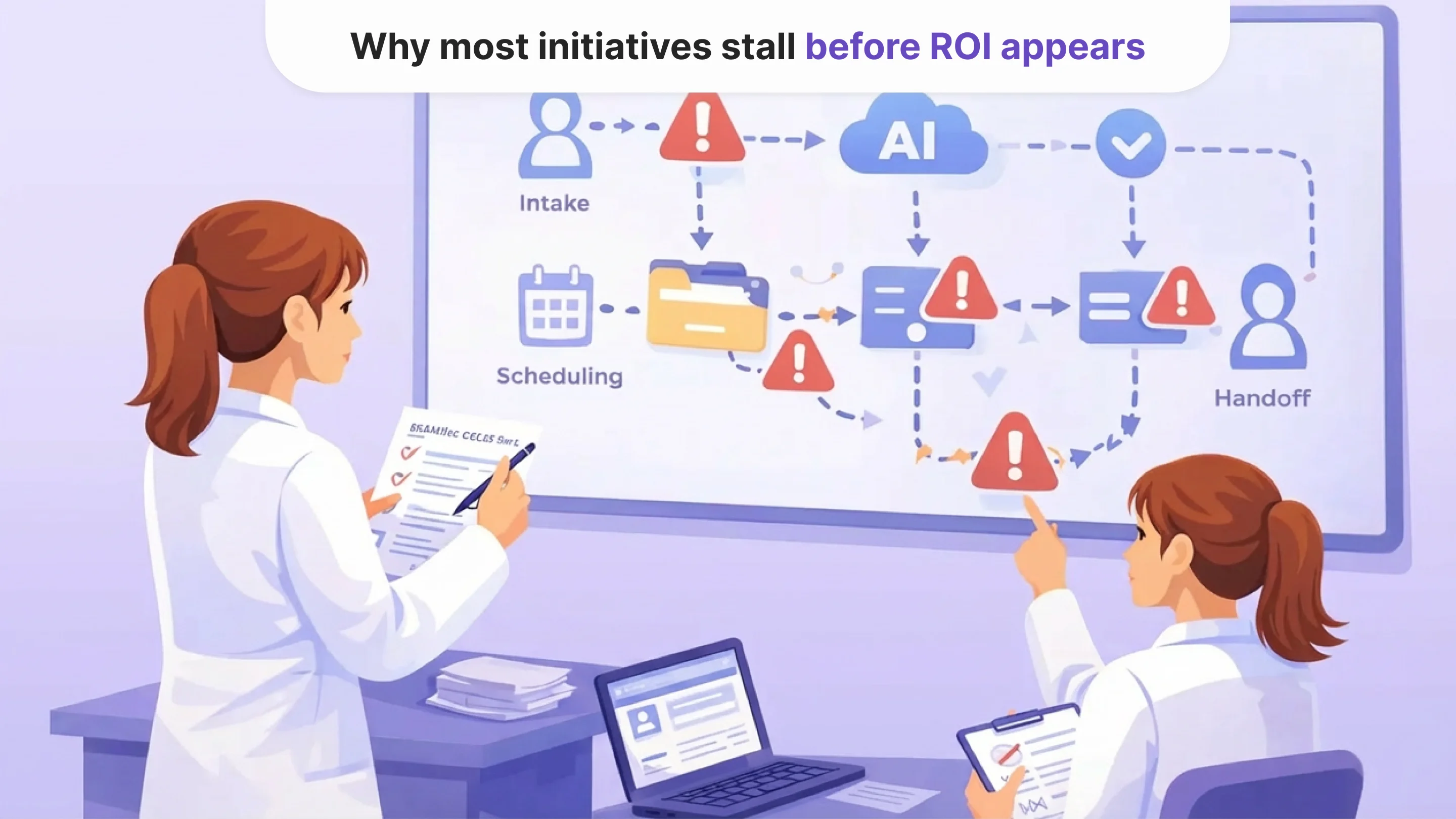
When initiatives stall at this stage, the issue is rarely technical. More often, new capabilities are layered onto processes that were never designed to scale. Automation is introduced where ownership is unclear, inputs vary widely, or data moves inconsistently between systems. In these environments, even well-built solutions struggle to produce reliable outcomes. Teams compensate with manual checks and workarounds, and value becomes harder, not easier, to capture.
From adoption to selectivity
This is where AI consulting for healthcare needs to move beyond adoption and toward selectivity. The real question is not whether advanced systems can be introduced, but whether they remove friction from execution. The improvements that generate ROI tend to be unglamorous but decisive: fewer handoffs, shorter cycle times, lower error rates, and more predictable throughput. When initiatives are chosen carefully, these gains compound quickly. When they are not, organizations inherit additional complexity without operational relief.
The leadership challenge
For founders, COOs, and heads of operations, the challenge is therefore not ambition, but prioritization. Which constraints are strategic, and which exist simply because manual effort is compensating for broken workflows? Where does human judgment truly add value, and where is it used only because systems cannot act on consistent rules? Most importantly, how can initiatives be evaluated early, before time and capital are committed, and expectations harden?
Where ROI Actually Comes From and Where It Rarely Does
High-ROI patterns
Not every operational problem is worth solving. Some are highly visible but structurally resistant to improvement, while others quietly drain time and money across thousands of daily interactions. The difference between initiatives that deliver ROI and those that stall has little to do with sophistication. It comes down to how closely an effort aligns with how work actually moves through the organization.
Returns are most predictable in areas where effort is repetitive, decisions follow stable patterns, and delays accumulate across teams rather than within a single role. In healthcare, this often includes intake, scheduling, documentation-heavy workflows, revenue cycle operations, and internal support functions that depend on manual data transfer between systems. These processes rarely feel strategic, but they directly affect throughput, cost per case, and staff utilization. Small improvements here tend to scale fast because they touch high volumes of routine work.
Where ROI usually breaks
Low-return initiatives usually start from the opposite direction. They focus on broad ambitions, becoming more “intelligent” or “data-driven”, without anchoring those goals in a specific operational constraint. Systems are introduced before workflows are stable, before ownership is clear, or before data flows reliably. Instead of reducing effort, they add another layer that teams must work around. Complexity increases, but leverage does not.
This difference becomes obvious when ROI is measured operationally rather than technically. High-return initiatives tie directly to a small set of metrics: cycle time, cost per transaction, error rate, or staff hours per unit of work. They can be tested incrementally and expanded once the impact is visible. Low-return efforts depend on broad adoption and ideal conditions before value appears, and by then, confidence is often gone.
Where AI automation consulting creates value
This is the boundary where effective AI automation consulting creates value. It starts with where execution breaks down today and asks which constraints are realistically addressable. In many cases, the real limiter is not the absence of advanced tools, but unclear workflows or fragile data pipelines. Without that foundation, even well-designed automation struggles to perform consistently.
What High-ROI Use Cases Look Like in Healthcare Operations
Operational problems hiding in plain sight
Despite its reputation for complexity, many of healthcare’s most expensive operational problems are surprisingly ordinary. They stem not from clinical judgment, but from coordination gaps, manual handoffs, and processes shaped by legacy systems. Because these issues sit below the clinical layer, they are often tolerated rather than redesigned, even though they heavily influence cost structures and staff experience.
Intake, scheduling, and patient coordination
Intake, scheduling, and patient coordination are common examples. Information is fragmented, data is re-entered multiple times, and exceptions are handled manually by default. Each step seems manageable in isolation, but at scale, the delays compound into missed appointments, underutilized capacity, and growing administrative burden. When these workflows are redesigned around consistent inputs and predictable decisions, the effects are immediate: fewer interventions, faster turnaround, and more stable use of clinical resources.
Documentation and internal reporting
The same pattern appears in documentation and internal reporting. Large amounts of time are spent transforming information that already exists into formats required by downstream systems or compliance processes. These tasks don’t benefit from judgment; they benefit from consistency. Reducing manual steps here typically improves both efficiency and data quality, while lowering the need for reconciliation later.
Revenue cycle operations
Revenue cycle operations highlight the same dynamic. Delays in coding, eligibility checks, or claim follow-ups are rarely caused by a lack of expertise. They are caused by volume and timing mismatches between teams and systems. When organizations distinguish clearly between cases that require human review and those that do not, they often recover value previously accepted as unavoidable loss.
For example, revenue cycle automation implemented at a large healthcare management services provider processed over 100 million transactions via AI-assisted automation, saving more than 15 000 employee hours per month, halving document turnaround times and driving a 30 % return on investment in a multi-year deployment (Business Insider, 2025).
Why these use cases scale
What links these use cases is not advanced technology, but their impact on metrics leaders already track: turnaround time, cost per case, utilization, and predictability. These initiatives succeed because they fit existing workflows instead of forcing teams to adopt entirely new behaviors. They are narrow, grounded, and measurable, which is exactly why they scale.
The Same ROI Patterns Beyond Healthcare
Why healthcare is less unique than it seems
Healthcare is far less unique than it is often made out to be. Across logistics, financial services, and SaaS, ROI tends to emerge in the same places: high-volume workflows, coordination-heavy processes, and environments where routine cases are interrupted by a small number of exceptions.
Outside healthcare, some of the strongest returns come from separating the predictable majority of work from genuine edge cases. Order processing, support triage, internal approvals, and exception handling all benefit from this structure. The financial impact does not usually come from reducing headcount, but from allowing teams to handle more volume with the same resources and fewer delays.
Another recurring source of ROI is reducing decision latency. In many organizations, outcomes suffer not because decisions are wrong, but because they arrive too late. Manual reviews slow execution past the point where optimal action is possible. Tightening these feedback loops produces modest gains individually but a meaningful financial impact over time.
What this means for healthcare leaders
These examples matter because they change how healthcare leaders think about risk. Many high-ROI patterns are already proven elsewhere; applying them in healthcare is not experimentation, but adaptation. ROI does not come from novelty. It comes from choosing problems that are structurally solvable and executing with discipline. AI strategy consulting is most valuable when it helps leaders make those choices early, before initiatives turn into expensive pilots with no clear path forward.
From insight to action
For many healthcare organizations, the hardest part of AI adoption is not implementation, it’s deciding where to start. Which operational problems are actually worth addressing? Where will automation simplify execution rather than add another layer of complexity? And which initiatives are likely to deliver measurable ROI versus stall at the pilot stage?
If these questions resonate, they’re usually a signal that the challenge is not technological, but strategic. Identifying high-impact opportunities early, before significant time, budget, and organizational effort are committed, is often what separates successful AI initiatives from those that never scale.
If you’re currently evaluating AI adoption in healthcare or operations and want a clearer view of where it can realistically deliver value in your context, we invite you to share your questions with us. We help teams assess readiness, prioritize use cases, and build a grounded roadmap based on operational constraints rather than hype.

Tell us about your project
Fill out the form or contact us

Tell us about your project
Thank you
Your submission is received and we will contact you soon
Follow us