
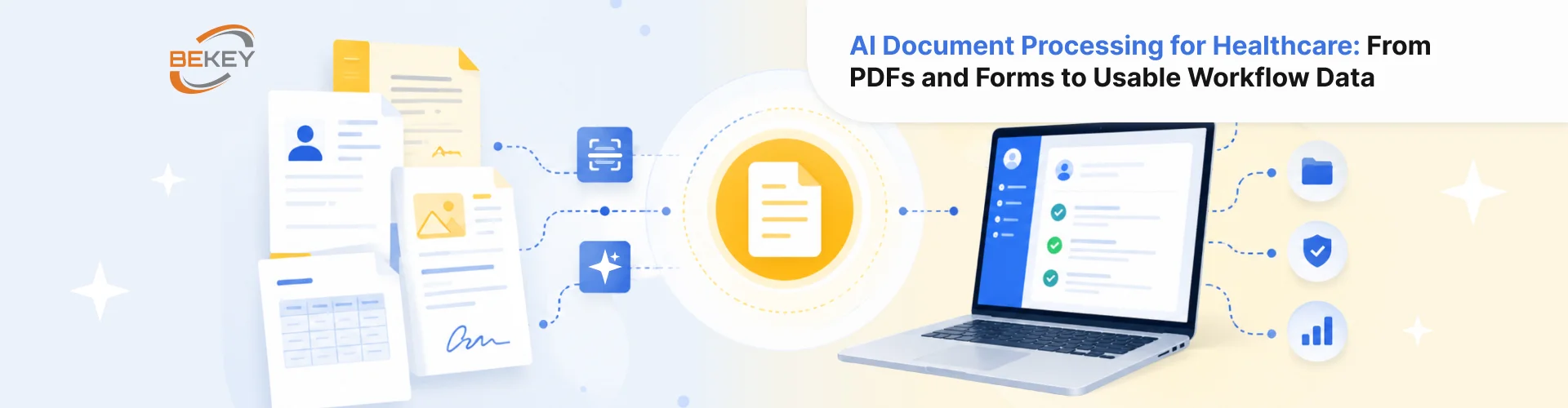
AI Document Processing for Healthcare: From PDFs and Forms to Usable Workflow Data
- Why healthcare document workflows are so difficult
- OCR vs AI document processing in healthcare
- Healthcare AI document processing use cases
- AI document processing capabilities
- What should not be fully automated?
- What should not be fully automated?
- Signs your healthcare organization needs AI document processing
- From static documents to usable workflow data
Healthcare companies run on documents: intake forms, referrals, insurance cards, consent forms, payer letters, claims attachments, and scanned records. The problem is not that these documents exist. The problem is that too much important information stays trapped inside them.
When staff have to open, read, classify, verify, and re-enter information manually, documents become an operational bottleneck. This is where AI document processing for healthcare can create practical value.
The goal is not just to “read” PDFs, forms, scans, and attachments. The goal is to turn them into usable workflow data that helps teams move faster, reduce manual review, and act with better context.
Why healthcare document workflows are so difficult
Healthcare document processing is harder than standard office automation because documents are inconsistent, sensitive, and tied to important operational decisions.
The same document type may arrive in several formats: a structured digital form, a scanned PDF, a blurry image, or a dense payer letter with codes, deadlines, and instructions. Even when the document is readable, the workflow question remains: what should happen next?
Many automation projects fail because they focus only on extraction. But knowing what a document says is not enough. Teams also need to know what it means for the next step.
For CTOs and operations leaders, the real challenge is building a healthcare document automation workflow that can identify document types, extract relevant data, flag missing information, route tasks, and keep human review where needed.
OCR vs AI document processing in healthcare
For years, optical character recognition helped organizations digitize paper-based information. OCR can identify text in images and scanned files. That is useful, but it is only the first layer.
OCR can tell you that a document contains words. It does not always understand whether the document is a referral, an insurance card, a lab result, a denial letter, or a consent form. It does not know which fields matter, whether the document is complete, or which team should review it.
AI form processing and medical document AI go further. They can help classify documents, extract structured fields, summarize free-text information, compare document content with system data, and flag uncertainty.
For example, AI can help answer practical workflow questions:
What type of document is this?
Which patient or case does it belong to?
Is the document readable?
Are required fields present?
Is the signature missing?
Does the payer request additional information?
Should this go to intake, billing, care coordination, or clinical review?
What information should be added to the internal system?
This is the difference between digitizing a document and making it operationally useful.
Healthcare AI document processing use cases
AI document processing can support several healthcare workflows where teams still rely on manual review.
Intake and onboarding
Patient intake often depends on uploaded documents: insurance cards, IDs, referrals, medical history forms, consent forms, questionnaires, or previous records. Staff must check whether each file is present, readable, complete, and relevant.
AI document processing can classify these files, detect missing documents, extract key details, and prepare summaries for staff. This helps reduce the manual work that happens before the first appointment or program enrollment.
For healthcare companies exploring broader AI document processing solutions, intake is often one of the clearest places to start because the workflow is repetitive, measurable, and directly tied to patient experience.
Referrals and clinical handoffs
Referrals often contain important information, but they may arrive in different formats and with different levels of completeness. A referral may include provider details, diagnosis information, reason for referral, requested service, attachments, and notes.
AI can help identify referral documents, extract relevant details, flag missing attachments, and route the case to the right team. Human review remains important, especially when clinical interpretation is required.
Revenue cycle and claims attachments
Revenue cycle teams often work with payer letters, denial notices, explanation of benefits documents, prior authorization files, and claims attachments. These documents may determine the next follow-up action, but reviewing them manually takes time.
AI can summarize payer responses, classify denial-related documents, extract deadlines or requested items, and help staff understand what action may be needed next. This can support claims follow-up automation and reduce delays caused by manual review.
Compliance and consent documentation
Consent forms, privacy notices, authorization forms, and internal compliance documents often need to be checked for completeness and correct handling.
AI can help identify whether required sections are present, whether a document appears incomplete, or whether it should be routed for compliance review. It should not make final compliance decisions independently, but it can reduce repetitive checking and improve visibility.
AI document processing capabilities
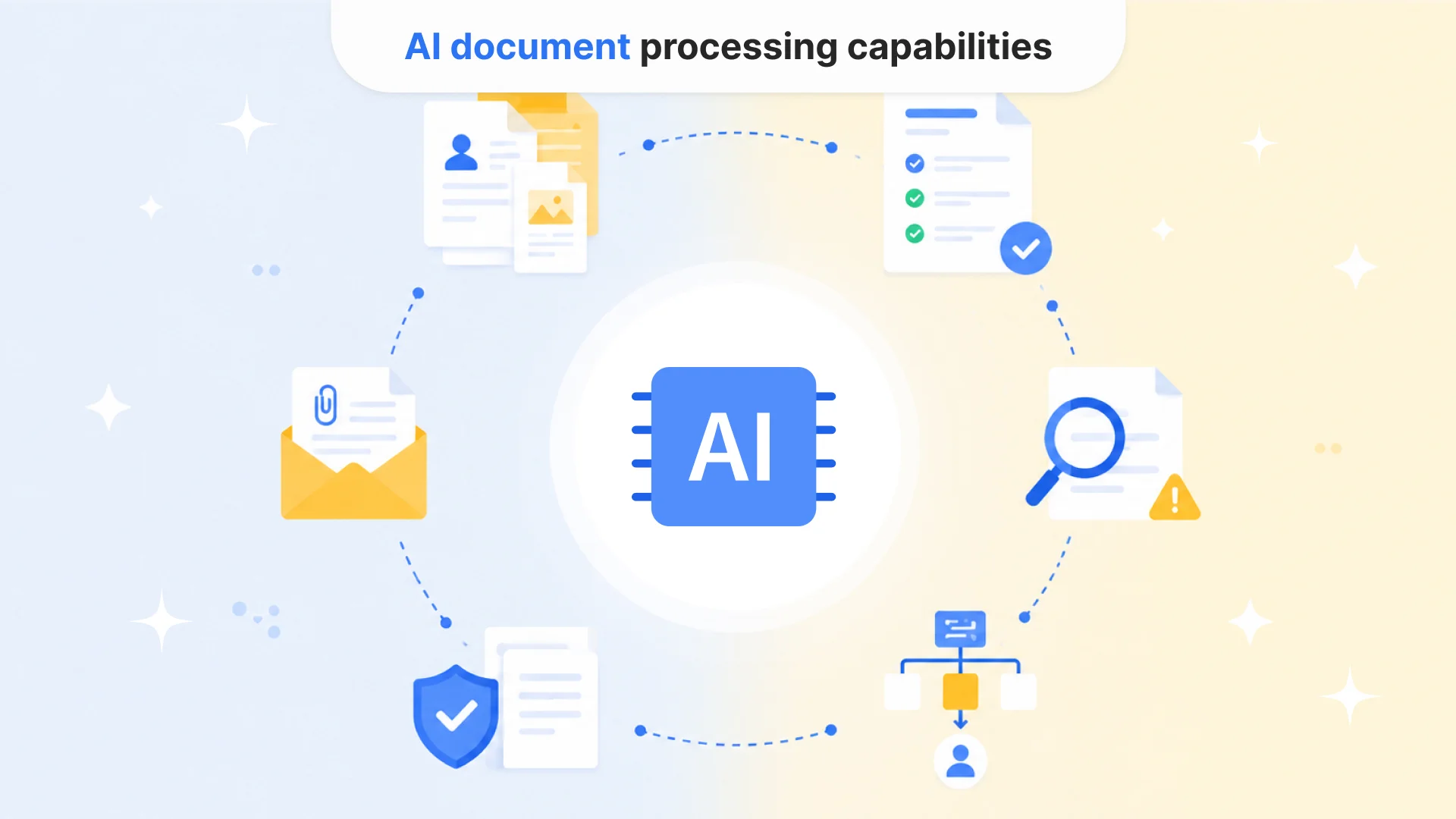
A strong document automation process is built around the workflow, not the document alone.
A practical workflow may look like this:
A document enters the system through a form, upload, email, portal, or integration.
The system identifies the document type.
AI extracts key fields and summarizes relevant details.
The system checks for missing, unreadable, or inconsistent information.
Low-confidence or sensitive cases are routed for human review.
Approved data moves into the right system or task queue.
The workflow triggers the next action: follow-up, scheduling, billing review, care coordination, or compliance review.
Managers track document volume, exception rates, and bottlenecks.
This structure keeps AI useful but controlled. It reduces repetitive review while keeping people responsible for decisions that require judgment.
What should not be fully automated?
AI document processing can reduce manual work, but it should not become an unchecked decision layer.
Healthcare documents often contain sensitive, incomplete, or clinically relevant information. A document may include symptoms, diagnoses, medications, insurance details, signatures, or payer instructions. Mistakes can affect care, billing, compliance, or patient experience.
AI should not independently diagnose, determine medical necessity, approve treatment, make final billing decisions, or decide whether a compliance requirement has been satisfied. It should support human review by preparing information, flagging issues, and making the workflow easier to manage.
A safe medical document AI workflow should include:
approved document types and use cases;
clear human review rules;
confidence scoring or uncertainty flags;
audit trails for AI-assisted actions;
role-based access to sensitive documents;
escalation rules for clinical or compliance concerns;
monitoring for errors and edge cases.
The goal is not to remove accountability. The goal is to remove unnecessary manual preparation.
What should not be fully automated?
AI document processing can reduce manual work, but it should not become an unchecked decision layer.
Healthcare documents often contain sensitive, incomplete, or clinically relevant information. A document may include symptoms, diagnoses, medications, insurance details, signatures, or payer instructions. Mistakes can affect care, billing, compliance, or patient experience.
AI should not independently diagnose, determine medical necessity, approve treatment, make final billing decisions, or decide whether a compliance requirement has been satisfied. It should support human review by preparing information, flagging issues, and making the workflow easier to manage.
A safe medical document AI workflow should include:
approved document types and use cases;
clear human review rules;
confidence scoring or uncertainty flags;
audit trails for AI-assisted actions;
role-based access to sensitive documents;
escalation rules for clinical or compliance concerns;
monitoring for errors and edge cases.
The goal is not to remove accountability. The goal is to remove unnecessary manual preparation.
Signs your healthcare organization needs AI document processing
Your healthcare document workflow may be ready for automation if:
staff manually open and review high volumes of PDFs or forms;
documents arrive in inconsistent formats;
missing or unreadable files delay the next step;
teams copy information from documents into other systems;
referrals, claims, or intake workflows depend on manual document checks;
managers cannot see which document types create the most delays;
staff spend time classifying documents before they can act;
document-related errors create rework or follow-up loops.
These signs suggest that the issue is not only document storage. It is document usability.
Before implementing automation, teams should map the document journey. Where do documents enter? Who reviews them? Which fields matter? Which documents are often incomplete? Which systems need the extracted data? What requires human review? What should happen after the document is processed?
This map helps identify the safest and most valuable automation opportunities.
From static documents to usable workflow data
Healthcare documents will not disappear. PDFs, forms, scans, attachments, and letters will continue to move through intake, referrals, billing, compliance, and operations.
The question is whether staff should continue processing all of that information manually.
AI document processing can help healthcare teams classify documents, extract key details, flag missing information, route cases, and make document-heavy workflows easier to manage. But the strongest value comes when document automation is connected to the next action, not just the file itself.
For healthcare leaders, the right question is not “Can AI read our documents?” It is: “Which documents slow our workflow down, and what would change if the right data reached the right team faster?”
That is where healthcare document automation can create real operational value.
Faq
What is AI document processing in healthcare?
+AI document processing in healthcare means using AI to classify, extract, validate, summarize, and route information from healthcare documents such as PDFs, forms, referrals, insurance cards, consent forms, payer letters, and claims attachments. The goal is to turn unstructured or semi-structured files into usable workflow data.
How is AI document processing different from OCR?
+OCR reads text from images, scans, or PDFs. AI document processing goes further by understanding document type, extracting relevant fields, identifying missing information, flagging uncertainty, and connecting the document to the next workflow step.
What healthcare documents can be automated with AI?
+Common examples include patient intake forms, referrals, insurance cards, consent forms, lab reports, prior authorization packets, payer letters, denial notices, claims attachments, onboarding documents, and internal SOPs.
Can AI document processing integrate with EHRs, CRMs, and billing systems?
+Yes, if the solution is designed for integration from the start. Extracted document data can be routed into EHRs, CRMs, billing platforms, task queues, dashboards, or internal workflow systems, depending on the organization’s infrastructure and compliance requirements.
Is AI document processing safe for sensitive healthcare data?
+It can be, but only with the right safeguards. Healthcare document automation should include role-based access, audit trails, human review, approved use cases, escalation rules, and clear boundaries around clinical, billing, and compliance decisions.

Tell us about your project
Fill out the form or contact us

Tell us about your project
Thank you
Your submission is received and we will contact you soon
Follow us