
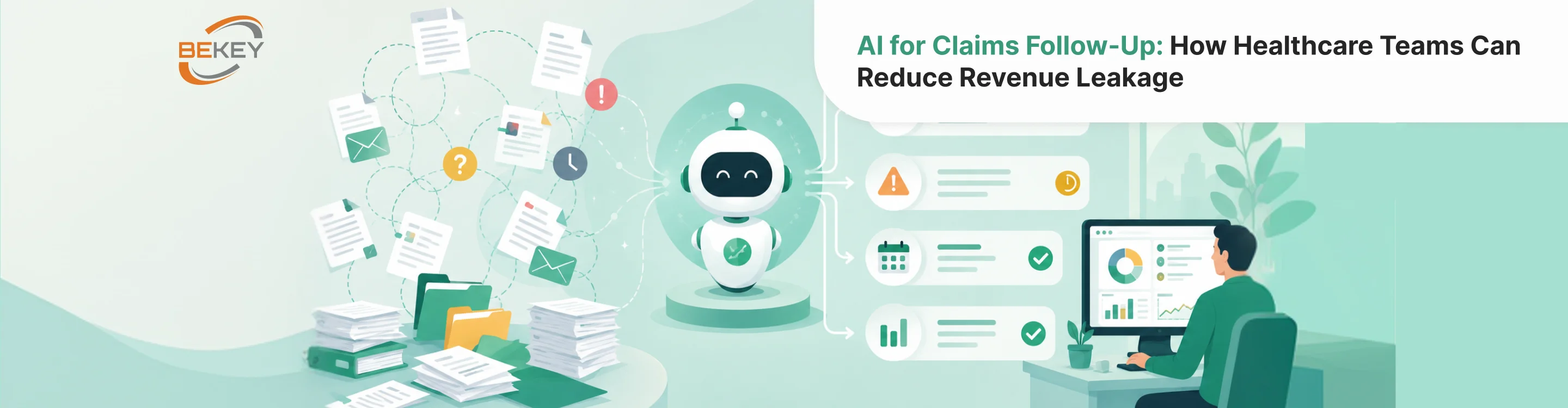
AI for Claims Follow-Up: How Healthcare Teams Can Reduce Revenue Leakage
- Why claims follow-up becomes a revenue bottleneck
- How revenue leakage happens in follow-up workflows
- What manual claims follow-up looks like
- Where AI can help in claims follow-up
- What should not be fully automated?
- How AI changes the workflow for RCM teams
- What a practical AI-assisted claims follow-up workflow looks like
- When claims follow-up is ready for automation
- Why this matters for CFOs and operations leaders
- From Manual Follow-Up to Revenue Protection
Claims follow-up is one of those healthcare operations problems that rarely looks urgent from the outside. A claim is submitted. A payer response is pending. A denial needs review. A missing document has to be found. Someone needs to check a portal, update a spreadsheet, send a message, or decide what happens next.
Each step may seem small. But across hundreds or thousands of claims, the delays add up. Money sits in accounts receivable. Staff spend hours checking statuses manually. Denials age before anyone acts. Follow-up tasks get lost across payer portals, billing systems, spreadsheets, and internal queues.
This is how healthcare revenue leakage often happens. Not always through one major billing mistake, but through repeated operational friction: slow follow-up, unclear ownership, missing information, delayed appeals, and manual work that does not scale.
That is why AI claims follow-up is becoming a more practical conversation for revenue cycle leaders, CFOs, and operations teams. The goal is not to let AI independently manage reimbursement decisions. The goal is to help teams identify what needs attention faster, reduce repetitive checking, and move claims through the follow-up process with less manual effort.
Why claims follow-up becomes a revenue bottleneck
Claims follow-up is often labor-intensive because it sits between multiple systems and stakeholders. Teams may need to work with EHRs, billing platforms, clearinghouses, payer portals, internal notes, denial codes, remittance advice, attachments, and patient or provider information.
Even when the billing system contains the claim record, the real status may still require manual checking. Staff may need to log into payer portals, interpret responses, compare information, identify missing documents, and decide whether to resubmit, appeal, escalate, or wait.
The problem is not only volume. It is fragmentation.
A claims team may handle:
unpaid claims with unclear status;
denied claims that need appeal decisions;
rejected claims caused by missing or incorrect data;
payer requests for additional documentation;
claims waiting on eligibility or authorization details;
follow-up tasks tracked outside the main system;
aging accounts that require prioritization.
When these workflows depend heavily on manual review, revenue cycle teams often spend too much time finding the next action instead of taking it.
How revenue leakage happens in follow-up workflows
Healthcare revenue leakage is not always visible immediately. It often appears as small delays and missed opportunities that accumulate over time.
A claim may sit in a pending status longer than necessary. A denial may not be worked quickly enough. A payer request may be missed. A follow-up task may be assigned to the wrong person. A spreadsheet may not reflect the latest update. A team may focus on easy claims while higher-value or time-sensitive claims age in the queue.
These issues can create financial impact in several ways:
delayed cash flow;
higher days in accounts receivable;
missed appeal windows;
avoidable write-offs;
duplicated staff effort;
lower productivity per RCM employee;
poor visibility into claim status and team performance.
For CFOs and RCM leaders, the challenge is not simply “collect more.” It is understanding where revenue is being slowed down by operational friction and which parts of the follow-up process can be improved without increasing compliance or billing risk.
What manual claims follow-up looks like
A manual claims follow-up workflow often requires staff to move between systems and make small decisions repeatedly.
A typical process may look like this:
Staff identifies claims that need follow-up.
They check claim status in the billing system or payer portal.
They review payer responses, denial codes, or notes.
They search for missing documentation or patient details.
They decide whether to resubmit, appeal, escalate, or wait.
They update the internal system or spreadsheet.
They create a task or reminder for the next follow-up step.
This process can work when volume is low. But as claims volume grows, manual follow-up becomes harder to control. Teams spend time on repetitive status checks, claims age without clear prioritization, and managers struggle to see where work is getting stuck.
The issue is not that staff lack expertise. It is that too much expert time is spent on administrative preparation before the team can act.
Where AI can help in claims follow-up
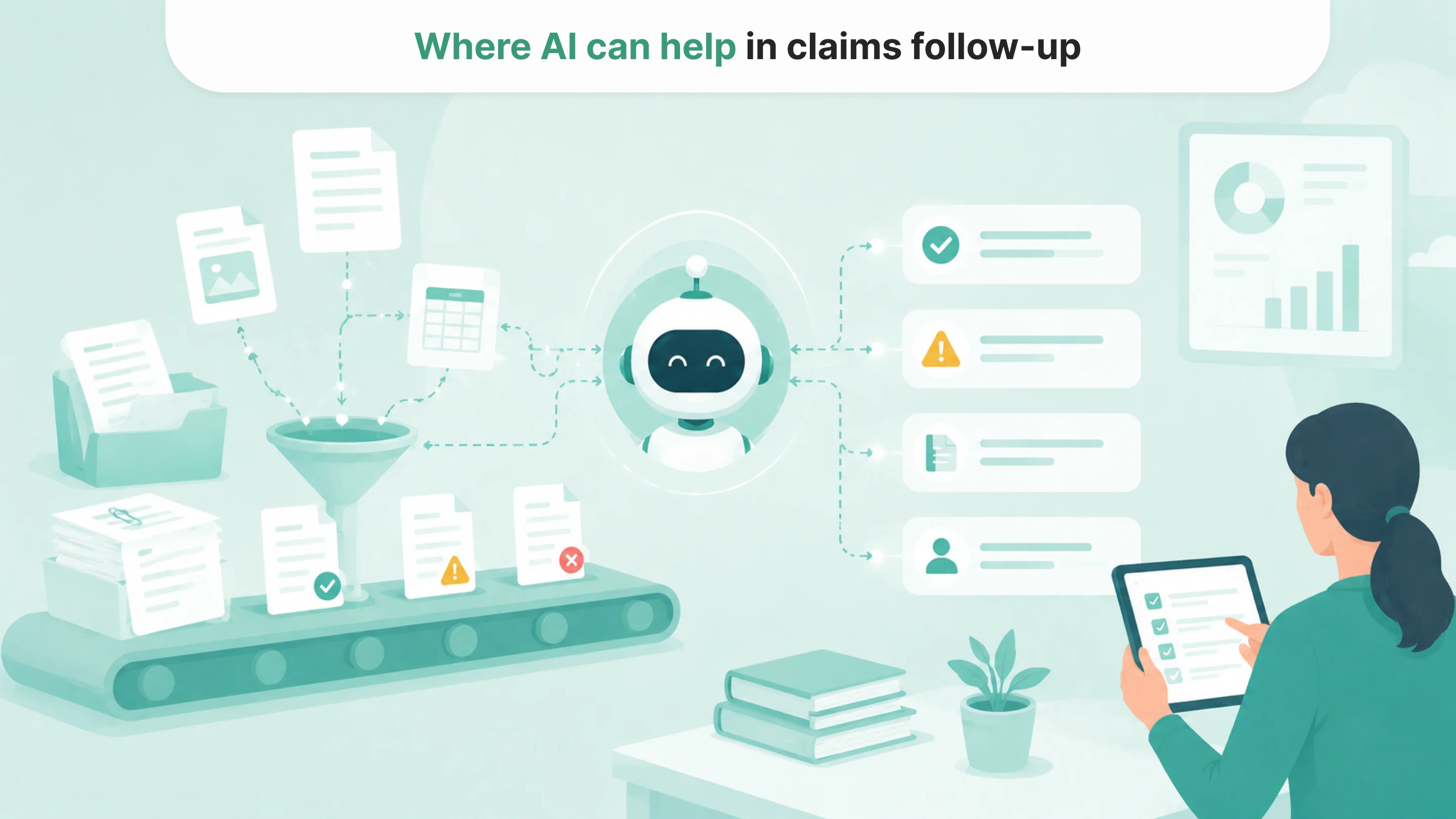
AI for claims management can support follow-up by helping teams process information faster and prioritize work more clearly. It is most useful when the workflow involves repeated reading, classification, extraction, summarization, and next-step preparation.
Status and response summarization
Payer responses can be difficult to review quickly, especially when teams work across multiple portals or formats. AI can help summarize claim status updates, denial reasons, requests for information, or payment-related notes into a clearer format for staff.
Instead of reading through long response details from scratch, the team can start with a summary and verify the source when needed.
Denial and issue classification
AI can help classify common claim issues: missing information, eligibility problems, coding-related issues, authorization gaps, documentation requests, or payer-specific requirements.
This makes it easier to group similar claims, route them to the right team member, and identify patterns that may require process improvement upstream.
Missing-document detection
Many follow-up delays happen because a claim depends on a document that is missing, incomplete, or hard to locate. AI can support document review by identifying whether required attachments are present, classifying uploaded files, and flagging incomplete documentation.
This is especially useful when claims teams work with PDFs, scans, payer letters, clinical notes, or authorization documents.
Next-action suggestions
AI can help prepare the next step based on predefined rules and historical workflow patterns. For example, it may suggest that a claim needs additional documentation, appeal review, eligibility verification, or escalation to a specialist.
The system should not make final reimbursement decisions alone. But it can reduce the time staff spends figuring out what to do next.
Follow-up drafts and task creation
Claims follow-up often involves repeated communication: payer inquiries, internal requests, documentation follow-ups, appeal drafts, or status updates. AI can help prepare draft messages or tasks using approved templates.
Staff can review and edit these drafts before sending. This keeps humans in control while reducing repetitive writing and coordination work.
What should not be fully automated?
AI can make claims follow-up faster, but it should not become an unchecked decision-maker. Revenue cycle workflows affect reimbursement, compliance, documentation, and sometimes patient financial responsibility. Mistakes can create financial and regulatory risk.
AI should not independently decide whether a claim should be written off, whether an appeal is clinically justified, whether documentation proves medical necessity, or whether a payer decision is correct. These steps require human review and clear organizational policies.
A safer approach is to use AI for preparation and prioritization:
summarize payer responses;
classify claim issues;
detect missing information;
suggest next steps;
draft follow-up messages;
flag high-risk or high-value claims;
route uncertain cases to human reviewers.
The goal is not to remove RCM expertise. The goal is to help experienced teams focus that expertise where it matters most.
How AI changes the workflow for RCM teams
The biggest operational shift is from reactive follow-up to more structured prioritization.
In a manual process, staff may work claims based on queue order, payer deadlines, personal knowledge, or spreadsheet filters. In an AI-assisted process, the system can help organize claims by urgency, value, missing information, denial type, payer response, or required next action.
This can change the daily workflow in several ways:
staff start with clearer claim summaries;
high-priority claims are easier to identify;
repeated follow-up messages take less time to prepare;
missing documents are flagged earlier;
managers get better visibility into bottlenecks;
teams spend less time checking statuses manually;
follow-up work becomes easier to measure.
For RCM leaders, this is valuable because it connects automation to measurable business outcomes: reduced aging, faster follow-up, fewer missed tasks, better staff productivity, and lower revenue leakage.
What a practical AI-assisted claims follow-up workflow looks like
A useful AI claims follow-up workflow does not need to automate every part of the revenue cycle. It can start with a narrow, high-friction area.
A practical workflow may look like this:
Claims are pulled from the billing system or work queue.
The system identifies claims that need follow-up.
AI summarizes payer responses and claim notes.
AI classifies the issue or denial type.
The system checks whether required documents are present.
AI suggests the next action based on predefined rules.
Staff reviews high-priority or uncertain cases.
Follow-up messages or tasks are created.
Managers track status, aging, and bottlenecks.
This approach keeps human review in the process while reducing the repetitive administrative work around claim follow-up.
When claims follow-up is ready for automation
Not every revenue cycle problem should start with AI. Sometimes the first step is cleaning up workflows, improving system configuration, or standardizing team processes. AI becomes more useful when the follow-up process is repetitive, high-volume, and difficult to manage manually.
Your claims follow-up workflow may be ready for automation if:
staff spend hours checking claim statuses manually;
follow-up tasks are tracked in spreadsheets;
payer responses require repeated review and interpretation;
denials age before action is taken;
missing documents cause frequent delays;
managers cannot easily see why claims are stuck;
high-value claims are not prioritized clearly;
team productivity depends heavily on individual knowledge.
These signs suggest that the problem is not only billing complexity. It is workflow visibility and coordination.
Why this matters for CFOs and operations leaders
For CFOs, claims follow-up is not just a back-office task. It affects cash flow, forecasting, revenue recovery, and operational efficiency. If follow-up is slow or inconsistent, the organization may lose money even when services were delivered and claims were submitted.
For operations leaders, the issue is scalability. A team can add more people to handle more claims, but that does not always fix the underlying process. If the workflow remains manual and fragmented, headcount growth may only increase coordination complexity.
AI-assisted follow-up can help by making the work more visible, structured, and measurable. It can reduce low-value manual effort while helping teams focus on the claims most likely to affect revenue.
The strongest use cases are not about replacing RCM staff. They are about giving them better tools to manage volume, identify risk, and act sooner.
From Manual Follow-Up to Revenue Protection
Claims follow-up is one of the most practical areas for healthcare AI automation because it is specific, repetitive, and directly tied to financial performance. When follow-up depends on manual status checks, spreadsheets, delayed reviews, and unclear next steps, revenue can leak slowly through the system.
AI can help by summarizing payer responses, classifying claim issues, detecting missing information, suggesting next actions, and preparing follow-up drafts. But it should support RCM teams, not replace their judgment.
For healthcare leaders, the right question is not “Can AI manage claims for us?” It is: “Where is manual follow-up slowing revenue down, and which steps can AI help our team handle faster?”
That is where claims follow-up automation can create measurable value.
Want to see how much manual claims follow-up may be costing your team?
Use BeKey to estimate where follow-up delays, repeated status checks, and manual coordination may be contributing to healthcare revenue leakage.

Tell us about your project
Fill out the form or contact us

Tell us about your project
Thank you
Your submission is received and we will contact you soon
Follow us