

AI for Compliance-Heavy Teams: Building Automation That Can Be Audited
An insurance operations team introduces AI to process incoming claims documents. The system extracts information, checks required fields, and routes cases for review. Processing gets faster, employees spend less time on repetitive tasks, and the backlog starts shrinking.
A few months later, someone questions how a particular case was handled. The team can see the final result, but finding out which documents the AI used, whether an employee corrected the output, or who approved the next step takes considerably more effort than expected.
For healthcare, insurance, fintech, and legal organizations, this is a serious limitation. Improving processing speed matters, but so does being able to explain what happened when a workflow is questioned.
Auditable AI automation addresses both needs. It allows organizations to automate routine work while preserving the information, permissions, review records, and controls needed to investigate errors and demonstrate accountability.
Why regulated teams need auditable AI workflows
Traditional business systems often record actions such as changes to records, approvals, and status updates. AI introduces additional complexity because its outputs may depend on the source information, model version, instructions, and workflow configuration.
Consider an AI-assisted document review process. A model might extract a value incorrectly or overlook an important attachment. If the output is transferred into another system without validation or a record of how it was handled, investigating the error becomes difficult.
For regulated teams, these concerns are also connected to existing compliance obligations. The HIPAA Security Rule, for example, requires covered entities and business associates to implement audit controls for information systems containing or using electronic protected health information.
The EU AI Act also includes record-keeping requirements for systems classified as high-risk under the regulation. Article 12 addresses automatic logging intended to support traceability and monitoring, although these requirements do not apply to every AI application.
Different industries and jurisdictions have different obligations, so organizations need to assess which requirements apply to their specific workflows. Still, the operational challenge is similar: companies need enough visibility to understand what their automated systems did and whether the necessary controls were followed.
What makes AI automation auditable?
An automated workflow is auditable when authorized reviewers can reconstruct relevant actions, inspect supporting information, and verify how a case moved through the process.
That requires more than a basic activity log.
Imagine a healthcare team using AI to prepare patient intake documentation. If the system only stores the completed form, reviewers may have no straightforward way to determine which source document was processed, what information was extracted, or whether an employee corrected a field.
A more reliable process connects the original document, AI output, validation results, human interventions, and final authorized action.
Four elements are particularly important.
AI audit trails. The workflow should record relevant processing events, including document receipt, validation results, status changes, and human approvals. Depending on the use case, model or workflow version information may also be necessary. Logs should be protected against unauthorized modification and retained according to applicable requirements.
Permissions and access controls. AI systems should only access information and perform actions within their authorized scope. A tool preparing claims documentation, for example, does not automatically need permission to approve payments or access unrelated patient records.
Source references. Reviewers need a practical way to verify AI-generated information against the original material. An extracted financial value, document summary, or contract clause should be traceable to its source whenever that verification is important to the workflow.
Human review and exception handling. Missing information, conflicting records, unusual cases, and uncertain outputs need a clear review path. Employees should know what they are expected to check, how to correct results, and when to escalate a case.
Together, these controls make it easier to investigate problems without reconstructing the entire process manually.
How AI can support compliance instead of weakening it
Compliance automation AI initiatives are often justified by the administrative time they can save. Their usefulness can extend to making existing controls easier to apply consistently.
An insurance team, for example, may need to classify policy documents, check required information, and ensure that each case reaches an authorized reviewer. AI can prepare the information, while validation rules identify missing fields and the workflow records where human intervention occurred.
Healthcare operations teams can use similar approaches to organize administrative records, flag incomplete submissions, and prepare documentation for staff review. In legal operations, AI may help locate relevant clauses or compare contracts against approved templates without replacing specialist interpretation.
In fintech, automated document classification and evidence preparation can support compliance reviews, provided data access and approval responsibilities remain properly controlled.
These examples have something in common: AI handles preparatory work, and the surrounding workflow determines what can happen next.
For regulated organizations, that distinction is important. A system that simply produces a result may save time, but a system that also records reviews, flags exceptions, and preserves supporting information can make the process easier to supervise.
AI does not make a workflow compliant by itself. It needs to operate within the organization's existing control framework, with appropriate testing, monitoring, and accountability.
What should stay human-led?
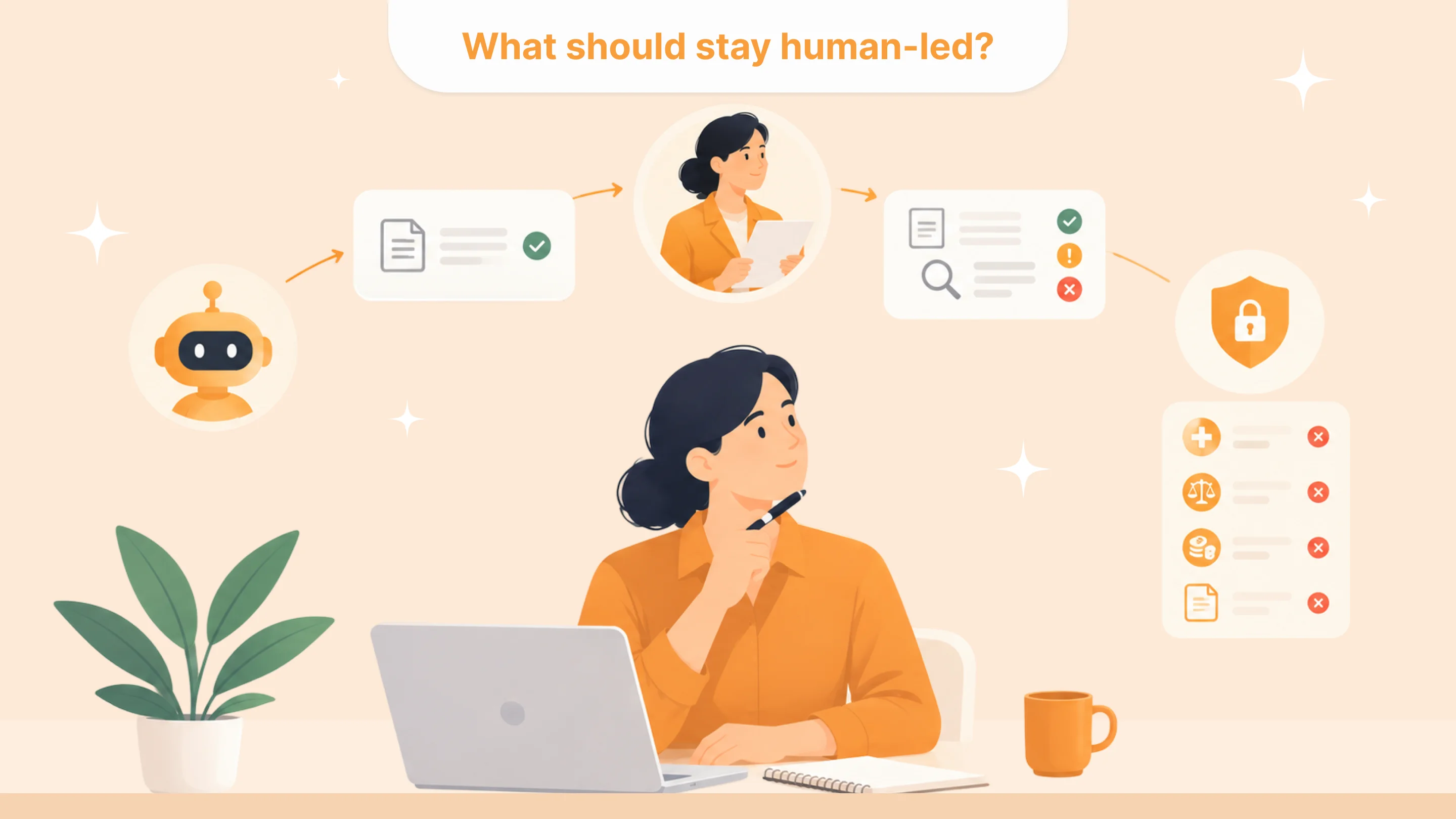
Not every AI output requires manual approval. In some lower-risk administrative workflows, automated classification, routing, or field validation may be appropriate when the process follows clear rules and includes reliable exception handling.
Other tasks require closer oversight.
Clinical decisions, insurance coverage determinations, legal interpretations, and actions with significant financial consequences may involve professional judgment, legal obligations, or risks that make human involvement essential.
Human review also needs to be meaningful. An employee who receives an AI recommendation without access to the original information may struggle to evaluate it properly.
Reviewers should be able to inspect relevant sources, understand what requires attention, correct errors, and reject or escalate questionable cases. Their actions should be recorded where necessary.
The purpose is not to add approvals everywhere. It is to identify where human judgment is genuinely needed and build the workflow around those responsibilities.
Designing AI workflows for traceability
Traceability is easier to establish during implementation than to add after a system is already handling large volumes of operational data.
A useful starting point is to map the workflow from beginning to end: what information enters, which systems process it, what AI produces, where validation occurs, and who is responsible for the final action.
Teams can then determine which events need to be recorded and how they will be connected to the relevant case.
For example, an AI-assisted claims documentation workflow may preserve the incoming file reference, extracted information, validation outcomes, reviewer corrections, and final routing status. Where relevant, the system may also record the model or processing configuration used.
More logging is not necessarily better. Keeping unnecessary sensitive information can introduce privacy and security risks, so organizations should define audit records with appropriate access, retention, and data-protection controls.
Integrations also matter. When an AI workflow spans an EHR, document-processing tool, case-management system, or approval platform, teams need a way to connect events across those systems. Otherwise, the information may technically exist but remain difficult to reconstruct during an audit.
Companies developing these workflows can use AI automation services to support system integration, workflow design, human review logic, and traceability requirements.
Is your AI workflow ready for an audit?
A successful AI demonstration shows that a system can perform a task. An audit-readiness assessment looks at whether the organization can explain and verify how that task was performed in real operations.
Before expanding an automation project, compliance and operations leaders should be able to answer several questions:
Can an authorized reviewer reconstruct the main steps of a specific case?
Is the original source information accessible for verification?
Are AI actions, human corrections, and approvals recorded?
Do permissions limit what the system can access or change?
Are exceptions assigned to clearly defined reviewers?
Can the organization investigate errors and unexpected behavior?
Are logging, retention, and monitoring practices aligned with applicable requirements?
These questions form the basis of a Compliance Automation Checklist. They can help teams identify gaps before an AI pilot becomes part of a larger operational process.
Some issues may require technical changes, such as better logging or integration. Others may involve unclear approval responsibilities, inconsistent review procedures, or missing documentation.
Finding those weaknesses early is usually easier than addressing them after automation has expanded across several departments.
Building automation that can be trusted and reviewed
For compliance-heavy teams, AI automation needs to do more than reduce processing time.
An AI system may classify documents accurately but provide no access to the supporting evidence. It may route cases efficiently while leaving human approvals undocumented. It may save employees time, but make errors harder to investigate.
These limitations become important when organizations need to respond to an audit, review an incident, or explain why a particular action was taken.
Auditable AI automation helps address them by connecting automated actions with source information, permissions, documented reviews, and exception-handling procedures.
The objective is not to record every interaction or require human approval for every step. It is to preserve the evidence and controls appropriate to the work being automated.
For compliance leaders, COOs, and operations teams, this provides a more useful way to evaluate AI investments: not only by asking how much work the technology can handle, but also whether the organization can remain accountable for the results.
Faq
What is auditable AI automation?
+Auditable AI automation involves designing automated workflows so authorized reviewers can trace relevant actions, verify source information, inspect human interventions, and assess whether required controls were followed.
Why are AI audit trails important?
+AI audit trails help organizations investigate errors, examine system activity, review approvals, and understand how individual cases were processed.
Does every AI workflow need human review?
+Not every action requires manual approval. Review requirements depend on the risk, applicable regulations, and consequences of errors. Higher-impact decisions may require qualified oversight.
How can organizations make AI automation more auditable?
+Organizations can establish appropriate logging, permissions, source references, review procedures, exception handling, and monitoring. These controls should be designed around the workflow and its applicable compliance requirements.

Tell us about your project
Fill out the form or contact us

Tell us about your project
Thank you
Your submission is received and we will contact you soon
Follow us