

AI for Digital Health Startups: What to Build Before You Add Another Feature
- Why digital health startups should not start with “AI features”
- AI product roadmap healthcare: what to prioritize first
- Where AI can create value before another feature
- What not to build first
- How to decide which AI feature to build first
- Signs your startup is ready for AI
- What a strong AI feature looks like
- From AI feature ideas to product strategy
Many digital health startups reach the same product moment: the core platform is live, users are active, competitors are talking about AI, and the roadmap starts filling with ideas for “AI features.”
An AI chatbot. A smart assistant. Automated recommendations. Predictive insights. A personalized user journey. A copilot for clinicians, coaches, or care teams.
The pressure to add AI is understandable. But for digital health founders and product leaders, the better question is not “What AI feature can we add?” It is: “Which workflow or product bottleneck should AI solve first?”
AI for digital health startups works best when it is tied to a real product problem: manual work, delayed follow-ups, poor onboarding, repetitive support, incomplete intake, scattered data, or low user engagement. Without that connection, AI becomes decoration - impressive in a demo, but weak in daily use.
Why digital health startups should not start with “AI features”
For many startups, AI enters the roadmap as a feature idea before it becomes a product strategy. This often leads to tools that look innovative but do not solve the biggest operational or user problem.
A startup may add a chatbot while the real bottleneck is manual intake review. It may build personalization while users are dropping off because onboarding is unclear. It may add predictive insights while care teams still spend hours searching for context across notes, forms, and support messages.
That is why digital health AI product strategy should start with friction, not technology.
Before deciding what to build, founders should ask:
Where do users or staff lose the most time?
Which workflow creates repeated manual work?
Where do patients get stuck?
What does the team still track in spreadsheets?
Which product experience feels inconsistent or hard to scale?
Which task is repetitive, measurable, and safe enough for AI support?
The strongest AI use cases usually come from these answers.
AI product roadmap healthcare: what to prioritize first
A strong AI product roadmap for healthcare should prioritize bottlenecks that are frequent, specific, and connected to measurable value.
For digital health startups, that often means starting with operational or workflow-support AI before building more complex clinical-facing features.
Good first AI use cases often share several traits:
the task happens often;
the current process is manual or inconsistent;
the expected output is clear;
the risk level is manageable;
human review can remain in place;
the impact can be measured;
the workflow already has enough data to support automation.
This is why AI is often more useful in intake, patient follow-up, care coordination, support, document processing, or internal team workflows than in broad “personalized AI” concepts.
The goal is not to make the product sound more advanced. The goal is to remove friction that slows growth, weakens engagement, or increases team workload.
Where AI can create value before another feature
Patient intake and onboarding
Many digital health startups underestimate how much product friction starts before the user receives value.
Patients may need to submit forms, upload documents, answer questionnaires, confirm eligibility, choose preferences, or wait for a team member to review their case. If that process is slow or unclear, users may drop off early.
AI can help classify documents, detect missing information, summarize intake details, and route cases to the right team. This can reduce manual review and create a smoother onboarding experience.
For startups exploring broader AI solutions for digital health, intake is often a practical starting point because the workflow is repetitive, measurable, and directly tied to activation.
Patient follow-up and engagement
Engagement problems are not always caused by lack of motivation. Sometimes users disengage because the product or team does not guide them clearly enough.
A patient may complete onboarding but never receive the next step. A missed appointment may not trigger outreach. A coach may not know who needs attention. A patient success team may not see which users are waiting.
AI can help identify patients who need follow-up, summarize context, prepare low-risk administrative messages, and route tasks to the right person.
This is where AI patient engagement becomes more than sending reminders. It becomes a way to make follow-up workflows visible and consistent.
Care coordination and patient navigation
For startups that support care delivery, coaching, chronic condition management, behavioral health, or hybrid care models, coordination is often a hidden bottleneck.
Patients move between intake, scheduling, care teams, support, providers, and sometimes external partners. Information gets scattered across messages, notes, documents, and systems.
AI can help summarize patient status, flag missing steps, prepare handoff notes, suggest routing, and show which cases are stuck.
This does not mean automating care decisions. It means reducing delays around care so teams can act with better context.
Internal team workflows
Some of the best AI use cases are not patient-facing at all.
Digital health startups often rely on lean teams. Founders, product managers, clinical leads, support staff, and operations teams may all share knowledge informally. As the company grows, this becomes harder to manage.
AI can support internal workflows by helping teams search SOPs, summarize meetings, answer operational questions, draft internal reports, or organize scattered knowledge.
This may not look as exciting as a patient-facing AI feature, but it can improve team speed and consistency before the product scales.
Customer support and repetitive requests
Support tickets often reveal what users do not understand about the product.
If patients repeatedly ask how to upload documents, schedule a visit, reset access, understand next steps, or check status, the product may need better guidance.
AI can help classify support requests, draft approved responses, route sensitive messages, and surface patterns for product teams.
This helps startups reduce support load while learning which parts of the product experience need improvement.
What not to build first
Not every AI idea belongs in the first version of a digital health product roadmap.
Founders should be careful with features that sound powerful but carry high risk, unclear value, or weak workflow grounding.
These may include:
broad symptom checkers without clear clinical oversight;
AI-generated care plans without qualified human review;
predictive models without enough reliable data;
patient-facing chatbots that may receive clinical questions;
personalization features with no clear engagement goal;
“AI insights” dashboards that do not change team behavior.
These ideas may become useful later. But they are often poor first AI bets if the startup has not solved simpler workflow problems first.
The safer path is to start with AI that prepares work, organizes information, flags issues, drafts low-risk content, or supports internal decision-making under human supervision.
How to decide which AI feature to build first
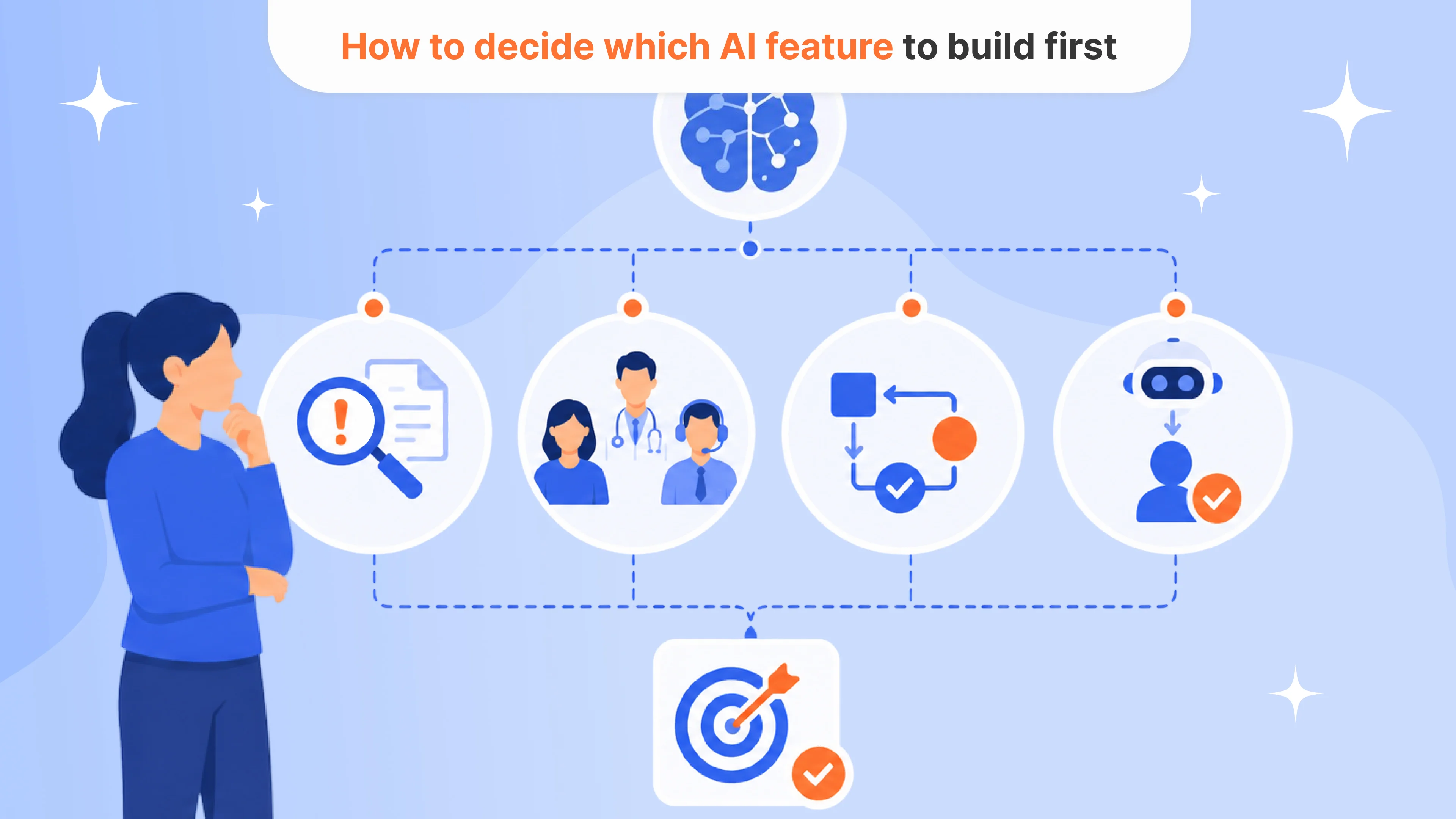
AI feature prioritization should combine product value, workflow fit, technical feasibility, and risk.
A useful prioritization process starts with four questions.
First, what problem are we solving? The answer should be more specific than “we need AI.” For example: “care teams spend too much time reviewing intake forms” or “patients drop off after onboarding because follow-up is inconsistent.”
Second, who benefits from the AI feature? The answer may be patients, care teams, support staff, providers, operations leaders, or internal product teams. A clear user helps define the right feature.
Third, what decision or action should AI support? AI should connect to a next step: route the case, prepare a summary, flag missing information, draft a message, create a task, or help staff review an exception.
Fourth, what needs human review? In digital health, AI should not quietly take over clinical or sensitive decisions. The roadmap should define where AI can act independently, where it can assist, and where humans must approve.
This helps founders avoid building AI as a novelty and start building AI as infrastructure for better workflows.
Signs your startup is ready for AI
Your digital health startup may be ready to add AI if:
your team manually reviews the same information every day;
users drop off because the next step is unclear;
care teams or support teams repeat the same responses;
patient follow-ups depend on manual reminders;
documents, forms, or messages delay the workflow;
internal knowledge is scattered across tools;
product data shows repeated friction at the same point;
your team can define what “good output” looks like.
These signs show that AI may have a real job to do.
But readiness also depends on boundaries. A startup should know what data the AI can access, which users it supports, what risks are involved, and how humans will review sensitive cases.
What a strong AI feature looks like
A strong AI feature in digital health usually has a narrow scope, a clear user, and a measurable outcome.
Instead of “AI assistant,” the feature may be:
an intake summary assistant for care coordinators;
a follow-up prioritization tool for patient success teams;
a document classification workflow for operations;
a support triage assistant for non-clinical requests;
a handoff summary generator for providers;
an internal knowledge assistant for staff.
These features are easier to test because the startup can measure whether they reduce manual work, improve turnaround time, lower support volume, increase completion rates, or help teams act faster.
The best healthcare startup AI features are not always the flashiest ones. They are the ones that remove a real bottleneck.
From AI feature ideas to product strategy
Digital health startups do not need to add AI everywhere. They need to add it where it makes the product or workflow meaningfully better.
That starts with choosing the right problem.
Before adding another feature, founders should look at the workflows already slowing the product down: intake, onboarding, document review, follow-ups, care coordination, support, internal operations, or reporting.
AI can help when the task is repetitive, measurable, and safe enough to support with automation. It can summarize, classify, route, draft, flag, and organize. But it should not replace clinical judgment or create risk just to make the product sound more advanced.
For founders and product leaders, the better question is not “How do we add AI?” It is: “Where can AI remove friction that is already limiting our product, team, or users?”
That is where AI becomes part of a real digital health product strategy.
Faq
What is AI for digital health startups?
+AI for digital health startups means using AI to improve healthcare products, workflows, and operations. This may include intake automation, patient follow-up support, care coordination, document processing, support triage, internal knowledge assistants, or workflow analytics.
What AI features should a digital health startup build first?
+The best first AI features usually solve repetitive, measurable, and low-to-medium-risk workflow problems. Examples include intake summaries, document classification, follow-up tracking, support request triage, and internal workflow assistants.
Should digital health startups build patient-facing AI first?
+Not always. Patient-facing AI can be useful, but it often carries higher risk because patients may ask clinical or sensitive questions. Many startups should first build internal or staff-facing AI that supports workflows under human review.
How should founders prioritize AI features?
+Founders should prioritize AI features based on workflow pain, user value, feasibility, available data, risk level, and measurable impact. A feature should solve a real bottleneck, not exist only because competitors are adding AI.
Can AI help improve patient engagement?
+Yes, but AI patient engagement should not only mean sending more messages. It can help identify missed follow-ups, summarize patient context, prepare safe administrative outreach, and help teams see where users are getting stuck.
What should AI not do in a digital health product?
+AI should not independently diagnose, make clinical decisions, create care plans without review, determine medical necessity, or handle urgent patient concerns without escalation. It should support humans, not replace qualified judgment.

Tell us about your project
Fill out the form or contact us

Tell us about your project
Thank you
Your submission is received and we will contact you soon
Follow us