
AI Governance for Healthcare and Regulated Operations: What Leaders Need Before Scaling
- Why AI governance matters before scaling
- What regulated teams need to define
- Data access, permissions, and source control
- Human review and escalation rules
- Audit trails and output monitoring
- Governance as an operational design problem
- What should leaders decide before scaling AI?
- From AI governance to responsible AI operations
AI governance becomes much harder when AI moves from a controlled experiment into daily operations.
A healthcare company may start with a small internal assistant that helps staff search documents faster. An insurance team may test AI for claims follow-up. A fintech company may explore automated document review. A legal or compliance team may use AI to summarize long files, classify requests, or prepare drafts for review. In the pilot stage, the work may feel manageable because only a few people are involved and the risk is contained. But scaling changes everything.
Once AI becomes part of real operational workflows, leaders need to know who owns decisions, what data the system can access, how outputs are reviewed, what happens when AI is uncertain, and how the company will monitor performance over time. Without those rules, AI can create more risk than efficiency.
That is why AI governance for healthcare and regulated operations should not be treated as a policy document that appears after implementation. It should be part of the operational design from the beginning.
For executives, compliance leaders, COOs, and CTOs, the question is not simply, “Can we use AI here?” The better question is, “What governance structure do we need so AI can be used safely, consistently, and responsibly inside our workflows?”
Why AI governance matters before scaling
AI governance matters because AI does not operate in isolation. It affects workflows, decisions, data access, staff behavior, customer or patient communication, compliance processes, and business risk.
In a small pilot, a team may tolerate uncertainty. They may manually check every output, use limited data, and rely on informal judgment. But once the system scales, informal control is no longer enough. More users interact with the tool. More data flows through it. More edge cases appear. More outputs influence real work.
This is where many AI projects become risky. The system may produce useful outputs, but no one has clearly defined who is accountable for them. Staff may not know when to trust AI, when to review it, or when to escalate. Compliance teams may not have visibility into what data is being used. Leaders may not know whether the system is improving the workflow or introducing new operational risk.
AI governance helps answer these questions before the system becomes embedded in daily work.
It gives teams a shared structure for ownership, review, permissions, monitoring, escalation, and continuous improvement. In healthcare and other regulated industries, this structure is especially important because workflows often involve sensitive data, high-impact decisions, strict documentation needs, and multiple layers of accountability.
Governance is not meant to slow AI adoption. Done well, it helps companies scale AI with more confidence because the rules are clear before the system reaches wider use.
What regulated teams need to define
Regulated teams need to define more than technical requirements. They need to define the operating rules around AI.
Before scaling, leaders should understand what workflow AI will support, what role AI will play, who owns that workflow, what data the system can use, what outputs it can generate, which outputs require human review, who approves them, and what should happen when AI is uncertain, incomplete, or wrong.
These questions may sound simple, but they often reveal gaps between leadership, compliance, operations, product, and engineering.
For example, a COO may see AI as a way to reduce manual review time. A compliance leader may focus on documentation and risk. A CTO may think about integrations, data architecture, and access controls. End users may care most about whether the workflow becomes easier or more complicated.
AI governance brings these perspectives into one structure. It makes the workflow explicit and defines how the system should behave in real conditions.
For healthcare and regulated operations, governance should cover at least four areas: data access, human review, auditability, and monitoring. Without these foundations, scaling AI becomes difficult because every new use case creates new uncertainty.
Data access, permissions, and source control
One of the first governance questions is what data AI can access.
This is not only a technical decision. It is an operational and compliance decision. Different workflows may require different levels of access, and not every user or AI system should be able to use the same information.
In healthcare, this may involve patient records, clinical notes, intake forms, insurance details, billing data, internal policies, provider documentation, or support conversations. In insurance, fintech, legal, HR, logistics, or education, the data may be different, but the governance problem is similar: AI needs enough context to be useful, but access must be controlled.
A responsible AI operations model should define approved data sources, restricted sources, user permissions, and rules for handling sensitive information. It should also define how the system deals with outdated, conflicting, missing, or incomplete data.
Source control matters because AI output is only as reliable as the information behind it. If the system pulls from old documents, duplicate files, or unverified sources, users may receive answers that look confident but are not trustworthy. If staff cannot see where an answer came from, review becomes harder.
Before scaling, teams should decide which sources AI can use, how often those sources are updated, who owns them, and whether users can trace outputs back to approved materials.
This is also where custom implementation choices matter. Companies using AI automation services can design workflows where AI access, permissions, source control, and integrations are built around the company’s operational and compliance requirements instead of being treated as an afterthought.
Human review and escalation rules
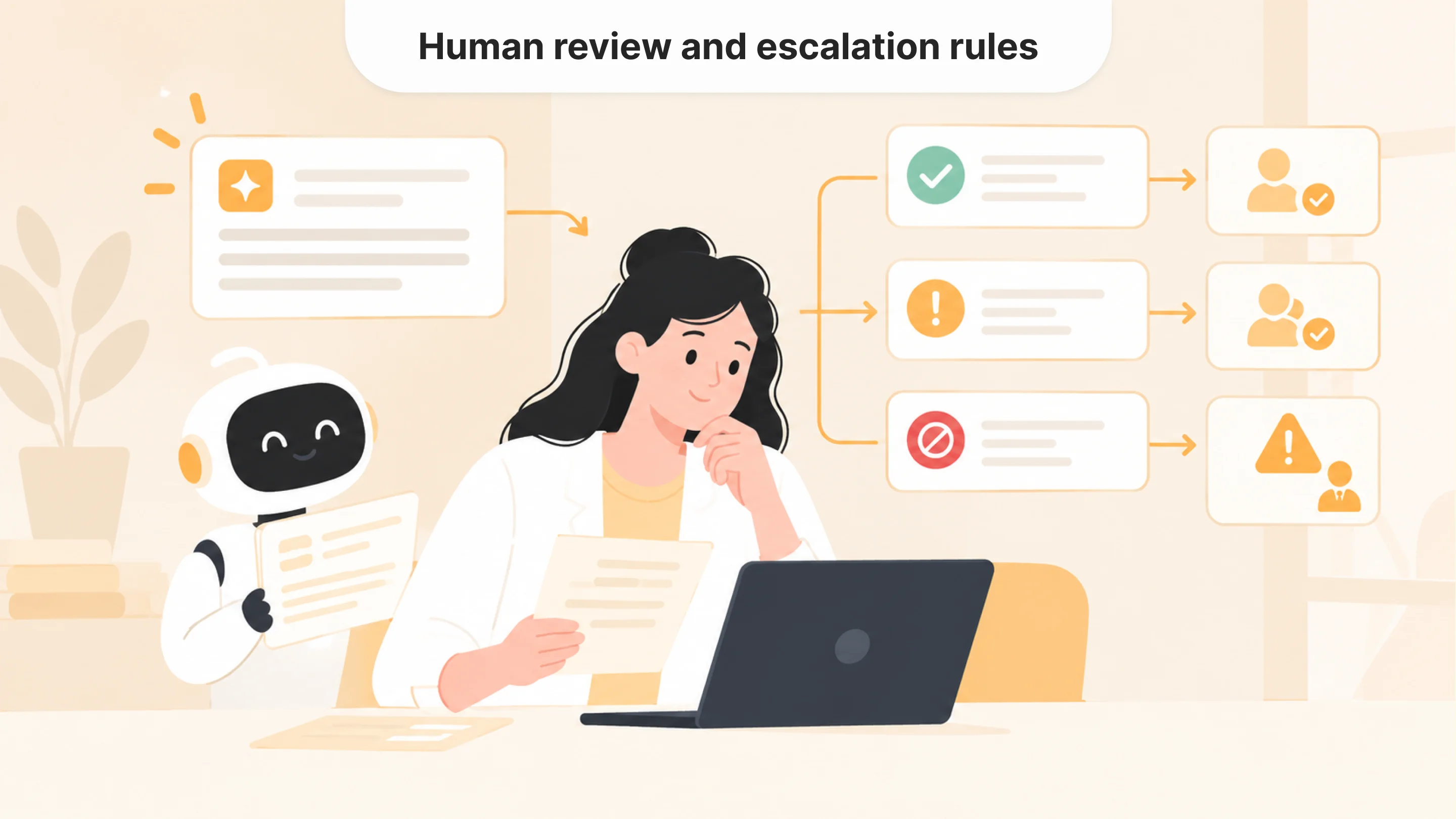
AI governance should clearly define the role of human review.
In regulated workflows, AI should rarely be treated as a fully independent decision-maker. More often, its value comes from preparing, organizing, summarizing, classifying, drafting, flagging, or routing work so humans can act faster and with better context.
But human review needs structure. If every output requires review, the workflow may become too slow. If too few outputs require review, the organization may take on unnecessary risk. The governance model should define which outputs can move forward automatically, which ones require approval, which ones require escalation, and which ones AI should not handle.
For example, a low-risk internal summary may only need a light review. A patient-facing message may require approval before being sent. A compliance-related classification may need documented review. A recommendation that affects eligibility, care, coverage, payment, legal status, or employment may need stricter controls or may not be appropriate for automation at all.
Escalation rules are just as important. The system should have a clear path for cases that are incomplete, uncertain, sensitive, unusual, or outside the expected workflow. Staff should know when to override AI output, when to send a case to a specialist, and how to document that decision.
Without review and escalation rules, AI can create confusion. Users may either overtrust the system or ignore it completely. Both outcomes reduce value.
Good governance helps teams find the right balance: AI supports the workflow, humans remain accountable for the right decisions, and riskier cases receive the attention they need.
Audit trails and output monitoring
Auditability is one of the most important parts of an AI compliance framework.
If a company cannot explain what AI did, what data it used, who reviewed the output, and what action followed, it will be difficult to manage risk. This is especially true in healthcare and regulated operations, where decisions may need to be documented, reviewed, or explained later.
An audit trail does not need to make every workflow overly complex. But it should capture the information that matters. This may include the input, the AI-generated output, the data source used, the user who reviewed or approved it, the final action taken, and any override or escalation.
Monitoring should also continue after launch. AI governance is not finished when the system goes live. Real-world use will reveal new edge cases, user behavior patterns, data gaps, and process weaknesses. Teams need a way to track whether the system is performing as expected and whether outputs remain useful, safe, and aligned with the workflow.
Output monitoring may include accuracy checks, review rates, escalation rates, user feedback, error patterns, response time, backlog reduction, and other workflow-specific indicators. For higher-risk workflows, monitoring may also include more formal compliance review.
The point is not to monitor AI for the sake of monitoring. The point is to make sure the system remains reliable as conditions change.
A governance structure should define who reviews performance, how often monitoring happens, what triggers an investigation, and how improvements are made.
Governance as an operational design problem
One common mistake is treating AI governance as a separate policy exercise.
Policies matter, but they are not enough. A written policy may say that AI outputs require review, but the workflow still needs to show where that review happens, who performs it, what information they see, how they approve or reject output, and what happens next. A policy may say that AI should only use approved data, but the system still needs access controls, source management, and integration rules.
This is why governance should be designed into the workflow itself. Operational governance means that rules are not only written down. They are reflected in the way the AI system works. Permissions are built into access. Review steps are built into the workflow. Escalation paths are clear. Audit trails are captured automatically where possible. Monitoring is assigned to a real owner. Users understand what AI can and cannot do.
For regulated teams, this approach is more practical than trying to govern AI from the outside. It reduces ambiguity because governance becomes part of daily work.
This also helps with adoption. Staff are more likely to trust AI when they understand the boundaries. Compliance teams are more comfortable when controls are visible. Leaders can scale with more confidence when ownership, review, and monitoring are already defined.
What should leaders decide before scaling AI?
Before scaling AI across healthcare or regulated operations, leaders should make several decisions explicit.
They should decide which workflows are appropriate for AI support and which are not. They should define who owns each workflow, what data AI can access, what outputs AI can produce, what needs human review, and what must be escalated. They should also define how outputs will be logged, monitored, and improved over time.
These decisions should not be left to engineering alone. AI governance requires input from leadership, compliance, operations, product, security, legal, and the teams that will actually use the system.
The goal is not to create a governance structure so heavy that no one can move. The goal is to create enough structure to scale responsibly.
A practical governance model should help teams answer the most important questions before launch: which workflow AI will support, what role it will play, what data it can use, who can access the system, which outputs require review, who is accountable for final actions, what needs to be escalated or logged, how performance will be monitored, and how the workflow will improve over time.
If these answers are unclear, the company may not be ready to scale the AI system yet.
From AI governance to responsible AI operations
AI governance is often discussed as a risk topic, but it is also an operations topic.
The companies that scale AI successfully are not only the ones with strong technical models. They are the ones who understand how AI changes work. They define ownership. They design review. They control access. They monitor outputs. They keep humans responsible where judgment matters. They make sure the system fits real workflows instead of forcing teams to adapt to unclear tools.
For healthcare and regulated operations, this is the difference between using AI as an experiment and using AI as a responsible operating capability.
AI governance should not arrive after scaling. It should make scaling possible.
When leaders define the rules early, teams can move faster with less confusion. Compliance becomes part of the design. Operations know what to expect. Engineering can build around real requirements. Users understand how to work with AI safely.
That is what responsible AI operations should do: not stop innovation, but make it usable, controlled, and sustainable.
Faq
What is AI governance in healthcare?
+AI governance in healthcare is the set of rules, responsibilities, review processes, data access controls, monitoring practices, and documentation standards that define how AI can be used safely in healthcare workflows. It helps teams clarify who owns decisions, what data AI can access, which outputs require human review, and how AI performance should be monitored over time.
Why does AI governance matter before scaling?
+AI governance matters before scaling because a small AI pilot can often be controlled informally, while a scaled system affects more users, more data, more workflows, and more operational risk. Without clear governance, teams may not know who is accountable for AI outputs, when human review is required, or how errors and edge cases should be handled.
What should an AI governance framework include?
+An AI governance framework should include workflow ownership, data access rules, user permissions, approved data sources, human review requirements, escalation paths, audit trails, output monitoring, and responsibility for ongoing improvement. For regulated operations, it should also define how sensitive data is protected and how AI-supported actions are documented.
Who should own AI governance?
+AI governance should not belong to one department only. Leadership, compliance, operations, product, security, legal, engineering, and end users may all need to be involved. However, each AI workflow should have a clear owner responsible for how the system is used, reviewed, monitored, and improved in daily operations.
How can healthcare companies make AI governance practical?
+Healthcare companies can make AI governance practical by building rules directly into workflows. This means defining access controls, review steps, escalation paths, audit logs, and monitoring responsibilities before the AI system is scaled. Governance works best when it is part of how the workflow operates, not just a separate policy document.
What is the difference between AI governance and responsible AI operations?
+AI governance defines the rules and responsibilities for using AI safely. Responsible AI operations put those rules into practice through workflow design, permissions, human review, monitoring, audit trails, and continuous improvement. In other words, governance sets the structure, while responsible operations make it usable in daily work.

Tell us about your project
Fill out the form or contact us

Tell us about your project
Thank you
Your submission is received and we will contact you soon
Follow us