
AI Implementation Roadmap: How to Move From Experiments to Operational Systems
- Why AI experiments often stay stuck
- What changes when AI moves into operations
- Start with the business problem, not the model
- Define the AI role clearly
- Prepare the data before scaling
- Design integration before launch
- Build governance into the workflow
- Decide what human review looks like
- Make success measurable
- Choose the production path
- What an AI implementation roadmap should include
- From AI pilot to system
A large number of companies have already put AI to the test. These companies have used various tools, tried out assistants, looked into document summarization, constructed small prototypes, or asked their teams to find out where AI could cut down on manual work. In some cases the experiments have indeed shown real promise, for example in terms of faster support responses, quicker document reviews, better reporting, easier knowledge searching, or fewer repetitive tasks.
The distinction between an AI experiment which functions in a controlled environment and an AI system that is incorporated into everyday operations is great.
An AI implementation roadmap is needed at this stage. If there is no such roadmap, AI tends to remain in pilot mode, although it may be good enough to talk about, it is not reliable, not integrated, not governed, and not measurable enough to be incorporated into the business. Although teams may be enthusiastic about the idea, leadership may perceive potential, and the initial results may appear encouraging, the project still fails to go into production because the following steps are not clear.
For executives, founders, CTOs and COOs the issue is not merely whether AI can function. The more significant question is if the company knows how to turn a promising AI experiment into an operational system which people can use, trust, measure and improve.
Why AI experiments often stay stuck
AI experiments typically begin with a problem; for example, a group may want to speed up the process of summarising documents, classifying requests, producing reports, drafting messages, or searching internal knowledge. At this stage, the aim is generally to demonstrate that AI can be of some help with the task.
That may be useful, but it doesn't amount to implementation. A pilot project can proceed even if the associated workflow is incomplete; it might make use of a small amount of data, involve only a limited number of users, avoid complicated edge cases, or operate outside the main systems. A production system cannot do this. When AI becomes part of operations it must deal with real inputs, real users, real exceptions, real security requirements, and real business expectations.
That is the reason why so many AI projects lose their momentum after the experimental stage. Although the pilot demonstrates that the technology is capable of generating a useful output, the company still has to deal with more difficult questions such as who will own the workflow, which systems will need to connect, how the reviewing process should function, what risks require controls, what success entails, and how the system is to be maintained once it has been launched.
It is usually at these questions that AI projects come to a standstill, and they involve more than just technical issues; they are also operational, organizational, and strategic.
What changes when AI moves into operations
An AI experiment may be impressive since it demonstrates what can be achieved. However, an operational AI system has to be useful on a daily basis.
The requirements change as a result. In a pilot phase, it might be sufficient for the AI to produce a summary, classify the request, or draft a response. But in operational settings, the output has to be suitable for inclusion in a workflow. The summary should aid a person in reaching a decision. The classification should ensure that a case is routed appropriately. The draft should go through a review process. The extracted data should be sent to the correct system. A flagged issue should result in ownership being assigned and action being taken.
It is here that a great many companies realize that the actual work does not lie in choosing a model but rather in designing the workflow, carrying out system integration, setting up permissions, carrying out monitoring, achieving adoption, and carrying out measurement.
A good implementation roadmap transforms the pilot phase into an operational process by specifying the tasks that will be carried out by AI, those that will be reviewed by humans, which systems will be linked together, the procedures to be followed when the AI is uncertain, and the method by which the company will be able to tell if the system is working.
If there is no such structure in place, AI might be useful but will remain isolated and will just be another tool that people have to check rather than a system which actually enhances the way work is carried out.
Start with the business problem, not the model
A practical roadmap for implementing an AI should start with the business or operational problem that the company wishes to solve. Although this might seem obvious, many AI projects go off track because the teams begin by selecting a tool or model before deciding on the workflow.
The situation should be specific; saying 'We want to use AI for support' is too vague. A more definite approach would be to say: 'We want AI to classify support requests, suggest low-risk responses, and route sensitive cases to human review within our present support platform.'
This applies as well to document processing, reporting, customer onboarding, claims, internal knowledge, or task routing; the company must decide which part of the workflow it wishes for AI to support and what outcome should be improved.
This also serves to prevent overlap with the wider range of challenges associated with the adoption of AI. If teams have difficulty in turning their ideas into decisions, the appropriate next move isn't to carry out more trials but rather to develop a more definite plan which links the use case to ownership, systems, data, review, and measurable business value.
Define the AI role clearly
A key aspect of an AI implementation roadmap is determining the role of AI within the workflow.
AI is capable of summarizing, classifying, extracting, drafting, routing, flagging, searching, comparing, recommending, or reporting. Each of these tasks has different requirements. For a summarization task it is necessary to have access to the source material, to apply a certain logic, and to identify a clear user. A classification task requires a set of categories, routing rules, and a method for dealing with exceptions. A drafting task needs approval rules and guidance regarding tone. A reporting task requires reliable data sources and well-defined metrics.
If the role of the AI is not clear then carrying out the project becomes more difficult since different stakeholders may have different ideas about the outcome and the project can end up going beyond its original purpose before the first version is even defined.
A good roadmap should keep the initial version focused by stating what the AI ought to do, what it ought not to do, and specifying what must take place after the AI has produced its output. This enables the team to prevent them from developing a feature that appears useful but in fact doesn't advance the work.
Prepare the data before scaling
It becomes more important to have ready data when AI goes from being used in a trial capacity to being put into actual use.
For a test, teams can make use of a small number of documents, examples, tickets, reports, or other internal knowledge sources. However, in a production environment the system must have continuous and safe access to the correct data, which may be distributed among CRMs, EHRs, ERPs, support tools, billing systems, document storage, spreadsheets, emails, internal databases, or product backends.
A roadmap for implementing an AI system should specify what data the system requires, where that data is stored, whether the data is complete, who is allowed to access it, and where the outputs are to be sent. It should also state which sources are approved, which data must be restricted, and the way in which the system is to deal with outdated, conflicting, missing or incomplete information.
What we want is not for all of the company's data to be perfect before going ahead with implementation; instead, our aim is to ensure that the data associated with the selected workflow is good enough for a controlled initial version.
Design integration before launch
AI only becomes genuinely useful when it is integrated into the systems in which work currently takes place.
Even if a document summary remains in the AI tool, the staff will still have to paste it into another platform. Even if a classification fails to trigger routing, a person will still have to transfer the request. Even if the extracted data doesn't update the correct record, the workflow will remain incomplete. Even if a dashboard is not linked to reliable sources, managers may not trust it.
Which is why integration should figure in the roadmap and not be left as a technical matter until later.
Companies must determine which systems need to connect, what data should be transferred between them, what actions should be set off, and where the output from the AI will be displayed. In some cases, the best solution is not to use a standalone AI tool but instead to build an AI-supported workflow directly into the software that the team currently uses.
For companies which need assistance in linking AI outputs to real workflows, AI automation services are able to help with the implementation process through the use of workflow design, integrations, custom automation, and the development of system architecture that is ready for production.
Build governance into the workflow
Carrying out an Enterprise AI implementation requires more than just a working model; it also requires governance.
Governance needn't be slow or unnecessarily complicated; in practice it means that the company knows who owns the AI workflow, who is allowed to use the system, what data the AI can access, which outputs require review, how exceptions are managed, and how the results are kept under review over time.
It is particularly important in the healthcare sector, in the insurance industry, in fintech, in the legal field, in human resources, in education, and in other regulated or sensitive areas. Even in industries that are not subject to regulation, companies still need to establish rules regarding data access, user permissions, communication with customers, internal decisions, and accountability.
An AI system used for production ought not to function like a black box; its outputs should be traceable, subject to review, and clearly linked to responsibilities.
Decide what human review looks like
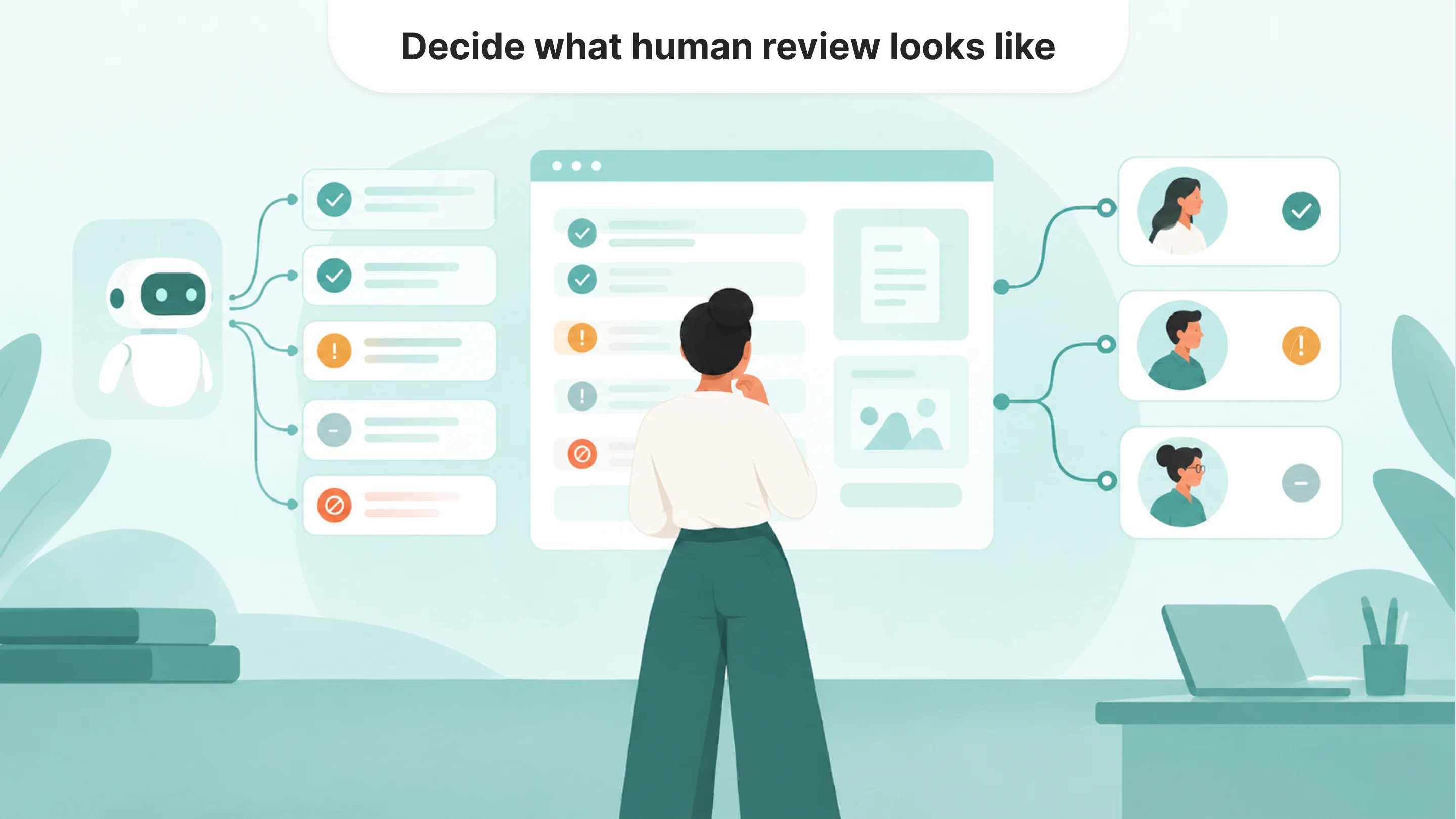
Human review ought not to be carried out after launch; instead it should be incorporated into the implementation roadmap.
A small number of users, namely those who understand the risks and limitations, might be involved in a pilot. A genuine system, on the other hand, will involve a larger number of people, a greater variety of cases, and more variation. Therefore, the review rules had better be clear before the system begins to operate on a daily basis.
The roadmap needs to specify the things that AI can carry out by itself, the things that it can propose, the things that require approval, the things that should be referred on to someone else, and the things that must never be automated. It should also state who is responsible for carrying out the review and what the reviewers must see in order to make a decision.
This does not reduce the value of AI. In many workflows, AI creates the most value by preparing work for people, not by replacing human judgment. Clear review rules make the system safer and more useful.
Make success measurable
An AI experiment can be judged by whether it works. An operational AI system needs success metrics.
Before scaling, leadership should define what improvement the project should create. Depending on the workflow, this may include reduced manual review time, faster response time, fewer repeated questions, lower backlog, faster document processing, fewer missed follow-ups, better completion rates, improved visibility, or lower dependency on spreadsheets.
Measurable goals make it easier to decide whether the system should be expanded, redesigned, or stopped. They also help teams avoid vague claims about AI value.
A strong AI strategy roadmap should connect each implementation step to a business outcome. Otherwise, the project may become a technical initiative with unclear business impact.
This shift is becoming especially important in healthcare and other regulated sectors, where the conversation about AI is moving from demos to real-world proof. Regulators and industry leaders are paying more attention to whether AI tools can be monitored after launch, measured against real outcomes, and safely used in live workflows.
Recent discussions around health regulation, including the FDA’s TEMPO pilot and UK proposals for more cautious, real-world approval and monitoring of AI health tools, point in the same direction: companies need to prove that AI works beyond the pilot environment. For business leaders, this makes the implementation roadmap more than a planning document. It becomes the structure that connects AI ambition to measurable, monitored, production-ready use.
Choose the production path
Not every AI experiment should become a large implementation project. Some should be scaled. Some should be narrowed. Some should be integrated into existing tools. Some should be rebuilt as custom systems. Some should be stopped before they consume more budget.
A useful AI implementation roadmap should help leadership make this decision deliberately.
Before moving forward, teams should ask whether the pilot solved a real problem, whether users would actually adopt it, whether the workflow is frequent enough, whether the data is usable, whether the risk is manageable, whether integrations are realistic, and whether the value justifies further investment.
This turns AI planning from enthusiasm into prioritization. The goal is not to scale every experiment. The goal is to identify which experiments deserve to become systems.
What an AI implementation roadmap should include
A practical roadmap should give the company a path from pilot to production. It should include the selected use case, the business problem, the workflow owner, the AI role, required data sources, integration requirements, review rules, risk controls, success metrics, timeline, and next implementation steps.
It should also define what is out of scope for the first version. This matters because AI projects can easily expand once stakeholders see what is possible. A focused roadmap helps teams launch something useful without trying to solve every related workflow at once.
For enterprise AI implementation, the roadmap should also include security and governance requirements, stakeholder responsibilities, user adoption planning, monitoring, and feedback loops. AI systems do not stay useful automatically. They need ownership after launch.
From AI pilot to system
Moving beyond pilot mode does not mean rushing AI into production. It means creating the conditions that make production possible.
A good AI experiment can prove that the technology has potential. A good implementation roadmap proves that the company knows how to use that potential in operations.
The strongest AI projects are not the ones with the most ambitious demos. They are the ones that become part of a real workflow, support the right users, connect to the right systems, keep human review where needed, and improve something measurable.
For executives, founders, CTOs, and COOs, this is the shift: AI should not remain a collection of experiments. It should become an operating capability.
That requires a roadmap, not just a pilot.
Faq
What is an AI implementation roadmap?
+An AI implementation roadmap is a practical plan that shows how a company will move from AI ideas or pilots to operational systems. It usually includes the use case, workflow, data, integrations, human review, governance, success metrics, and implementation steps.
Why do AI pilots often fail to reach production?
+AI pilots often fail to reach production because they are not connected to real workflows, systems, ownership, security requirements, review rules, or measurable business outcomes.
What is the difference between an AI strategy roadmap and an AI implementation roadmap?
+An AI strategy roadmap is usually broader and defines the company’s overall AI direction. An AI implementation roadmap is more practical and focuses on how specific AI use cases will be built, integrated, reviewed, measured, and scaled.
What should companies prepare for before enterprise AI implementation?
+Companies should prepare workflow maps, data sources, integration requirements, security and access rules, human review logic, success metrics, and clear ownership before enterprise AI implementation.
Should every AI experiment become a production system?
+No. Some AI experiments should be scaled, some should be narrowed, some should be redesigned, and some should be stopped. The decision should depend on business value, feasibility, risk, adoption, and measurable impact.
How can companies move beyond pilot mode?
+Companies can move beyond pilot mode by defining the business problem, narrowing the use case, preparing data, designing integrations, adding governance, defining human review, and measuring operational value.

Tell us about your project
Fill out the form or contact us

Tell us about your project
Thank you
Your submission is received and we will contact you soon
Follow us