

AI-Powered Care Coordination: Reducing Delays Between Teams, Patients, and Providers
Care coordination is one of the most human parts of healthcare operations, and one of the easiest to slow down.
A patient needs a follow-up. A referral has to be checked. A care team waits for missing information. A provider needs context before the next appointment. A message sits in the wrong queue. A coordinator tries to understand what happened across calls, notes, documents, and systems.
None of these delays may look dramatic on their own. But together, they create friction between teams, patients, and providers. Patients wait longer. Staff spend more time chasing updates. Providers receive incomplete context. Operations leaders struggle to see where coordination breaks down.
This is where broader healthcare AI automation solutions can help.not by replacing care teams, but by reducing the repetitive administrative work around coordination: summarizing information, flagging missing steps, routing tasks, tracking follow-ups, and helping teams see which cases need attention.
For digital health founders, care coordination teams, and operations leaders, this is a specific and practical AI use case. It is not generic workflow automation. It is about making patient movement through care less fragmented.
Why care coordination breaks down
Care coordination often depends on information moving between people, systems, and organizations. That movement is rarely clean.
A patient may interact with intake, scheduling, support, billing, care coordination, providers, and external partners before one issue is resolved. Information may live in an EHR, CRM, support tool, shared inbox, referral document, spreadsheet, call note, or patient message.
When these systems do not connect well, people become the integration layer. Staff manually check statuses, copy notes, ask other teams for updates, search for documents, and remind patients or providers about next steps.
The result is delayed coordination. A follow-up is missed because no one owns it clearly. A referral waits because a document is incomplete. A care plan stalls because a provider does not have the latest context. A patient repeats the same information to multiple people.
Healthcare coordination AI is useful when it reduces this operational friction without taking control away from care teams.
AI care coordination use cases
AI-powered care coordination can support several workflows where delays often happen.
Patient follow-up tracking
Follow-ups are easy to lose when they depend on manual reminders, spreadsheets, or individual memory. AI can help identify patients who need follow-up based on recent interactions, notes, status changes, or missing next steps.
For example, the system can flag patients who submitted information but have not been scheduled, patients waiting on referral review, or patients who need outreach after a missed appointment.
The goal is not to automate every message. It is to make sure the right follow-up is visible before it becomes a delay.
Referral coordination
Referrals often involve documents, provider details, patient history, authorization requirements, and internal review. If any part is missing, the referral may sit in a queue.
AI can help classify referral documents, summarize relevant details, detect missing information, and route the case to the right team. This supports faster review while keeping clinical interpretation and final decisions with humans.
Related content from BeKey: “AI Document Processing for Healthcare: From PDFs and Forms to Usable Workflow Data.”
Patient navigation support
Patient navigation automation can help teams guide patients through next steps: what documents are missing, which appointment needs scheduling, what information must be confirmed, or which team will contact them next.
AI can support this by preparing administrative messages, summarizing patient status, and helping staff personalize communication based on the current workflow stage.
The system should not provide medical advice or independently determine care. It should help staff communicate clearly and consistently about operational next steps.
Care team handoffs
Handoffs often fail because the next person does not have enough context. A coordinator may need to read several notes, messages, forms, or documents before understanding the case.
AI can summarize relevant information into a short handoff brief: patient status, recent interactions, missing items, next steps, open questions, and escalation flags.
This helps providers and care teams spend less time reconstructing context and more time acting on it.
Task routing and escalation
Care coordination depends on the right task reaching the right person. AI can help classify requests and suggest routing to scheduling, billing, intake, care coordination, clinical review, or provider follow-up.
Escalation rules matter. If a message includes symptoms, urgent language, medication questions, or clinical uncertainty, it should be routed to a human reviewer. AI should support routing, not quietly make sensitive decisions.
Internal reporting
Operations leaders need visibility into where coordination delays happen. AI can help organize data from notes, tasks, messages, and statuses into reports that show common bottlenecks: delayed referrals, missed follow-ups, incomplete intake, repeated patient questions, or overloaded queues.
This turns coordination from a reactive process into something leaders can measure and improve.
What care coordination automation changes for teams
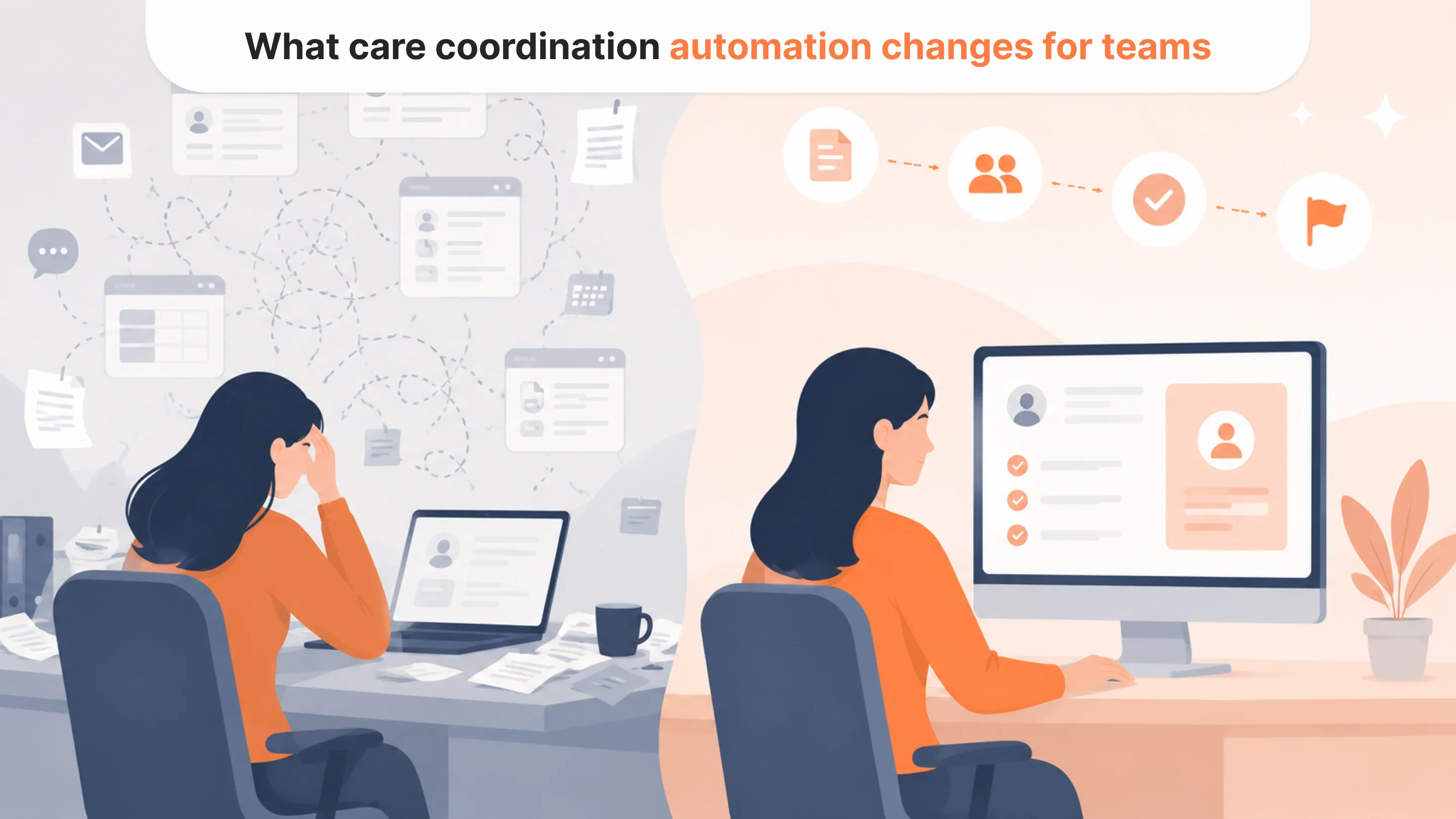
The main change is that staff spend less time searching for context and more time resolving exceptions.
In a manual workflow, care coordinators often need to open multiple tools, read long notes, check message history, look for missing documents, and ask other teams for updates before they know what to do.
With AI-assisted coordination, the system can prepare the case first. It can summarize what happened, identify what is missing, suggest the next operational step, and flag unclear or sensitive cases for review.
This creates several practical improvements:
fewer missed follow-ups;
faster referral review;
clearer handoffs between teams;
less repeated patient communication;
better visibility into stuck cases;
more consistent routing and escalation;
less time spent searching across systems.
The point is not to remove the coordinator. The point is to give coordinators better context earlier.
What changes for patients and providers
For patients, care coordination delays often feel like silence. They do not always know whether their referral was received, whether documents are missing, whether someone reviewed their case, or what happens next.
AI-assisted care coordination can help teams communicate more clearly and sooner. Patients can receive better updates because staff have a clearer view of status, missing information, and next steps.
For providers, the value is context. Instead of receiving incomplete or scattered information, they can get a concise summary of what happened before the appointment or review. This can make visits, follow-ups, and internal decisions more efficient.
Better coordination does not mean removing human care. It means reducing the administrative gaps that make healthcare feel fragmented.
What should not be automated?
Care coordination is close to clinical work, so boundaries are essential.
AI should not independently decide care plans, diagnose conditions, determine medical necessity, prioritize clinical urgency without review, or give patients medical instructions. Those decisions require qualified human judgment.
AI can support:
summarizing patient status;
flagging missing information;
preparing administrative messages;
routing tasks;
identifying delayed follow-ups;
organizing handoff notes;
creating operational reports.
A safe care coordination automation workflow should include human review, escalation rules, role-based access, audit trails, and clear limits around clinical content.
The best approach is human-in-the-loop. AI prepares and organizes the work. Care teams make the decisions.
Signs your care coordination workflow needs automation
Your organization may be ready for care coordination automation if:
follow-ups are tracked manually;
patients often ask for status updates;
referrals wait because documents are missing;
care coordinators search across multiple tools for context;
providers receive incomplete handoff information;
tasks are routed manually between teams;
managers cannot see where cases are stuck;
patient navigation depends heavily on individual staff knowledge.
These signs show that the problem is not only workload. It is workflow visibility and coordination.
Before adding automation, teams should map the current care journey. Where do requests enter? Which teams touch the case? What information is needed at each step? Where do delays happen? Which tasks repeat? Which decisions require human review?
That map helps identify the safest first automation opportunity.
From scattered coordination to clearer patient movement
Care coordination delays rarely come from one single failure. They usually come from small gaps between systems, teams, documents, messages, and next steps.
AI can help reduce those gaps by making information easier to summarize, route, track, and act on. It can help staff see what is missing, which cases need attention, and where patients are getting stuck.
For healthcare leaders, the right question is not “Can we automate care coordination completely?” It is: “Where are patients delayed because staff do not have the right information at the right time?”
That is where AI-powered care coordination can create real value.
Faq
What is AI care coordination?
+AI care coordination means using AI to support the administrative and operational work involved in moving patients through care. This can include follow-up tracking, referral routing, patient navigation support, handoff summaries, task routing, and workflow visibility.
How is AI care coordination different from general workflow automation?
+General workflow automation can apply to almost any business process. AI care coordination focuses specifically on healthcare workflows where patients, providers, documents, tasks, and teams need to stay aligned.
Can AI communicate directly with patients?
+It can support patient communication in limited administrative contexts, but clinical or sensitive communication should include clear boundaries and human oversight. In many cases, AI is safer when it prepares messages for staff review rather than sending them independently.
What healthcare workflows can benefit from care coordination automation?
+Common examples include referral management, follow-up tracking, patient navigation, care team handoffs, missed appointment follow-up, document review, scheduling support, and internal task routing.
Is AI care coordination safe for healthcare teams?
+It can be safe when designed with role-based access, human review, escalation rules, audit trails, and clear limits around clinical decision-making. AI should support care teams, not replace qualified judgment.

Tell us about your project
Fill out the form or contact us

Tell us about your project
Thank you
Your submission is received and we will contact you soon
Follow us