
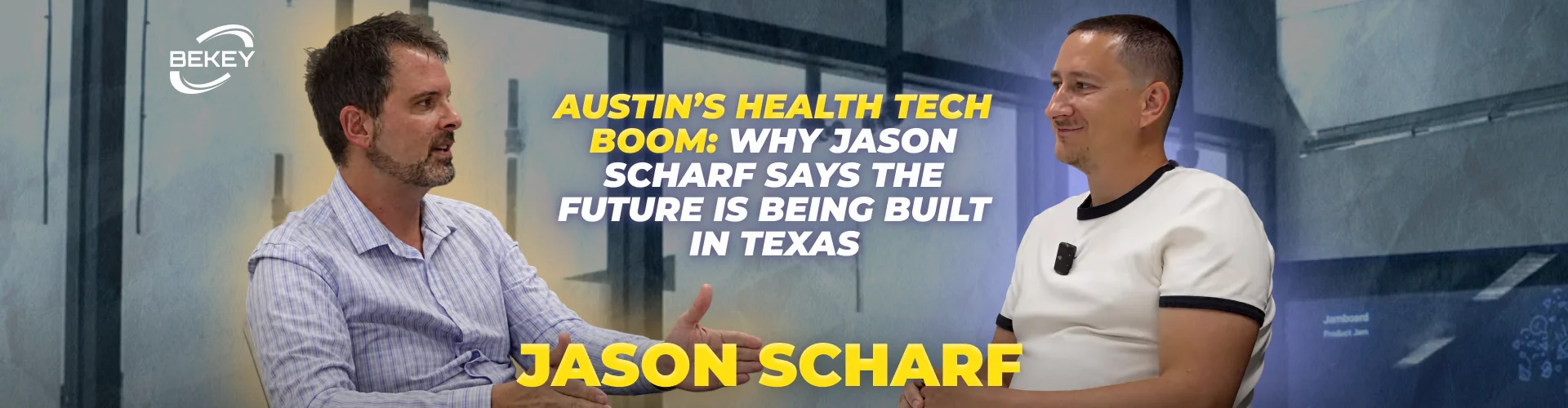
Austin’s Health Tech Boom: Why Jason Scharf Says the Future Is Being Built in Texas
- From Molecular Biology to the Business of Innovation
- Austin’s Biggest Problem Was Never Talent — It Was Narrative
- “There Is No Business Model for Cure”
- Why New Entrants Matter More Than Legacy Giants
- Why Healthcare Must Move Faster
- GLP-1 Drugs Are More Than a Pharmaceutical Trend
- Austin’s Advantage: Permission to Build
- The Missing Ingredient: Ecosystem Connectivity
- Founders Need to Think Beyond the Product
In a recent episode of Digital Health Interviews, we sat down with Jason Scharf - investor, ecosystem builder, podcast host, and one of the loudest advocates for Austin’s rise as a serious force in health tech and biotech innovation.
What makes Scharf interesting is not just that he invests in startups or talks about ecosystems online. It’s the way he connects seemingly separate shifts, AI, GLP-1 drugs, CRISPR, defense tech, infrastructure, regulation, venture capital, and even storytelling, into one larger thesis about where healthcare is heading next.
And according to him, the future won’t be built by companies making incremental improvements to the current system.
It will be built by those willing to redesign the system itself.
From Molecular Biology to the Business of Innovation
Scharf originally planned to pursue a PhD in molecular biology before realizing that life in the lab wasn’t for him. Instead, he found himself drawn toward the business side of science, starting in PR for life sciences companies before moving through consulting, strategy, market intelligence, and eventually startup investing.
Over the years, he worked with companies like Covance, Becton Dickinson, Amgen, and Illumina, gaining exposure to nearly every corner of the healthcare ecosystem. But the real turning point came after moving from San Diego to Austin during the COVID era.
Like many outsiders, he initially assumed Austin’s life sciences ecosystem was relatively small. Then the region raised nearly a billion dollars in funding in a single year while producing multiple unicorns. That contradiction became impossible to ignore.
The ecosystem was growing rapidly. The problem was that almost nobody outside Texas seemed to realize it.
Austin’s Biggest Problem Was Never Talent — It Was Narrative
One of Scharf’s core arguments is that ecosystems don’t grow on infrastructure alone. They also grow on perception.
For years, Austin suffered from what he calls a “narrative problem.” Important companies were being built, capital was flowing into the market, and innovation was accelerating, but there weren’t enough people telling the story.
This is partly why he launched the Austin Next podcast. Initially, it was simply a way to meet interesting people and build relationships inside the ecosystem. Over time, it evolved into something larger: an attempt to understand the mechanics of innovation itself, from individual founders to city-scale ecosystems. That distinction matters.
Scharf is highly critical of regional podcasts that function purely as promotional channels for startups. In his view, ecosystems become interesting when they move beyond company pitches and begin exploring the deeper forces shaping innovation - incentives, infrastructure, regulation, talent flows, and culture.
And in Austin’s case, those forces are starting to converge in unusual ways.
“There Is No Business Model for Cure”
One of the most provocative ideas in the conversation comes from Scharf’s TEDx talk, where he argues that healthcare still lacks a true business model for cures.
The problem is not technological capability. In many areas, medicine is advancing faster than the structures designed to support it.
CRISPR therapies, AI-driven drug discovery, robotics, and GLP-1 drugs are not simply incremental upgrades to existing healthcare products. They fundamentally change what is possible. But healthcare systems, especially large pharmaceutical companies, are still optimized around older economic models built for chronic disease management.
Scharf uses the example of Casgevy, the first CRISPR-based therapy for sickle cell disease. Despite its transformative potential, adoption remains limited, partly because the healthcare system struggles to accommodate therapies that operate outside traditional reimbursement frameworks.
A one-time cure does not fit neatly into a business model designed around recurring treatment.
This, he argues, mirrors moments seen in other industries. Cloud computing only became transformative once SaaS emerged as the business model that unlocked its potential. Defense tech underwent a similar shift when companies moved away from cost-plus contracting toward product-driven innovation.
Healthcare may now be entering its own version of that transition.
Why New Entrants Matter More Than Legacy Giants
Scharf is skeptical that incumbent healthcare giants can fully adapt to this new paradigm.
Historically, transformational technologies rarely emerge from the dominant players already optimized for existing systems. Kodak invented the digital camera but failed to transition into the digital era. Large organizations often struggle to abandon the business models that made them successful in the first place.
That’s why Scharf believes the next wave of healthcare transformation is more likely to come from new entrants rather than established pharmaceutical companies.
At the same time, he points to Eli Lilly as one of the few large companies that appears to understand the shift underway. Beyond capitalizing on the massive success of GLP-1 drugs, Lilly has been aggressively investing in AI partnerships, startup ecosystems, and next-generation biotech infrastructure.
The key difference is mindset. Instead of treating current successes as permanent advantages, companies that survive long term will need to continuously place new bets on emerging technologies and business models.
Why Healthcare Must Move Faster
Perhaps the most controversial part of the conversation centers on speed.
Healthcare traditionally prioritizes caution, often for good reason. Clinical validation, regulation, and patient safety matter enormously. But Scharf argues that the industry has overcorrected toward slowness.
The ethical debate usually focuses on the risks of moving too quickly. Far less attention is paid to the human cost of moving too slowly.
“How many people are dying because we’re moving slowly?” becomes the central question.
This perspective becomes particularly relevant when discussing modern technologies like AI and precision medicine. Scientific discovery cycles are accelerating, but regulatory and operational systems often remain locked into timelines built decades ago.
In some cases, even small modifications to approved therapies can trigger years of additional review processes. For technologies evolving iteratively and rapidly, those structures increasingly feel mismatched to reality.
GLP-1 Drugs Are More Than a Pharmaceutical Trend
The conversation also dives deeply into GLP-1 drugs like Ozempic and Zepbound - a category Scharf sees as genuinely transformational.
Not simply because they help patients lose weight, but because they generate second- and third-order effects across multiple industries.
Obesity treatment impacts far more than healthcare outcomes. It affects food industries, insurance economics, employer healthcare costs, consumer behavior, and long-term chronic disease rates.
Scharf references Clayton Christensen’s framework around behavior change and feedback loops to explain why these drugs matter so much. Traditional obesity interventions require massive behavioral change with relatively slow feedback. GLP-1s reduce that friction dramatically by delivering faster, more visible results.
In his view, that shift fundamentally changes adoption dynamics.
At the same time, he emphasizes that competition within the GLP-1 market is already driving something healthcare rarely experiences efficiently: market-based pricing pressure. As new drugs enter the category, companies are being forced to compete on efficacy, delivery methods, and pricing, accelerating innovation further.
Austin’s Advantage: Permission to Build
When discussing why Austin is gaining momentum in biotech and health tech despite Texas ranking poorly on many healthcare access metrics, Scharf points to a different factor entirely: permission.
Austin, in his view, is a place where people are still allowed to build aggressively. That mindset extends across industries, from robotics and defense tech to AI infrastructure and biotech platforms. Compared to more established ecosystems, Austin remains earlier in its development cycle, which creates room for experimentation and unconventional thinking.
Importantly, Scharf does not believe Austin should try to become Boston or Silicon Valley.
Boston excels at optimizing traditional biotech models - therapeutics, diagnostics, incremental innovation within established structures. Austin’s opportunity lies elsewhere: frontier technologies that require entirely new systems, incentives, and operating models.
That distinction shapes the kinds of founders and companies likely to thrive there.
The Missing Ingredient: Ecosystem Connectivity
Despite the momentum, Scharf argues Austin still faces several structural challenges before it can become a true top-three biotech ecosystem.
The first is fragmentation. Healthcare startups, corporations, investors, and operators are spread geographically and socially across the city, with relatively little connective tissue tying them together. Unlike ecosystems where networks naturally overlap, Austin’s health tech scene still feels scattered.
The second challenge is infrastructure. More talent, more investors, more specialized facilities, and even better airport capacity are all part of what’s required for Austin to scale sustainably. Right now, the city consistently “punches above its weight,” but eventually the weight itself has to catch up.
And finally, there is storytelling. Scharf repeatedly returns to the idea that ecosystems need not only builders, but storytellers and philosophers, people who explain why innovation happening in a region matters in the first place.
Without narrative, even large ecosystems remain invisible.
Founders Need to Think Beyond the Product
Toward the end of the interview, Scharf offers perhaps his most important advice to founders. Don’t just build a product. Identify the hinge point.
In other words, what broader system change becomes possible if your company succeeds?
He contrasts truly transformational companies with businesses that simply create isolated “assets.” Uber did not merely improve taxi services; it reshaped mobility itself. The same principle applies in healthcare.
The most important startups are not those building slightly better tools within existing structures. They are the ones capable of changing relationships, incentives, and operating models at a systemic level.
That, ultimately, is what Scharf believes Austin represents right now. Not a finished ecosystem, not a polished machine, but a frontier where entirely new systems are still possible to build.


Tell us about your project
Fill out the form or contact us

Tell us about your project
Thank you
Your submission is received and we will contact you soon
Follow us