
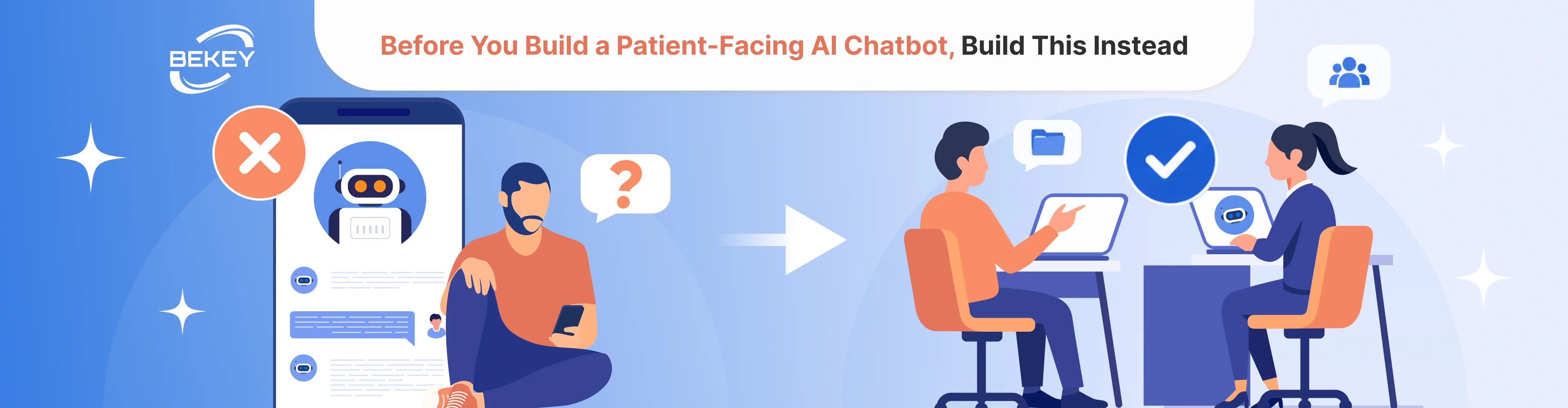
Before You Build a Patient-Facing AI Chatbot, Build This Instead
- Why patient-facing AI chatbots are harder than they look
- The better first use case: an internal AI assistant
- Why internal assistants create value faster
- What changes for staff
- Why this is a strong first AI project for founders
- This is not an argument against patient-facing AI
- What should stay out of scope
- How BeKey can help
- Conclusion
Healthcare founders and product teams often start with the same idea: “Let’s build an AI chatbot for patients.”
On paper, it makes sense. Patients need faster answers. Support teams are overloaded. Front-desk and care teams spend time responding to repeated questions. A chatbot seems like a visible, modern way to improve access and reduce manual work.
But in healthcare, the most obvious AI assistant is not always the safest first one.
Before building a patient-facing AI chatbot, many healthcare companies should consider building an internal AI assistant for staff instead.
That may sound less exciting. It is not as visible to users. It does not create the same product demo moment. But it can solve real operational problems with lower risk: helping staff find policies, search SOPs, answer administrative questions, support onboarding, route internal requests, summarize meetings, and access approved information faster.
For many teams, this is the better first step toward practical AI adoption.
Why patient-facing AI chatbots are harder than they look
A patient-facing AI chatbot does not operate in a neutral environment. It speaks directly to people who may be worried, confused, frustrated, or looking for medical guidance. Even if the chatbot is designed for administrative support, the conversation can quickly move into sensitive territory.
A patient may start by asking about an appointment and then mention symptoms. A billing question may include personal health information. A simple “What should I do next?” can become clinically ambiguous. In these moments, the chatbot needs more than a good answer. It needs boundaries, escalation logic, approved content, auditability, and a clear understanding of what it should not handle.
That does not mean healthcare companies should never build patient-facing AI tools. They can be useful when designed carefully. But they are rarely the easiest or lowest-risk first AI assistant use case.
The risks are not only clinical. A patient-facing chatbot can create problems if it gives inconsistent answers, misunderstands urgency, fails to escalate, exposes sensitive information, or creates a support experience that feels less trustworthy than a human response.
For early-stage companies and growing healthcare teams, this can turn a promising AI project into a complicated risk-management exercise before the organization has even learned how to use AI internally.
The better first use case: an internal AI assistant
An internal AI assistant for healthcare teams works differently. Instead of communicating with patients, it supports staff. It helps employees search internal knowledge, find the right SOP, understand administrative processes, answer routine HR or compliance questions, prepare summaries, and route issues to the right team.
This makes it a safer and more practical starting point.
The assistant can work with approved internal documentation. It can show source references. It can be limited by role-based access. It can route uncertain questions to managers, compliance teams, HR, IT, or operations leads. Most importantly, its first users are employees who can evaluate, correct, and improve the system before AI is exposed to patients.
An internal AI assistant healthcare teams actually use can support:
internal policy Q&A;
SOP search;
onboarding support;
compliance guidance;
IT and helpdesk routing;
HR and admin questions;
meeting summaries;
internal reporting;
operations knowledge search.
This is not about replacing people. It is about reducing repetitive knowledge work that slows teams down every day.
Why internal assistants create value faster
Patient-facing chatbots often require careful patient communication design, clinical escalation rules, legal review, privacy review, and extensive testing before launch. Internal assistants also require governance, but they can often start with narrower, lower-risk workflows.
For example, a team can begin with an internal knowledge assistant that answers questions only from approved SOPs and policies. If the assistant is uncertain, it can say so and direct the employee to the right owner. If a document is outdated, the team can update the source. If employees ask the same question repeatedly, managers can see where documentation or process clarity is missing.
That feedback loop is valuable. It helps the company improve its internal operations while learning how AI performs in a controlled environment.
Internal assistants can also create visible productivity gains across departments. HR teams receive fewer repeated questions. Compliance teams can make approved guidance easier to access. Operations teams can reduce interruptions. New employees can onboard faster. Managers can spend less time answering process questions and more time improving the process itself.
The result is not just an AI tool. It is a better operating system for internal knowledge.
What changes for staff
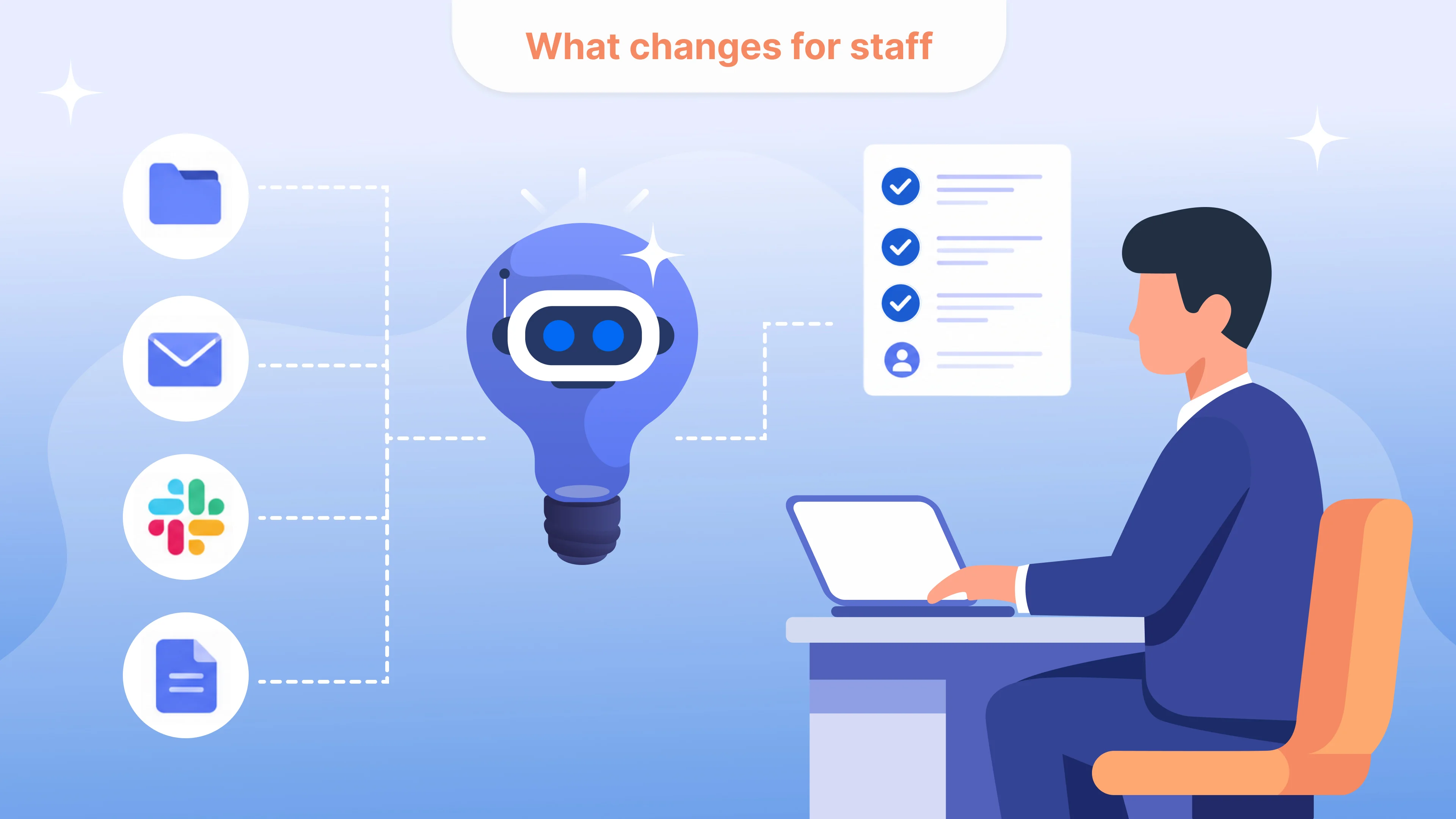
In many healthcare companies, experienced employees become the default source of truth. If someone does not know how to handle an exception, find a policy, use a tool, or follow a workflow, they ask the person who “just knows.”
This works until the company grows. Then the same people become bottlenecks. They answer repeated questions, interrupt their own work, and carry knowledge that should be easier for the whole team to access.
An internal AI assistant changes that pattern. Instead of searching through folders, old emails, Slack threads, or asking a manager, staff can ask the assistant and receive a structured answer based on approved materials. The assistant can point to the source, summarize relevant steps, and suggest who should be contacted if the question requires human judgment.
This helps staff work more independently while keeping the organization’s knowledge more consistent.
Why this is a strong first AI project for founders
For founders and product leaders, internal AI assistants offer a practical way to test AI inside the business before making it part of the patient experience.
They help answer important questions early:
Which internal workflows are repetitive enough for AI support?
Which documents are reliable enough to use as approved sources?
Where do employees need faster access to information?
What questions should AI answer, and what should be escalated?
How should role-based access and audit trails work?
How will the team measure adoption and usefulness?
These questions matter for any future AI assistant, including patient-facing ones. Starting internally helps the company build the discipline required for safer AI adoption: documentation hygiene, access control, escalation design, monitoring, feedback loops, and human-in-the-loop workflows.
In other words, an internal assistant can become the training ground for better AI implementation.
This is not an argument against patient-facing AI
The point is not that patient-facing chatbots are bad. In the right context, they can reduce support volume, answer routine questions, improve access, and help patients navigate services more easily.
The point is sequencing.
If a healthcare company has scattered internal knowledge, unclear SOPs, overloaded managers, repeated staff questions, and no tested AI governance process, building a patient-facing chatbot first may create unnecessary risk. The organization is asking AI to interact with patients before it has proven that AI can reliably support its own staff.
A better approach is often:
Start with an internal AI assistant.
Use approved internal documents and narrow use cases.
Add access controls and escalation paths.
Measure staff adoption and answer quality.
Improve documentation and workflows.
Expand only when the organization understands the risks and limits.
This creates a more responsible path from internal productivity to patient-facing automation.
What should stay out of scope
Even internal AI assistants need boundaries. They should not give legal advice, make compliance decisions, interpret clinical information independently, or expose sensitive data to the wrong users.
A safe internal AI assistant should include:
approved knowledge sources;
role-based permissions;
source references;
clear escalation rules;
feedback options;
audit logs for sensitive workflows;
human ownership for high-risk questions.
The assistant should also be honest when it does not know the answer. In healthcare, a confident but unsupported answer is more dangerous than a limited one.
How BeKey can help
For BeKey, the strongest AI assistant strategy starts with workflow discovery, not a chatbot demo.
Before building anything, teams need to understand where internal knowledge is scattered, which questions repeat most often, what documents can be used safely, who owns each knowledge area, and which requests should be escalated to a human.
From there, BeKey can help design an internal AI assistant that fits the company’s real operations. This may include SOP search, policy Q&A, onboarding support, internal helpdesk routing, compliance guidance, meeting summaries, reporting support, and integrations with existing tools.
The goal is not to build the most impressive chatbot. The goal is to find the safest first AI assistant use case for the team, one that creates value, reduces repetitive work, and builds the foundation for more advanced AI adoption later.
Conclusion
A patient-facing AI chatbot may sound like the obvious first AI assistant for a healthcare company. But obvious does not always mean best.
For many founders and product leaders, the smarter first move is to build internally. An internal AI assistant can help staff find information faster, reduce repeated questions, support onboarding, improve SOP access, and create a lower-risk environment for learning how AI should work inside the organization.
Once the team knows how to manage approved sources, access control, escalation, monitoring, and feedback, it will be better prepared to consider patient-facing AI.
Before asking AI to talk to patients, ask whether it can help your staff work better first.
That may be the safer and more useful place to begin.
Not sure where your first AI assistant should start?
Find the safest first AI assistant use case for your team with BeKey. We can help you identify internal workflows where AI can reduce repetitive work, support staff, and create value before moving into higher-risk patient-facing automation.

Tell us about your project
Fill out the form or contact us

Tell us about your project
Thank you
Your submission is received and we will contact you soon
Follow us