

Beyond the Hype: AI + CRISPR, Longevity, and VR - What to Build Now vs Watch
In healthcare innovation, timing is often more important than the idea itself.
Many technologies look inevitable in hindsight. At the moment they appear, however, the picture is far less clear. Some directions move quickly from research into practice. Others remain technically promising but operationally irrelevant for years.
AI has amplified this dynamic.
Today, it is increasingly discussed alongside areas such as gene editing, longevity research, and immersive technologies like VR. These combinations generate strong narratives - AI accelerating drug discovery, AI enabling personalized longevity strategies, and AI-powered virtual care environments.
Most of these narratives are directionally correct. A few of them are immediately actionable.
For founders and innovation teams, the challenge is not understanding where the industry is heading. It is deciding where to commit resources now, and where to wait.
Building too early creates systems that depend on immature infrastructure, unclear regulation, or workflows that do not yet exist. Waiting too long means missing the point where experimentation becomes a competitive advantage.
This material looks at several high-visibility intersections, AI with CRISPR, longevity, and VR, and approaches them from a practical perspective. Not what is possible, but what is buildable today, what is worth early exploration, and what should remain under observation.
AI + CRISPR: Strong Science, Slow Productization
Few areas attract as much attention as the intersection of AI and gene editing. On paper, the logic is compelling. CRISPR, a gene-editing technology that allows scientists to modify DNA sequences, generates complex biological problems, and AI is well-suited to pattern recognition, prediction, and optimization. It is easy to see why this combination is framed as one of the most important directions in the future of AI in healthcare.
The difficulty is that scientific promise and product readiness are not the same thing.
In the CRISPR space, AI can already contribute to research workflows. It can help model guide RNA design, predict off-target effects, and accelerate parts of experimental analysis.
These are meaningful applications, but they operate primarily inside research and platform environments. They are not the kind of products most healthcare startups can turn into scalable, near-term businesses unless they already sit very close to the underlying science, data, and regulatory process.
This is where many innovation narratives become misleading. The phrase “AI + CRISPR” sounds like a category. In reality, it describes a collection of very different opportunities, most of which are still constrained by biology, validation cycles, and translation into clinical use. The bottleneck is rarely the model itself. It is access to high-quality biological data, wet-lab feedback loops, and the long path from promising signal to approved application.
For most founders, this means AI + CRISPR is not a broad product category to rush into. It is a space to watch carefully unless the company already has a clear scientific wedge, proprietary data, or a strong reason to build inside the research infrastructure layer. The opportunity is real, but the timing is uneven. There is value in the ecosystem today, just not evenly distributed across all builders.
AI + Longevity: Plenty of Narrative, Uneven Infrastructure
If CRISPR is constrained by scientific translation, longevity is constrained by definition.
The longevity market is full of ambition, but much of it still lacks operational clarity. The field blends preventive care, biomarker tracking, diagnostics, lifestyle intervention, consumer wellness, and highly speculative science. AI fits naturally into this landscape because it promises personalization, prediction, and pattern detection across large volumes of health data.
That promise is part of the problem.
In theory, AI can help identify risk trajectories, interpret biomarker changes, personalize recommendations, and support long-term health optimization. In practice, many longevity-focused products are working with fragmented data, weak clinical feedback loops, and unclear standards for what meaningful improvement actually looks like. It is easier to build an impressive interface than a system that reliably changes health outcomes over time.
This makes longevity one of the more difficult areas to assess. There is clearly commercial interest. There is also real room for useful products, especially around data interpretation, member engagement, and structured decision support for clinicians or coaches operating in preventive care settings. But the field still contains a large gap between what can be marketed and what can be operationalized responsibly.
For innovation leaders, that distinction matters. The near-term opportunity is less about solving “longevity” as a category and more about building tools around defined workflows: biomarker review, care navigation, adherence support, patient segmentation, and operational analytics inside preventive health programs. Products in these categories can be built now because they solve concrete problems. Broad claims about AI-driven longevity platforms are harder to defend unless the company has unusually strong data infrastructure and outcome measurement.
In other words, longevity is not a market to ignore. But it is also not a category where visionary language should substitute for product discipline.
AI + VR: Narrower Than the Hype, More Useful Than It Looks
VR tends to follow a familiar cycle in healthcare. It is repeatedly presented as a transformative interface, then dismissed when broad adoption fails to materialize. Both reactions miss the more interesting reality.
VR is not becoming a universal healthcare platform. It is, however, proving useful in specific settings where immersion has a clear functional role.
That matters because AI and VR are often discussed together in ways that imply a much broader shift than what is actually happening. The more practical view is narrower. AI can make VR systems more adaptive, more personalized, and more responsive to user behavior, but only in contexts where VR already has a workflow fit. Pain management, rehabilitation, behavioral health, exposure therapy, and certain training environments make sense because the immersive layer is part of the intervention, not just a novelty.
This makes AI + VR more buildable in the near term than some people assume, but only within defined use cases. There is little reason to treat it as a general platform play. There is more reason to think about it as a set of tools for targeted applications where outcomes can be observed, and workflows are already structured.
For founders, this is an important distinction. Broad AI + VR narratives tend to drift into futurecasting. The real opportunities today are much more specific. If the immersive component is central to the clinical or behavioral mechanism, AI can improve personalization and triage. If it is not, the technology stack becomes harder to justify.
Of the three areas discussed here, AI + VR may actually offer some of the clearest build-now opportunities, not because it is larger, but because the operational boundaries are easier to define.
What to Build Now vs What to Watch
The real strategic mistake in emerging healthcare categories is treating every promising direction as if it deserves the same type of investment.
It does not.
Some areas are ready for product development because they already sit on top of clear workflows, known buyers, and measurable outcomes. Others are better approached through partnerships, internal research, or light experimentation until the surrounding infrastructure becomes more mature. The question is not whether a category sounds important. The question is whether the company can build something useful inside it now.
That usually comes down to a few practical signals. Is there a defined workflow? Is there data of sufficient quality and continuity to support the product? Is there a buyer with a budget and a reason to act? Can outcomes be measured in a way that goes beyond user engagement or investor narrative? If those conditions are missing, the right move is often to watch rather than build.
Applied to the categories above, the distinction becomes clearer. AI + CRISPR remains compelling but highly dependent on scientific proximity and infrastructure. AI + longevity offers selective opportunities, especially where products are tied to concrete preventive workflows rather than broad platform claims. AI + VR is narrower than the hype suggests, but in the right settings, it is already practical.
This is what an AI innovation roadmap should actually do. It should reduce the temptation to chase visibility and force a more disciplined decision about timing. In healthcare, a good strategy is often less about seeing the future first and more about recognizing which parts of the future are investable now.
Building With Timing in Mind
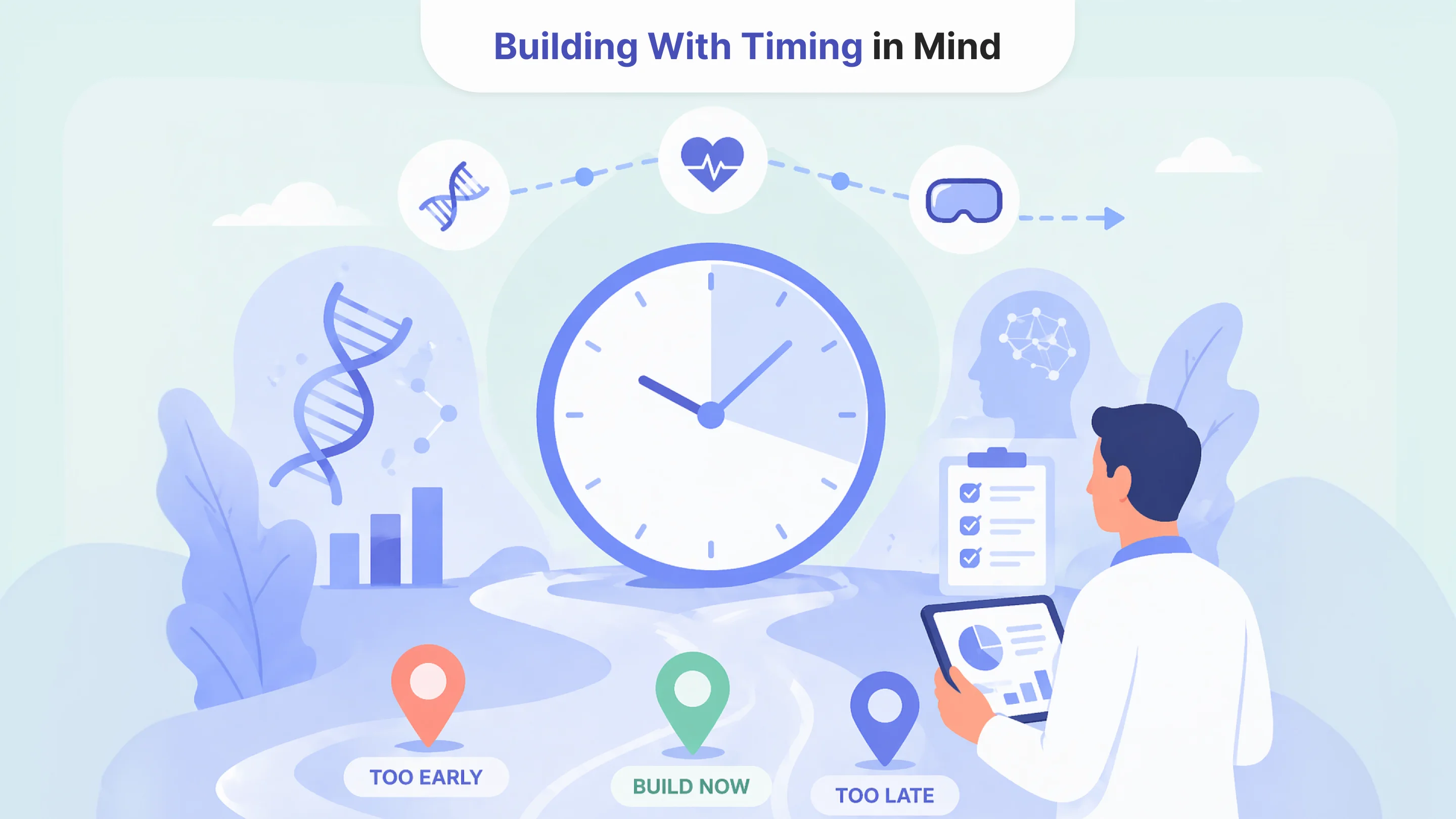
The future of AI in healthcare will almost certainly include fields such as gene editing, longevity, and immersive care. The harder question is not whether these categories matter, but when they become worth building against.
That decision depends on more than technical feasibility. It depends on workflow maturity, data readiness, regulatory shape, and the ability to measure real value. Founders and innovation leaders who ignore those factors usually end up with products that sound timely but arrive in the market either too early or in the wrong form.
The more durable approach is to separate signal from narrative. Some intersections are ready for focused execution now. Others deserve serious attention, but not full commitment.
If your team is evaluating where to build, where to test, and where to wait, our AI strategy advisory work helps define practical innovation priorities grounded in timing, operational fit, and market readiness.

Tell us about your project
Fill out the form or contact us

Tell us about your project
Thank you
Your submission is received and we will contact you soon
Follow us