
Beyond the Hype: Building Responsible AI for Mental Health
In August 2025, Illinois passed the Wellness and Oversight for Psychological Resources (WOPR) Act, becoming one of the first U.S. states to legally restrict AI's role in mental healthcare. The Act prohibits licensed professionals from using AI to make therapeutic decisions, interact with clients in a therapeutic capacity, or generate treatment recommendations independently. AI remains permissible only for strictly administrative or supplementary support, and only with informed, written client consent when sessions are recorded. Violators face civil penalties of up to $10,000 per incident.
This legislative move is more than a local story. It reflects a broader unease with how quickly AI is being woven into one of the most sensitive areas of healthcare. For every enthusiastic headline about “AI therapists,” there are growing questions about safety, transparency, and the very limits of what algorithms can or should do when dealing with human distress.
Artificial intelligence has entered the mental health space with bold promises: faster diagnoses, personalized treatment plans, round-the-clock chatbot support, and predictive insights that could prevent crises before they occur. The idea of algorithms as companions to psychiatrists, or even as digital therapists, is no longer science fiction but a growing reality. Startups are raising millions on the claim that they can “revolutionize” mental health, while health systems experiment with AI-driven screening and triage tools.
But beneath the enthusiasm lies a more complicated story. Can an algorithm truly capture the nuance of human emotion? Who ensures that the data it learns from is representative and not skewed toward certain demographics? And how do we protect the privacy of patients when mental health apps collect intimate details of their lives, often without clear consent?
The hype cycle is familiar: new technologies generate excitement, funding surges, and adoption accelerates before rigorous validation catches up. In the context of mental health—a domain already fraught with stigma, inequity, and underfunding—the stakes are even higher. A poorly designed AI tool is not just a failed product; it can misdiagnose, overlook urgent warning signs, or erode trust in therapy altogether.
In our previous analyses, we explored how AI can assist in mental health crisis intervention and how the broader mental health tech landscape is evolving toward consolidation and personalization. This article takes a step further, looking critically at the promises and pitfalls of AI in mental health, and asking what it would take to build responsible, trustworthy systems.
The Promise: What AI Can Do for Mental Health
Despite the justified skepticism, there is a reason why AI has attracted so much attention in mental health care: the needs are enormous, and the gaps in traditional systems are undeniable. More than 1 billion people globally experience mental health challenges, yet according to the World Health Organization, nearly 85% of them receive no treatment at all. The shortage of trained psychiatrists, long waiting times, and high costs make care inaccessible for millions. In this context, AI is not just a technological experiment - it represents a possible way to bridge systemic gaps.
One of AI’s most tangible contributions is improving accessibility. Chatbots and virtual assistants such as Woebot or Wysa provide 24/7 text-based support, offering coping strategies for anxiety, depression, or stress. While no one seriously argues they can replace human therapists, they function as scalable companions, especially in regions with few mental health professionals. For many users, simply having a non-judgmental, always-available interface reduces isolation and encourages seeking further help.
AI also opens the door to personalization at scale. Traditional care often relies on standardized protocols - everyone with mild depression might be offered cognitive behavioral therapy (CBT), for example. But AI-driven systems can integrate data from multiple sources: wearable devices measuring sleep and heart rate, smartphone usage patterns, digital journaling apps, and electronic health records. These inputs allow algorithms to tailor interventions more precisely, matching individuals with the most suitable type of care.
Another promising area is prediction and early intervention. Mental health crises rarely appear out of nowhere; they are often preceded by weeks of subtle changes in mood, cognition, or behavior. AI systems can detect these shifts earlier than human observation alone.
Finally, AI has the potential to scale clinical expertise. By automating tasks like intake assessments, symptom tracking, or progress monitoring, algorithms can free up human clinicians to focus on deeper therapeutic work. This is particularly important in overburdened systems where psychiatrists spend much of their time on paperwork rather than patient interaction. In theory, AI could act as a “force multiplier” for clinicians, extending their reach without sacrificing quality.
These opportunities explain why startups attract rapid investment and why health systems are eager to experiment. Yet precisely because of their potential power, some governments are already drawing boundaries. The new WOPR Act in Illinois, for example, explicitly allows AI only in a supporting role - not as a stand-alone therapist or treatment engine. It’s a reminder that even at the state level, the message is clear: there is promise, but also a need for limits.
The Pitfalls: When AI in Mental Health Fails to Deliver
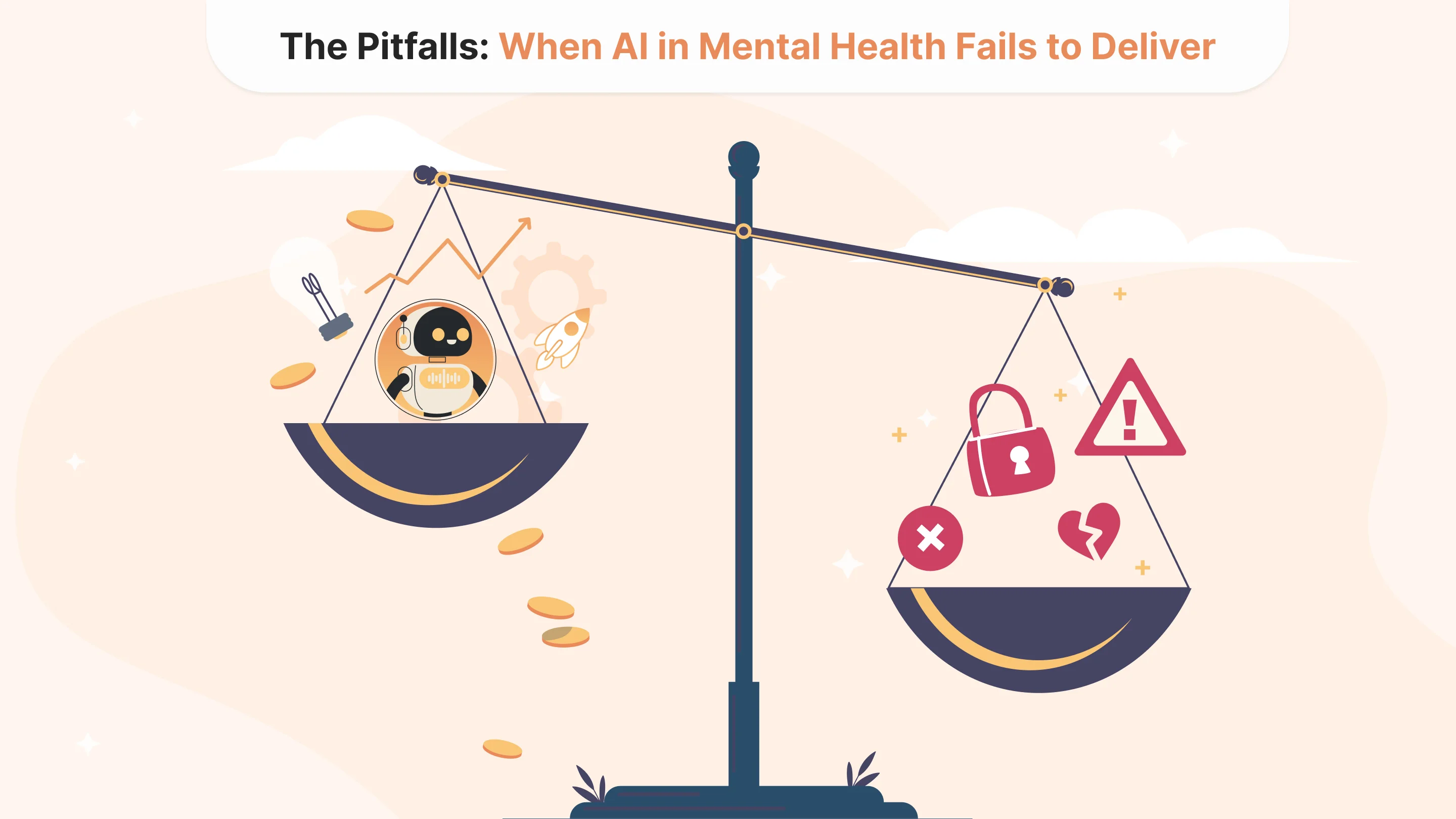
The history of digital mental health is filled with bold promises. For nearly a decade, headlines have proclaimed that chatbots, predictive apps, and digital platforms will “revolutionize therapy.” Yet the reality has been more complicated: many projects that once attracted investment and media attention have struggled with adoption, clinical validation, or even basic safety. Looking at these cases reveals the gap between vision and execution, and why critical oversight is essential.
The Rise and Retreat of Mindstrong
Mindstrong was once hailed as the future of mental health monitoring. Founded by former National Institute of Mental Health director Thomas Insel, the company promised to turn smartphone usage patterns into a “digital biomarker” for mental health. Typing speed, scroll behavior, and interaction frequency were supposed to reveal early signs of depression or cognitive decline. Investors poured in over $100 million, and expectations soared.
But by 2022, Mindstrong laid off much of its staff and scaled down operations. Why? Despite intriguing research, the science behind its biomarkers proved harder to validate in real-world populations. Privacy concerns also loomed - patients were uneasy about handing over their most intimate digital behaviors. Most importantly, the product struggled to integrate into clinical workflows. What looked innovative in theory failed to provide actionable insights that clinicians could reliably use.
Chatbots That Overpromised
AI-powered chatbots like earlier-mentioned Woebot and Wysa have become household names in digital mental health. They offer text-based conversations grounded in cognitive behavioral therapy, delivering support at any time. But while initial studies suggested benefits, subsequent scrutiny raised doubts. In 2021, researchers pointed out that many chatbot trials were small, industry-funded, and lacked long-term follow-up.
The issue isn’t that chatbots are harmful; many users find them comforting. The problem is overstatement. Marketing campaigns framed them as “therapy substitutes” rather than supplementary tools. This mismatch between promise and reality has led some clinicians to worry that vulnerable individuals might rely on them instead of seeking professional help. In mental health, such misplaced reliance can delay life-saving interventions.
Mental Health Apps and the Privacy Backlash
The explosion of mental health apps on app stores has given millions of people access to self-care tools. But investigations by watchdog groups and journalists have revealed widespread privacy violations. A 2022 report by Mozilla found that many popular apps, including those targeting anxiety and depression, shared sensitive user data with third parties, often without clear consent.
For example, BetterHelp, a widely known online therapy platform, faced criticism after revelations that it was sharing user data with Facebook and Snapchat for targeted advertising. Even though BetterHelp later reached a settlement with the U.S. Federal Trade Commission, the damage to trust was significant. For a patient struggling with depression, the idea that their intimate disclosures might be monetized can feel like a betrayal.
Scandals around data sharing and privacy violations, like those involving BetterHelp, further validate the regulatory approach. Under the Illinois Act, recording or collecting data in therapy requires explicit, written consent, with heavy fines for violations. It’s a concrete response to exactly the kinds of abuses that have plagued the industry.
Clinical Integration Barriers
Many AI-driven tools work well in controlled studies but falter in actual practice. Predictive algorithms that detect suicidal ideation, for example, often produce high rates of false positives. While catching every possible signal is important, over-alerting clinicians creates “alarm fatigue,” where urgent warnings lose their impact. Hospitals that piloted such tools sometimes found them more disruptive than helpful.
Moreover, AI tools rarely fit seamlessly into existing electronic health record systems. Clinicians face a barrage of dashboards and alerts from different vendors, adding to their workload rather than streamlining it. The result is that promising algorithms gather dust instead of guiding real-world decisions.
Why These Failures Matter
These cases underscore a sobering reality: in mental health, good intentions and advanced algorithms are not enough. The challenges are not just technical - they are clinical, ethical, and human. Patients must trust the system, clinicians must find the tools useful, and regulators must ensure safety. Without all three, even the most well-funded projects can collapse under the weight of their own hype.
Responsible AI in Mental Health: Moving Past the Hype
The story of AI in mental health is neither one of unqualified triumph nor outright failure. It is a story of potential colliding with complexity. On one hand, AI can expand access, personalize treatment, and help clinicians anticipate crises earlier than ever before. On the other hand, rushed deployment, weak evidence, and questionable business models have already shown how fragile trust in these tools can be.
The lesson is not to abandon AI in mental health, but to recalibrate expectations. The most promising tools are not those that try to replace clinicians, but those that extend their reach. Chatbots may provide first-line support, but they cannot replace therapy. Predictive algorithms may flag risk, but they must be paired with professional judgment. Data from wearables and smartphones can enrich clinical insight, but only if collected transparently, protected securely, and validated against diverse populations.
Accountability is the missing ingredient. Without clear regulatory standards, startups can market unproven tools as if they were clinically robust. Without transparency, patients cannot know how their most private data is being used. Without integration, clinicians see AI not as a partner but as a distraction. Building responsible AI in mental health means confronting these issues head-on: demanding rigorous trials, enforcing privacy protections, and designing systems that fit into - not complicate - clinical practice.
The WOPR Act in Illinois is one of the first attempts to codify these principles into law. It sets a precedent: AI can be an assistant but not a therapist; a multiplier but not a replacement. If other regions adopt similar standards, the sector has a chance to evolve responsibly. Without such frameworks, the cycle of hype, disappointment, and distrust will only repeat. Regulation, in this sense, is not a brake; it’s the guardrail that makes innovation sustainable.

Tell us about your project
Fill out the form or contact us

Tell us about your project
Thank you
Your submission is received and we will contact you soon
Follow us