
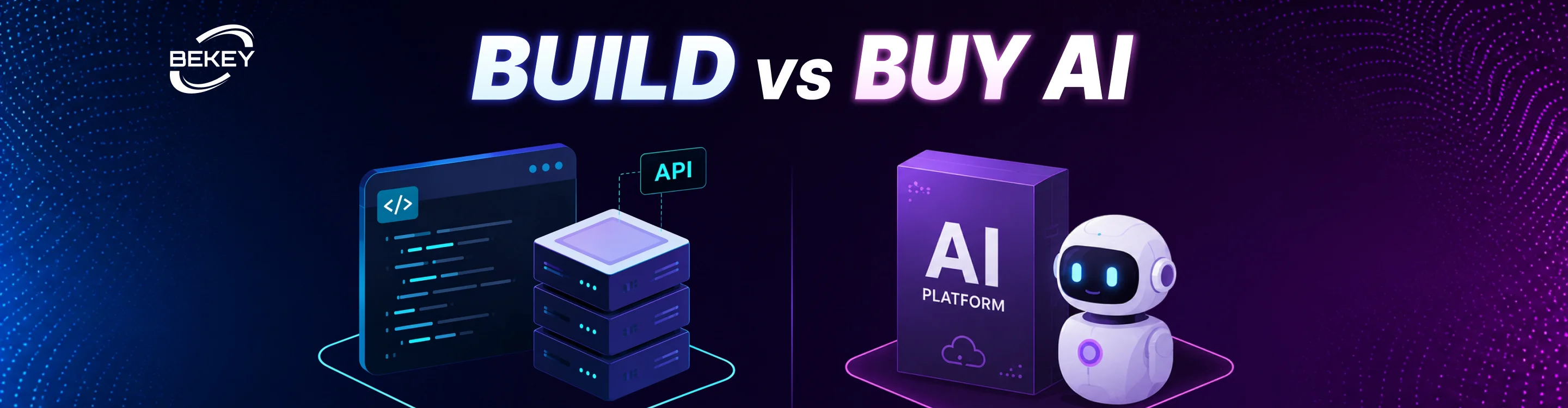
Build vs Buy AI in Healthcare: The Real Tradeoffs
- Why the build vs buy decision matters in healthcare
- Building AI: more control, more responsibility
- Buying AI: faster launch, less flexibility
- The hidden tradeoff: speed vs ownership
- Why many healthcare teams choose a hybrid approach
- What healthcare companies should consider before choosing
- Building systems that last
AI is becoming a practical part of healthcare products, from clinical decision support and patient engagement tools to workflow automation, documentation, analytics, and operational platforms. But before a healthcare organization can benefit from AI, it needs to make one important strategic decision: should the solution be built internally, bought as a ready-made product, or developed with an external technology partner?
In our new video, “Build vs Buy AI in Healthcare: The Real Tradeoffs,” we look at this decision from a product and architecture perspective. The main point is simple: in healthcare, the right AI strategy is not only about speed or cost. It is also about control, compliance, scalability, and the ability to support real workflows over time.
Why the build vs buy decision matters in healthcare
For many companies, the build vs buy question starts as a practical business choice. Building seems attractive because it gives more ownership. Buying seems attractive because it helps teams move faster. At the early stage, both options can look reasonable: the interface works, the model runs, and the team can show progress.
But healthcare systems rarely stay simple. Once an AI solution moves beyond a prototype, it has to work with sensitive data, internal systems, user roles, audit requirements, security rules, and often highly specific clinical or operational workflows. A solution that looks convenient during the first month may become difficult to scale, customize, or govern later.
That is why this decision should not be treated as a one-time purchasing or engineering question. It is a long-term product strategy decision.
Building AI: more control, more responsibility
Building an AI system internally gives a healthcare organization the highest level of control. The company can decide how data flows through the product, how the architecture is designed, how the model connects to the user experience, and how the system evolves over time.
This level of ownership can be valuable when AI is part of the company’s core product, competitive advantage, or long-term roadmap. It is also important when the product works with sensitive health data or needs to follow strict compliance and security requirements. A custom-built system can be designed around the organization’s actual workflows instead of forcing the team to adapt to a generic tool.
However, building AI also means owning everything behind it. The organization becomes responsible for infrastructure, data pipelines, security, compliance documentation, model monitoring, maintenance, updates, and scaling. What starts as a controlled internal project can quickly become a long-term engineering commitment.
For teams without enough technical capacity, this can slow down development. Costs may grow, timelines may stretch, and the product roadmap can become harder to manage. In healthcare, building AI is not only about creating a model. It is about supporting a system that has to remain safe, reliable, and compliant in real use.
Buying AI: faster launch, less flexibility
Buying a ready-made AI solution solves a different problem: speed. It allows healthcare companies to start faster, test use cases sooner, and avoid building everything from scratch. For narrow or standardized tasks, this can be the most practical choice.
A ready-made product may be useful when the organization needs a specific function, has limited internal resources, or wants to validate a use case before investing in custom development. If the vendor has strong security practices, clear compliance documentation, and good integration options, buying can reduce time to market and help teams move from idea to implementation faster.
But convenience also comes with limits. A purchased solution usually has predefined logic, a fixed product roadmap, and limited customization. The organization may have less visibility into how the system works, how data is processed, or how easily the tool can be adapted to future needs.
Vendor dependency can also become a long-term issue. The deeper the tool becomes integrated into daily operations, the harder it may be to replace later. A solution that works well at the beginning can become a constraint if the company needs more control, more flexibility, or a different architecture as the product grows.
The hidden tradeoff: speed vs ownership
The build vs buy decision is often framed as a choice between speed and control. Building gives more ownership but takes more time. Buying helps teams move faster but limits flexibility.
In healthcare, this tradeoff is especially important because AI systems are not isolated tools. They often sit inside larger product ecosystems and interact with sensitive data, user permissions, clinical workflows, reporting systems, and compliance processes.
A healthcare AI solution needs to be evaluated not only by what it can do today, but also by how it will behave when the product scales. Can the architecture support more users? Can the system be audited? Can the team explain where data goes? Can the solution adapt to new workflows? Can it remain compliant as requirements change?
These questions matter because the cost of a poor AI architecture often appears later, when the system is already difficult to change.
Why many healthcare teams choose a hybrid approach
For many healthcare organizations, the best answer is not purely build or buy. A hybrid approach can offer a more balanced path.
Instead of building everything alone, a company can work with an experienced external technology partner to design and develop an AI solution around its own data, workflows, compliance needs, and product goals. This gives the organization more ownership than a ready-made vendor product, while still helping the team move faster than a fully internal build.
In this model, the healthcare company keeps strategic control over the product direction, data logic, and business requirements. The external partner supports architecture, development, AI implementation, integration, and scalability planning. The result is not a generic tool added on top of the product, but a system designed around the company’s real operational needs.
This approach can be especially useful for digital health startups, medtech companies, and healthcare platforms that know what they want to build but do not have all the engineering, AI, or compliance expertise in-house.
What healthcare companies should consider before choosing
Before deciding whether to build, buy, or take a hybrid path, healthcare teams should look beyond the first release. The right choice depends on the role AI will play in the product and how much control the organization needs to keep.
If AI is central to the company’s value proposition, custom development or a hybrid model may make more sense. If the use case is narrow, standardized, and not strategically unique, buying may be enough. If the company needs both speed and ownership, working with a technology partner can help reduce development pressure while avoiding long-term vendor lock-in.
The decision should also include compliance, data governance, integration, maintenance, and scalability from the beginning. In healthcare, these are not secondary technical details. They define whether the AI system can safely move from prototype to production.
Building systems that last
AI adoption in healthcare is not just about adding a new feature or using the latest model. It is about building systems that can support real users, protect sensitive data, fit into complex workflows, and grow with the product over time.
That is why the build vs buy conversation should not end with a simple choice between internal development and a ready-made tool. The more important question is how to balance speed, control, compliance, and long-term scalability.
At BeKey, we help healthcare companies design and build AI-powered solutions that are not only functional at launch, but also ready to scale. Our goal is to help teams move faster without losing control over the architecture, data, and product logic that matter most.
Watch the full video “Build vs Buy AI in Healthcare: The Real Tradeoffs” to explore the key differences between building, buying, and choosing a hybrid approach for healthcare AI.
Build smarter. Scale faster.


Tell us about your project
Fill out the form or contact us

Tell us about your project
Thank you
Your submission is received and we will contact you soon
Follow us