
Building HIPAA-Compliant Apps Without Killing Agility
Every fast-moving digital health team eventually hits the same invisible wall. One day, you’re shipping features weekly, your engineers are moving fast, and your roadmap feels alive. The next, someone on a sales call mentions a BAA, or a hospital requests a security questionnaire, and suddenly the entire product feels fragile. Engineers stop to reassess data flows. Product managers freeze releases. Compliance starts raising red flags. What was once an agile development machine becomes a maze of uncertainty, risk, and technical debt, all orbiting one five-letter word: HIPAA.
The irony is that HIPAA itself isn’t the enemy of speed. It’s a framework designed to be flexible, technology-neutral, and adaptable - a set of guardrails, not handcuffs. The real slowdown happens when teams treat compliance as a late-stage hurdle instead of an architectural principle. When boundaries around PHI are unclear, when infrastructure isn’t built to compartmentalize risk, and when compliance sits outside the development lifecycle, every new feature becomes a potential crisis.
But it doesn’t have to be this way. The most successful digital health companies aren’t fast despite HIPAA - they’re fast because they’ve built systems that make compliance a natural byproduct of good engineering. They ship quickly, safely, and confidently by designing for privacy from day one, not scrambling to retrofit it later.
This article breaks down how to build HIPAA-compliant apps without sacrificing agility, and how to turn regulatory constraints into a genuine competitive advantage.
Why Teams Lose Agility When HIPAA Enters the Room
When companies talk about HIPAA slowing them down, they’re not actually talking about the regulation itself. They’re talking about the uncertainty it creates inside organizations that haven’t been designed for it. HIPAA becomes the villain not because it is overly restrictive, but because most teams discover it too late, at the exact moment their lack of structure becomes visible.
The slowdown usually begins with something small: a feature touching a patient note, an analytics event containing a symptom, or a support ticket revealing that an internal tool exposes more data than anyone realized. Suddenly, the engineering team has to pause and map out every service, every API call, every database table, and every repository where PHI might exist. The product roadmap halts, not because HIPAA demands it, but because the system wasn’t built with clear data boundaries from the start.
This is the moment when agility breaks.
Developers stop shipping because no one knows how far PHI has spread. Compliance cannot approve anything because it lacks visibility into data flows. Infrastructure engineers discover they need encryption, access controls, audit logs, and backup policies retrofitted across an architecture that was never meant to handle sensitive health data. And leadership begins to fear that every new feature could expand risk exponentially.
What feels like “HIPAA slowing us down” is, in reality, a lack of PHI governance multiplied by product complexity.
Agile teams thrive on rapid decision-making, short feedback loops, and reversible choices. HIPAA introduces friction only when decisions become irreversible, when one small feature forces massive redesigns because no one planned for data segregation or minimization. In those environments, every compliance review becomes a fire drill.
The companies that maintain agility don’t avoid HIPAA - they anticipate it. They establish a clear PHI boundary early, keep it intentionally small, and design systems so that most services never touch sensitive data at all. They document data flows lightly but consistently, ensuring that compliance isn’t a black box but a shared understanding across engineering, product, and security. As a result, HIPAA becomes a known constraint rather than a disruptive surprise.
In other words, agility isn’t lost because HIPAA demands too much. It’s lost because teams wait too long to align their architecture with the realities of regulated data. And once they cross that line, every step forward feels heavier than it needs to be.
The PHI Boundary: The Single Most Important Architectural Decision
If there is one architectural choice that determines whether a digital health product remains agile or collapses under the weight of HIPAA, it is the decision around the PHI boundary - the conceptual and technical line that separates sensitive data from everything else. Teams that draw this boundary early move fast. Teams that ignore it end up refactoring half their stack.
The PHI boundary isn’t simply “where we store patient names.” It is a deliberate design principle that defines exactly which services process protected health information, which do not, and how data moves between them. In mature health tech companies, this boundary is narrow, explicit, and deeply respected. Only a handful of microservices, identity, authorization, and clinical data storage are allowed inside it. Everything else, from analytics to notifications to UI rendering, operates on tokenized or pseudonymized identifiers. This not only limits exposure; it isolates risk.
When this boundary is vague or undefined, scope creep becomes inevitable. A messaging service unexpectedly logs PHI. A search index pulls patient attributes into its metadata. A new dashboard bundles identifiers with clinical variables for convenience. One shortcut becomes ten, and suddenly half the infrastructure qualifies as a regulated environment. At that point, agility disappears: now every deployment requires stricter access controls, every AWS service needs a BAA, every log stream must be sanitized, and every vendor integration must be audited.
The opposite approach, protecting a small, carefully architected PHI core, has the opposite effect. It keeps compliance tight, predictable, and contained. Engineers can ship features to the non-PHI side of the system in the same rapid cycles as any modern SaaS product. Monitoring, logging, QA automation, and infrastructure can remain flexible because they never touch sensitive health data. And compliance knows that if something touches the PHI boundary, it’s intentional, not accidental.
In other words, the PHI boundary isn’t merely a security decision; it’s an agility decision. When done well, it preserves the speed of development by minimizing the blast radius of every new feature. The system becomes modular, safer to evolve, and easier to reason about. Architecture stops being a constraint and becomes a protective shield that lets teams innovate faster without increasing risk.
This is why the most successful digital health engineering teams treat the PHI boundary as non-negotiable. They draw it early, enforce it consistently, and use it as the foundation for everything else they build. HIPAA compliance becomes not a burden, but a side effect of good system design - predictable, manageable, and aligned with the way modern engineering teams work.
Building on HIPAA-Ready Infrastructure Without Reinventing Security
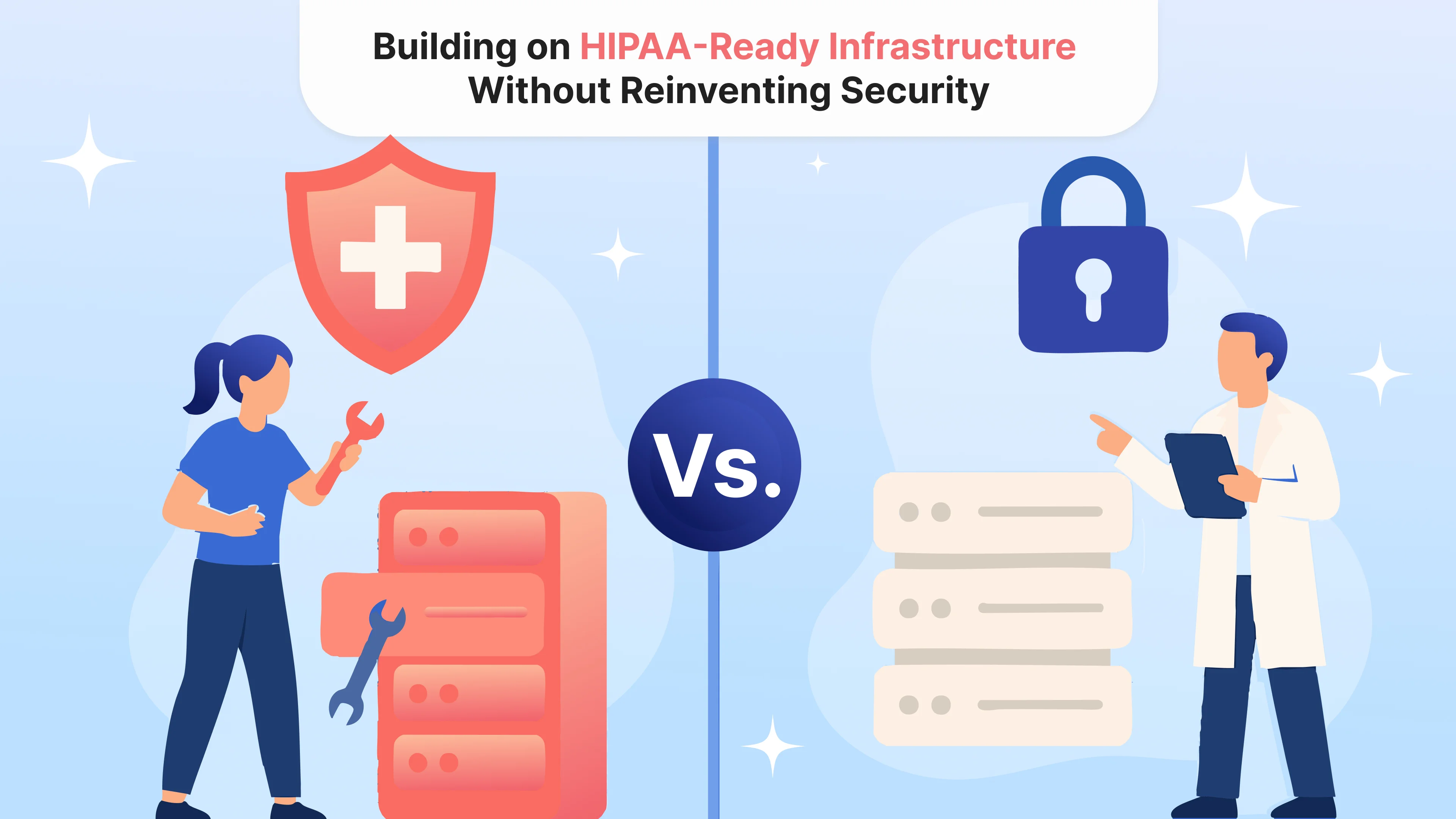
When teams start building a HIPAA-compliant product, they usually fall into one of two patterns. One of them keeps the team fast. The other slows everything to a crawl.
The first approach, the “slow” one, is trying to build everything yourself.
Teams design custom encryption layers, homegrown logging systems, their own permission models, and handcrafted audit trails. At first, this feels flexible and empowering. But as the product grows, every new feature means touching the security code. Every refactor risks breaking compliance. Every audit becomes a panic. Instead of focusing on the product, engineers spend months maintaining internal security plumbing. Agility evaporates.
The second approach, the “fast” one, is using mature, pre-built security components.
These aren’t tied to a single vendor. They can be open-source tools, widely adopted frameworks, or well-tested modules built to meet healthcare standards. They handle encryption, access control, logging, monitoring, and backups in a consistent, predictable way. Instead of writing your own crypto or building an audit system from scratch, you integrate existing components and configure them properly. This gives you reliability without the overhead of reinventing foundational security features.
The difference between the two approaches is night and day.
In the “DIY security” model, compliance becomes a never-ending engineering project. In the “use proven building blocks” model, compliance becomes an architectural choice that’s already 80% solved. Engineers get to work on the product, not the scaffolding. Compliance teams review configurations, not thousands of lines of custom logic. And audits go faster because the underlying components follow widely recognized security patterns.
The lesson is simple: you don’t keep speed by avoiding security - you keep speed by avoiding custom security. When the core protections are built on stable, well-understood components, the team moves faster, builds safer systems, and avoids the massive slowdowns that come with homegrown solutions.
Security isn’t a burden; it’s your product’s signal of maturity.

Tell us about your project
Fill out the form or contact us

Tell us about your project
Thank you
Your submission is received and we will contact you soon
Follow us