

Does Your Digital Health Product Actually Need AI? A Founder’s Checklist
- Why AI feature validation matters
- Checklist: does your digital health product need AI?
- 2. Is the workflow repetitive?
- 3. Is there a clear user?
- 4. What action should AI support?
- 5. Is the risk level manageable?
- 6. Do you have the right data?
- 7. Can humans stay in control?
- 8. Can you measure success?
- 9. Would a simpler solution work?
- 10. Is this feature part of the product strategy?
- When your startup probably does not need AI yet
- When AI may be worth building
- From AI idea to validated product decision
AI can make a digital health product more useful, scalable, and competitive. It can also become an expensive distraction.
For founders and product managers, the question is not whether AI sounds impressive. The question is whether it solves a real product, workflow, or user problem better than a simpler solution would.
Many digital health startups feel pressure to add AI because competitors are doing it, investors ask about it, or users expect smarter experiences. But adding AI without a clear use case can create more complexity than value: higher development costs, unclear product outcomes, compliance concerns, weak adoption, and features that look good in a demo but do not improve daily workflows.
So before asking, “How do we add AI?” founders should ask a more practical question: does my startup need AI for this problem at all?
This checklist can help validate an AI feature idea before investing in development.
Why AI feature validation matters
AI should not start as a technology decision. It should start as a product decision.
A good AI feature solves a specific bottleneck. It helps a user complete a task faster, helps staff reduce repetitive work, helps patients move through the product more clearly, or helps the business scale a workflow that is currently too manual.
A weak AI feature usually starts with a vague idea: “Let’s add a chatbot,” “Let’s personalize the experience,” or “Let’s build insights.” These ideas may become useful, but only if the team can explain what problem they solve, who they help, what output they produce, and how success will be measured.
For digital health AI startup teams, validation matters even more because healthcare products carry additional risks. A feature may touch sensitive data, patient communication, clinical context, care coordination, or regulated workflows. That means the team needs to define boundaries before development starts.
Checklist: does your digital health product need AI?
1. Is the problem specific enough?
AI works best when the problem is clearly defined.
“Improve engagement” is too broad. “Identify patients who completed onboarding but did not receive the next step” is much better.
“Automate support” is vague. “Classify non-clinical support requests and draft approved responses for staff review” is more actionable.
Before building, describe the problem in one sentence:
Our users/team struggle with ___ because ___, and this causes ___.
If that sentence is hard to write, the AI idea is probably not ready.
2. Is the workflow repetitive?
AI is most useful when it supports work that happens often.
A feature may be a good candidate if staff repeatedly review similar forms, answer the same questions, summarize similar notes, route similar requests, or check the same types of missing information.
If the workflow happens rarely, changes every time, or depends heavily on expert judgment, AI may not be the best first investment.
For founders exploring broader AI solutions for digital health, repetitive workflows are often the safest starting point because they are easier to test, measure, and improve.
3. Is there a clear user?
Every AI feature needs a clear primary user.
Is it for patients? Care coordinators? Providers? Coaches? Patient success teams? Support staff? Operations managers? Internal product teams?
If the user is unclear, the feature will likely become too broad. A patient-facing assistant, a provider copilot, and an operations tool all need different workflows, safeguards, and success metrics.
A strong AI feature usually has one main user and one main job.
4. What action should AI support?
AI should not only generate output. It should support a next action.
That action might be:
route a request;
summarize patient context;
flag missing information;
draft an administrative message;
classify a support ticket;
create a follow-up task;
prepare an intake summary;
surface a workflow bottleneck.
If the AI output does not lead to a useful action, the feature may become noise.
A good validation question is: what will the user do differently because of this AI feature?
5. Is the risk level manageable?
In digital health, not every AI idea has the same risk.
Low-risk use cases often involve administrative workflows: intake summaries, document classification, support triage, missing-form reminders, internal knowledge search, or task routing.
Higher-risk use cases may involve symptoms, medications, diagnosis, care recommendations, treatment decisions, medical necessity, mental health risk, or urgent concerns.
This does not mean high-risk AI is impossible. But it should not be treated like a simple feature. It needs stronger review, clinical oversight, escalation rules, audit trails, and compliance planning.
For many startups, the better first step is AI that supports staff behind the scenes rather than AI that directly advises patients.
6. Do you have the right data?
AI features depend on data quality.
A team may want predictive insights, but the product may not yet have enough consistent data. A startup may want personalization, but user behavior may still be too fragmented. A team may want automated summaries, but notes may be incomplete or stored across disconnected tools.
Before development, founders should ask:
Where does the data come from?
Is it structured, semi-structured, or unstructured?
Is it consistent enough?
Who can access it?
Does the AI need historical data or only current workflow data?
Are there privacy or consent constraints?
If the data is not ready, the first product investment may need to be data infrastructure, not an AI feature.
7. Can humans stay in control?
A useful AI feature should define where human review happens.
In healthcare, AI should not quietly make sensitive decisions. It should support people by preparing information, flagging uncertainty, drafting content, or routing tasks.
Before building, define what AI can do alone, what it can suggest, and what requires approval.
For example:
AI can classify a document, but staff review low-confidence cases.
AI can draft a follow-up message, but staff approve sensitive outreach.
AI can summarize a case, but clinicians make clinical decisions.
AI can flag missing information, but humans decide how to resolve it.
This makes the product safer and easier to trust.
8. Can you measure success?
AI feature validation should include measurable outcomes.
Depending on the use case, success may mean:
less manual review time;
faster onboarding;
fewer missed follow-ups;
lower support volume;
faster referral routing;
higher completion rates;
better staff productivity;
fewer repeated questions;
clearer workflow visibility.
If the team cannot define success, it will be hard to know whether the AI feature worked.
A good AI feature should have a before-and-after metric, even if the first version is small.
9. Would a simpler solution work?
This is one of the most important questions.
Not every problem needs AI. Some problems can be solved with better UX, clearer onboarding, improved forms, simple automation rules, better templates, or workflow redesign.
For example, if patients keep asking what happens next, the product may need clearer status updates before it needs an AI assistant. If staff copy data between systems, an integration may matter more than AI. If support receives the same question repeatedly, better in-product guidance may solve part of the issue.
AI should be used when it handles variation, context, language, classification, summarization, or decision support better than simpler automation.
10. Is this feature part of the product strategy?
Finally, the AI idea should fit the product roadmap.
A good AI feature should support the startup’s core product direction: better activation, better engagement, better care coordination, faster operations, stronger retention, or a more scalable service model.
If the feature does not support a strategic goal, it may become a distraction.
The best healthcare startup AI features are not added because AI is trending. They are built because they make the product work better.
When your startup probably does not need AI yet
Your digital health product may not need AI yet if:
the problem is not clearly defined;
the workflow is not repeated often;
the data is messy or unavailable;
the feature has no clear user;
the expected output does not support a real action;
a simple rule, template, or UX change would solve the issue;
the team cannot define how success will be measured;
the risk level is high, but review processes are not ready.
In these cases, building AI too early can slow the product down instead of making it stronger.
When AI may be worth building
AI may be worth building when the product has a repeated workflow, clear user need, available data, manageable risk, and measurable business or user value.
For digital health startups, strong early use cases often include:
intake review and summarization;
patient follow-up prioritization;
document classification;
support request triage;
care coordination summaries;
internal knowledge assistants;
operational reporting;
routing and escalation support.
These use cases are not always the flashiest. But they often solve real problems that founders, teams, and users feel every day.
From AI idea to validated product decision
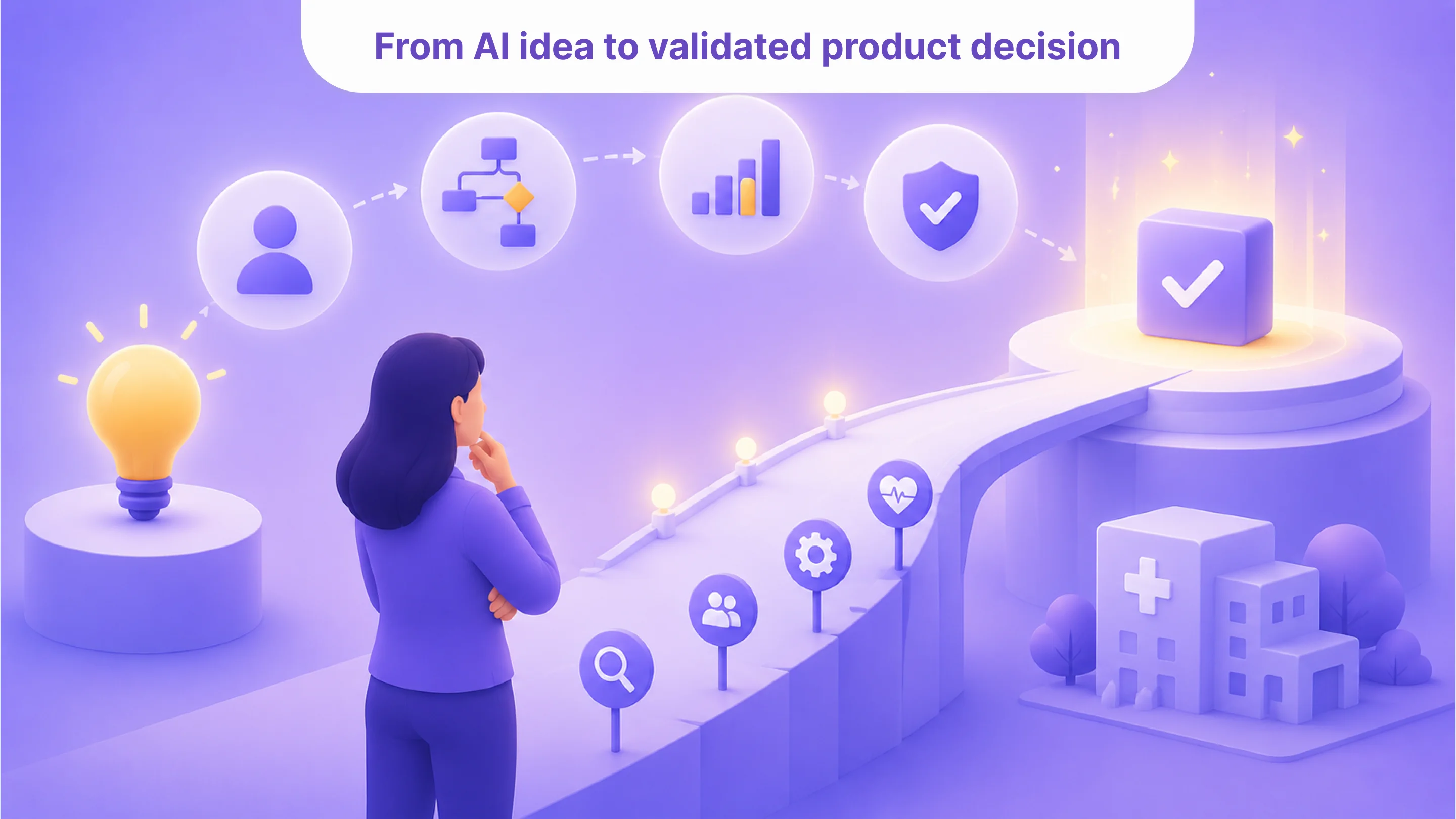
AI can be a strong advantage for digital health startups, but only when it solves the right problem.
Before investing in development, founders should validate whether the feature is specific, repeated, useful, measurable, and safe enough to build. They should also check whether a simpler solution would work first.
The best AI features do not start with a model. They start with a workflow bottleneck, a user need, and a clear reason why AI is the right tool.
For founders and product managers, the goal is not to add AI to the roadmap. It is to build a product that works better because AI is solving a real problem.
Faq
Does my startup need AI?
+Your startup may need AI if you have a repeated workflow, a clear user pain point, available data, manageable risk, and a measurable outcome. If the problem is vague or could be solved with simple automation or better UX, AI may not be the right first step.
How do I validate an AI feature idea?
+Start by defining the problem, user, workflow, expected output, risk level, available data, human review process, and success metric. A feature should not move into development until these are clear.
What are good first AI features for digital health startups
+Good first AI features often support intake, follow-ups, document classification, support triage, care coordination, internal knowledge search, or operational reporting. These use cases are usually more practical than broad patient-facing AI assistants.
Should digital health startups build patient-facing AI?
+Patient-facing AI can be valuable, but it often carries higher risk because patients may ask clinical or sensitive questions. Many startups should begin with internal or staff-facing AI where human review is easier to maintain.
What is AI feature validation?
+AI feature validation is the process of checking whether an AI idea solves a real problem, has a clear user, can be supported by available data, fits the roadmap, and can deliver measurable value before the team invests in development.
What should AI not do in a digital health product?
+AI should not independently diagnose, make clinical decisions, create care plans without review, handle urgent concerns without escalation, or replace qualified human judgment.

Tell us about your project
Fill out the form or contact us

Tell us about your project
Thank you
Your submission is received and we will contact you soon
Follow us