
From ChatGPT Prototype to Production AI Assistant: What Teams Miss
- Prototype vs Production: The Structural Differences
- What Teams Miss #1: Evaluation Is Not Benchmarking
- What Teams Miss #2: Guardrails Are Not Prompt Instructions
- What Teams Miss #3: Monitoring Is the Control Layer
- What Teams Miss #4: Escalation Is a Designed Control, Not a Fallback
- Prototype Proves Capability. Production Proves Control.
The Prototype Phase Is Not the Problem
The first version of an AI assistant is usually easy to build. A team connects to an LLM, designs several prompts, tests internally, and quickly demonstrates value. The assistant summarizes notes, drafts responses, or answers domain questions convincingly enough to move forward.
At this stage, the model performs well under controlled conditions. The demo works. Early users are impressed. The technical integration appears straightforward.
The Operational Gap Appears After Deployment
The real challenges begin once the assistant is exposed to real users and real workflows.
Unpredictable inputs surface. Outputs vary in tone and confidence. Edge cases emerge that were never part of internal testing. Logging is incomplete. There is no defined threshold for escalation. No one can clearly explain how performance is measured over time, how errors are categorized, or how model behavior is systematically improved.
The prototype works, but the operational system around it does not exist.
What Production AI Systems Actually Require
This is the gap between experimentation and production AI systems.
A prototype proves that a model can generate useful responses. A production system ensures those responses are reliable, observable, constrained, and continuously improved within defined architectural and governance boundaries.
That requires:
structured evaluation frameworks
layered AI guardrails
LLM monitoring and logging
defined human escalation pathways
ongoing improvement loops
Without these components, an AI assistant remains a feature powered by a model, not an operational capability.
For founders, product leaders, and CTOs, this distinction is strategic. Production AI systems are not integrations; they are long-lived systems that must be measurable, controllable, and aligned with risk tolerance and compliance requirements.
The difference is rarely in the model choice. It is in everything built around the model.
Prototype vs Production: The Structural Differences
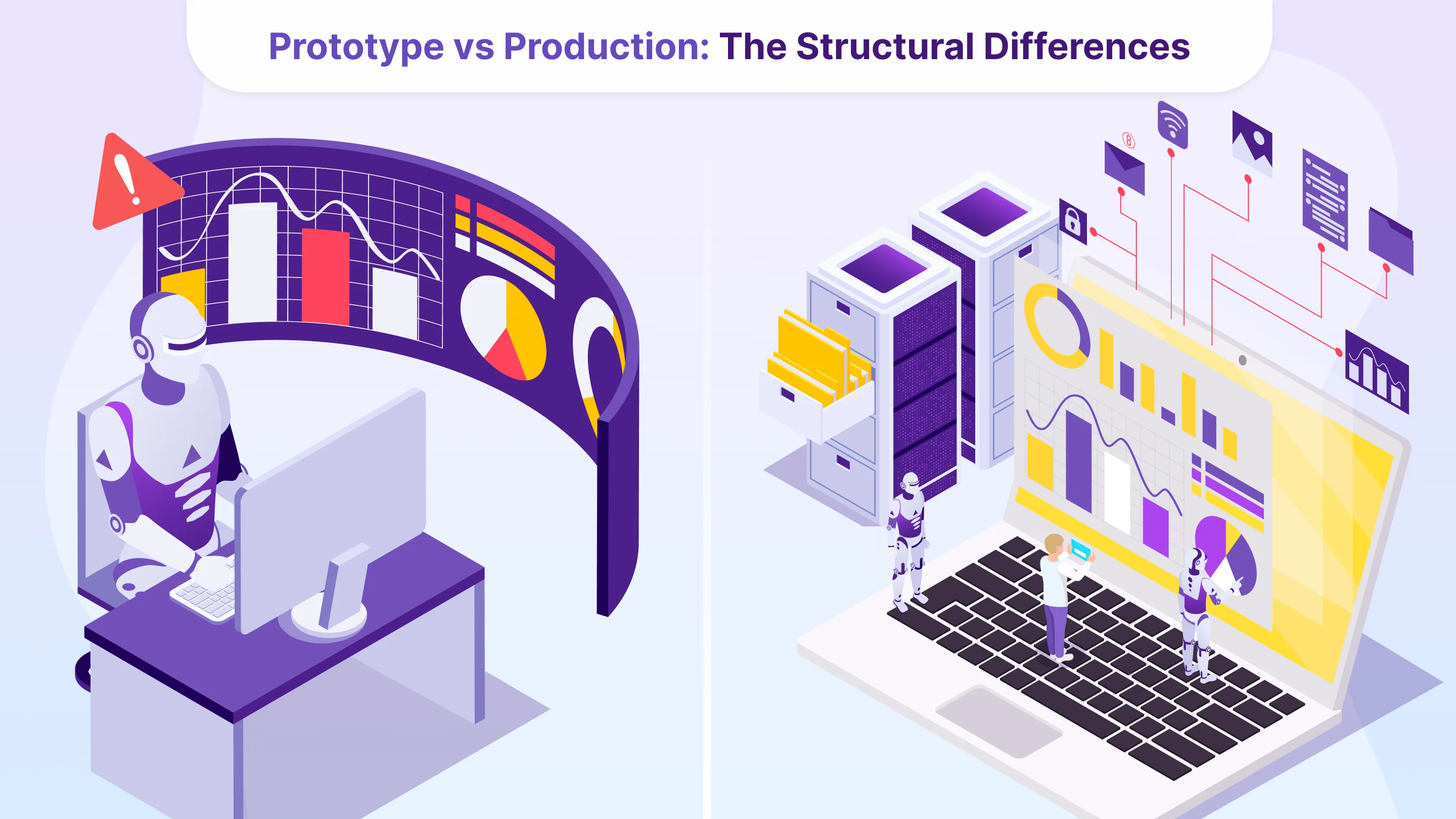
Most teams believe they are moving to production once the assistant is integrated into their product and exposed to users. In reality, they are often shipping an extended prototype.
The difference between a prototype and a production AI system is not scale. It is an operational structure.
Evaluation: From Manual Testing to Measurable Reliability
In prototype mode, evaluation is informal. Teams test prompts internally, try a few edge cases, and rely on subjective judgment. If responses look reasonable, the system is considered ready.
Production AI systems require structured evaluation tied to real workflows. Performance must be measured against defined scenarios, with clear criteria for success and failure. Updates must be tested before release to prevent silent degradation.
Without this discipline, teams cannot answer a critical question: Is the system improving or drifting? In healthcare, “mostly correct” is not enough. Reliability must reflect workflow risk, not just linguistic quality.
Guardrails: From Instructions to Enforcement
Early assistants rely on prompt instructions to control behavior. This assumes the model will consistently follow guidance.
In production, guardrails move into the architecture. Inputs must be scoped. Retrieval must be constrained. Outputs must be validated before reaching users. The system verifies behavior instead of trusting the model to self-regulate.
That shift from suggestion to enforcement defines maturity in production.
Monitoring: From Assumptions to Visibility
Prototypes operate with minimal visibility. If no one complains, the assistant appears stable.
Production AI systems require structured LLM monitoring that makes behavior measurable over time. Interactions must be observable, failure patterns identifiable, and drift detectable. Model behavior changes. User behavior changes faster. Without monitoring, degradation becomes visible only after it affects trust or compliance.
Escalation: From Ad Hoc Review to Designed Workflow
In prototype environments, human review happens reactively. In production systems, escalation is predefined. The assistant must know when to defer, and the review process must be traceable and integrated into improvement cycles.
Human oversight is not a fallback. It is a control layer.
Continuous Improvement: From Reactive Fixes to Managed Evolution
Prototypes evolve through quick adjustments. Production AI systems evolve through structured improvement loops. Failures are captured, changes are tested, and performance is re-measured.
Without this discipline, complexity increases while reliability does not.
What Teams Miss #1: Evaluation Is Not Benchmarking
When teams say they have evaluated their AI assistant, they usually mean internal testing or reviewing model benchmark scores. Neither is sufficient for production AI systems.
Benchmarks measure generalized capability. They do not reflect how your assistant behaves inside your product, with your users, under your constraints. A high public score says nothing about workflow risk, domain nuance, or the cost of being partially wrong.
Production AI systems require contextual evaluation. The assistant must be tested against realistic usage scenarios, with a clear definition of what “correct” means in that workflow. In healthcare, for example, a response can be factually accurate yet operationally unsafe if it omits context, signals false confidence, or fails to escalate.
Another common gap is the lack of regression discipline. Teams update prompts, retrieval logic, or model versions without re-testing historical failure cases. Over time, this creates silent degradation. Behavior shifts, and no one notices until users do.
Effective evaluation answers three operational questions: what defines correctness, how violations are detected, and how updates are verified before release. If these answers rely on intuition rather than evidence, the system is still a prototype.
In production AI systems, evaluation is not a launch milestone. It is an ongoing control mechanism. Without it, every deployment becomes an uncontrolled experiment.
What Teams Miss #2: Guardrails Are Not Prompt Instructions
One of the most persistent misconceptions in early AI builds is the belief that guardrails live inside the prompt.
Teams write careful instructions: do not provide medical advice, avoid definitive statements, defer when uncertain, cite sources. These instructions reduce obvious failures and create the impression of control. But they remain probabilistic. The model is still generating outputs based on learned patterns, not enforcing policy.
In production AI systems, guardrails cannot rely solely on model compliance. They must exist outside the model as enforceable layers.
The first layer concerns input boundaries. The system must define what kinds of requests are allowed to enter a particular workflow. If an assistant is designed for administrative triage, it should not be processing diagnostic reasoning queries. Scope control is not a prompt concern; it is a routing decision.
The second layer concerns context restriction. Retrieval mechanisms must be limited to authorized data sources. If the assistant can access broad or loosely filtered content, it increases the probability of irrelevant, outdated, or policy-violating outputs. Guardrails here are about constraining what the model can “see,” not merely instructing how it should behave.
The third layer concerns output validation. Before a response reaches a user, it may need to pass through checks for policy violations, disallowed claims, missing disclaimers, or confidence thresholds. In high-risk domains such as healthcare, this layer often determines whether the response is delivered directly or escalated for review.
This layered approach reflects a core shift in production AI systems: control is architectural, not instructional.
AI guardrails are not text constraints. They are system constraints. They define what the assistant is allowed to do, what it is allowed to access, and under what conditions it is allowed to respond autonomously.
Without these layers, teams are not enforcing safety; they are requesting it.
And requests are not controlled.
What Teams Miss #3: Monitoring Is the Control Layer
Many teams think monitoring begins when something goes wrong. In production AI systems, monitoring begins before deployment.
The core mistake is assuming that model quality is stable. It is not. Behavior shifts as user inputs change, as new workflows are introduced, and as model versions or retrieval configurations are updated. Even subtle prompt adjustments can alter tone, reasoning depth, or risk posture.
Monitoring exists to make those shifts visible.
Visibility Before Incident
In prototype mode, performance is inferred from the absence of complaints. In production, the absence of complaints proves nothing. Users adapt silently. They work around weak answers. They stop trusting certain flows. Degradation often accumulates before it becomes visible.
Production AI systems require structured visibility into real-world interactions. That visibility must make it possible to analyze patterns, detect anomalies, and identify categories of failure, not just review isolated examples.
If you cannot systematically review how the assistant behaves across hundreds or thousands of interactions, you are not operating a controlled system.
Defining Failure Explicitly
Monitoring only works when failure is defined. Hallucinations are one category, but they are not the only one. Overconfidence, incomplete reasoning, missed escalation triggers, policy boundary violations, these are operational failures even if the answer looks linguistically correct.
Without a shared internal definition of what constitutes unacceptable behavior, monitoring turns into log storage rather than risk control.
Production AI systems treat failure detection as an engineering responsibility, not a support afterthought.
Drift Is Inevitable
User behavior evolves. Prompts become more complex. Edge cases accumulate. Over time, the distribution of inputs shifts. If model updates are introduced, behavior may shift again.
Drift is not an exception. It is a property of deployed AI systems.
LLM monitoring must therefore support longitudinal analysis. The question is not whether the assistant works today. The question is whether its behavior is consistent with its defined boundaries over time.
If you cannot answer that with data, the system is operating on an assumption.
Monitoring Is Not Logging
Logging captures events. Monitoring interprets them.
Production AI systems require monitoring that supports categorization, trend analysis, and structured feedback into evaluation and improvement cycles. Without that loop, issues remain anecdotal, and prioritization becomes political rather than evidence-based.
Monitoring is the control layer that makes every other safeguard measurable.
Without it, you are trusting the model.
With it, you are operating a system.
What Teams Miss #4: Escalation Is a Designed Control, Not a Fallback
A clear sign that a team is still operating in prototype mode is the absence of a defined escalation strategy.
In early builds, escalation is informal. Someone reviews an output if it looks wrong or after a user complaint. That works at a small scale. It fails under real usage.
Production AI systems must define in advance when the assistant can act autonomously and when it must defer.
Uncertainty Must Be Operationalized
Models do not produce simply correct or incorrect answers. They generate outputs with varying levels of confidence and risk. A production system must translate that variability into rules.
Which types of queries require oversight?
What level of uncertainty triggers review?
Who owns that decision?
If these thresholds are not encoded into workflow logic, escalation depends on luck.
Escalation Protects Stability
Human-in-the-loop is often seen as a limitation. In reality, it stabilizes the system. It creates a buffer between model uncertainty and user-facing consequences.
In healthcare, this distinction is critical. An assistant may draft or suggest, but there must be clarity about which outputs require validation before action.
Effective escalation is not manual override. It is a structured workflow with ownership, traceability, and feedback into improvement cycles.
When embedded into architecture, escalation becomes a control mechanism, not an admission of model weakness.
Prototype Proves Capability. Production Proves Control.
Moving from a ChatGPT-powered prototype to a production AI system is not a model upgrade. It is an operational shift.
A prototype demonstrates that an LLM can generate useful outputs. A production system demonstrates that those outputs are measurable, constrained, observable, and aligned with defined risk boundaries.
Evaluation defines what “correct” means. Guardrails enforce scope. LLM monitoring provides visibility. Escalation protects against uncertainty. Continuous improvement ensures the system evolves without destabilizing.
When these layers are missing, teams are not running production AI systems. They are running experiments inside customer-facing products.
For founders, product leaders, and CTOs, the question is not whether the assistant works in a demo. The question is whether it can withstand real usage, real edge cases, and real accountability.
Production AI systems are not built by choosing the right model. They are built by designing everything around the model.
If you are moving from prototype to production, designing AI assistants in healthcare, or trying to stabilize an assistant that is already live, we can help. Our team supports the full transition to production AI systems, including evaluation design, AI guardrails implementation, LLM monitoring architecture, escalation workflows, and governance alignment.
If you need structured production AI rollout support, we are ready to work with your team.

Tell us about your project
Fill out the form or contact us

Tell us about your project
Thank you
Your submission is received and we will contact you soon
Follow us