
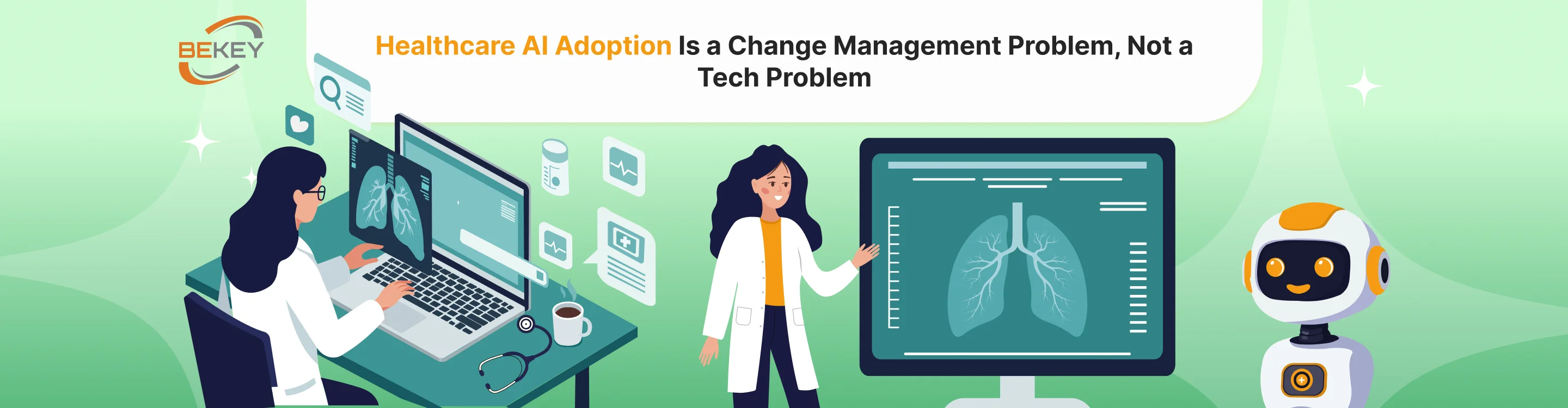
Healthcare AI Adoption Is a Change Management Problem, Not a Tech Problem
Many healthcare AI initiatives are evaluated as technology projects. Leadership asks whether the model performs accurately, whether the system integrates with existing infrastructure, and whether the pilot demonstrates measurable efficiency gains.
These questions matter. But they rarely determine whether the system will actually be used.
Across hospitals and health systems, the gap between successful pilots and sustained adoption is rarely caused by technical limitations. More often, the barrier is organizational. Staff are uncertain about how the new tool fits into their responsibilities. Incentives remain aligned with existing processes rather than new workflows. Leaders endorse the initiative publicly but do not actively reshape operational expectations around it.
In other words, the technology may work, while the organization remains unchanged.
Healthcare AI adoption, therefore, depends less on model sophistication and more on change management discipline. Introducing automation or decision support tools inevitably alters how work is distributed, how accountability is perceived, and how performance is evaluated. If these shifts are not addressed explicitly, even well-designed systems struggle to move beyond the pilot phase.
This article examines why AI change management in healthcare is often underestimated and what organizations must address to support real adoption: cultural alignment, incentive structures, and leadership ownership during AI rollouts.
Why AI Rollouts Fail Even When the Technology Works
Many healthcare AI initiatives reach a point where the system functions exactly as designed. The model produces accurate outputs, the interface integrates with existing systems, and early pilot users report measurable improvements. From a technical perspective, the project is successful.
Yet adoption still stalls.
This happens because introducing AI into clinical and operational environments inevitably changes how work is organized. Tasks shift between roles. Verification responsibilities move. Decision boundaries evolve. These changes are rarely neutral, and they are not always visible during the pilot phase.
If these shifts are not actively managed, staff often revert to familiar workflows. The new system may remain technically available, but it becomes peripheral rather than central to daily practice.
Cultural Resistance Is Often Structural
Resistance to AI tools in healthcare is frequently interpreted as skepticism toward technology. In reality, it often reflects uncertainty about professional expectations. Clinicians and operational staff are trained to prioritize reliability and accountability. When a new system appears to alter decision processes without clearly redefining responsibility, hesitation is rational.
Without explicit communication about how the tool should be used, when it should be trusted, and how errors will be handled, staff tend to rely on established practices. The system may be perceived as an additional layer of complexity rather than a support mechanism.
Pilots Do Not Reveal Organizational Friction
Pilot environments are typically controlled. Early adopters are engaged and motivated, leadership attention is close, and the scope of usage is limited. These conditions mask many of the organizational dynamics that emerge during broader rollout.
Once the system expands beyond the pilot group, differences in workflow, training levels, and departmental priorities become visible. What appeared seamless during testing may introduce coordination challenges in real clinical settings.
This is why AI change management healthcare initiatives must address organizational behavior as seriously as technical deployment. Without that focus, even well-performing systems struggle to become embedded in everyday work.
Incentives: When the Organization Rewards the Old Workflow
Even when healthcare teams understand the purpose of a new AI system, adoption can stall if the surrounding incentive structure remains unchanged.
In many organizations, performance is still measured according to the processes that existed before automation was introduced. Clinicians are evaluated on throughput, documentation completeness, or adherence to existing protocols. Operational teams are rewarded for maintaining stability and avoiding disruptions. When a new AI tool alters how tasks are performed, these incentives do not automatically adjust.
The result is a subtle but powerful contradiction. Leadership encourages staff to use the new system, yet the metrics that determine professional success continue to reflect the old workflow. In that environment, adopting the AI tool can feel risky rather than beneficial.
Staff quickly notice this mismatch. If using the assistant requires extra time to verify outputs, learn a new interface, or adapt established routines, but those efforts are not recognized in performance evaluation, the rational response is to revert to familiar methods. The tool may remain available, but it becomes secondary to the practices that the organization continues to reward.
Effective AI change management healthcare initiatives address this issue directly. Adoption cannot depend solely on training or communication. It requires aligning incentives with the new way of working. Metrics, expectations, and accountability structures must reflect the role that AI tools are intended to play in daily operations.
When incentives support the transition, staff are more willing to invest the effort required to integrate the system into their routines. When incentives remain tied to the old workflow, even strong technical solutions struggle to gain sustained use.
Leadership Ownership: AI Adoption Cannot Be Delegated
Even when culture and incentives are addressed, AI adoption in healthcare rarely succeeds without clear leadership ownership.
In many organizations, AI initiatives begin within innovation teams, digital strategy groups, or IT departments. These teams play an important role in identifying opportunities and coordinating implementation. However, long-term adoption depends on operational and clinical leadership, not on the teams that introduced the technology.
When AI rollouts remain positioned as “innovation projects,” staff tend to interpret them as temporary experiments rather than structural changes. The system may be interesting, but it does not redefine expectations. Without visible leadership engagement, it is easy for departments to treat the tool as optional.
Leadership involvement changes that dynamic. When clinical and operational leaders actively communicate how the AI system supports patient care, workflow stability, or staff capacity, the initiative becomes part of the organization’s operating model rather than an external initiative.
This responsibility extends beyond messaging. Leaders must clarify where the tool fits into decision-making processes, how its outputs should be interpreted, and how accountability is shared between human professionals and automated systems. These questions cannot be resolved through technical configuration alone.
AI change management in healthcare, therefore, requires leadership that treats adoption as an operational transformation rather than a technology rollout. The role of leadership is not only to approve the initiative but to shape the environment in which the system becomes part of everyday work.
AIdoption Is Organizational Change
Healthcare AI adoption rarely fails because the technology is incapable. More often, it fails because the organization around the technology does not evolve at the same pace.
When culture remains unchanged, staff hesitate to integrate new tools into their routines. When incentives continue to reward existing workflows, adopting AI can feel like an unnecessary risk. When leadership treats the rollout as a technical project rather than an operational shift, the system remains peripheral to everyday practice.
These dynamics explain why many healthcare AI initiatives stall after promising pilots. The model performs well, the infrastructure works, yet the system never becomes embedded in real workflows.
AI change management healthcare initiatives, therefore, require more than deployment planning. They require cultural alignment, incentive structures that reflect the new workflow, and leadership that actively integrates the system into operational expectations.
Organizations that approach AI in this way tend to see steadier adoption and fewer post-pilot reversals. The difference is not the sophistication of the technology, but the discipline with which the change is managed.
For a deeper look at how human-centered design supports sustainable AI adoption, explore our Human-Centered AI Automation in Healthcare pillar article.

Tell us about your project
Fill out the form or contact us

Tell us about your project
Thank you
Your submission is received and we will contact you soon
Follow us