
Healthcare, Legal, and Insurance Have the Same AI Automation Problem
- Why regulated industries struggle with AI automation
- The shared problem: 70% automation is not enough
- What healthcare can teach legal and insurance teams
- AI for legal operations: the same pattern
- AI insurance automation: the same pattern
- Where compliance automation AI usually helps first
- What should stay human-led
- How to map healthcare-grade automation patterns to your industry
- From industry-specific tools to regulated workflow design
Healthcare, legal, and insurance may look like very different industries. One deals with patients and providers. Another with contracts, cases, and legal review. The third deals with policies, claims, risk, and coverage decisions.
But operationally, they share the same AI automation problem.
Their workflows are document-heavy, rule-bound, sensitive, and full of exceptions. A task may look repetitive from the outside, but the next step often depends on context, review, permissions, and accountability.
That is why AI automation in regulated industries cannot be designed like simple task automation. It has to support speed without removing control.
For operations leaders outside healthcare, this matters because healthcare has already exposed many of the problems other regulated industries are now facing with AI: fragmented data, manual review, unclear handoffs, compliance boundaries, and the need to keep humans responsible for sensitive decisions.
Why regulated industries struggle with AI automation
In ordinary business automation, the goal is often simple: reduce manual work, move tasks faster, and save time.
In regulated industries, that is only part of the goal.
Healthcare, legal, and insurance teams also need to know:
what information was used;
who reviewed the case;
why something was routed or escalated;
whether required documentation was complete;
whether access rules were respected;
what action was taken;
what should remain human-led.
This makes automation harder. A system cannot simply complete a task and move on. It needs to preserve traceability, context, and accountability.
For example, a healthcare team may need to review a referral before scheduling. A legal operations team may need to route a contract clause to the right specialist. An insurance team may need to process a claims document while keeping coverage decisions human-led.
The industries are different, but the workflow challenge is similar.
The shared problem: 70% automation is not enough
Many regulated teams run into the same issue: AI can support part of the workflow, but the hardest steps still stay manual.
AI may summarize a document, but a person still has to decide where it goes. It may extract fields, but someone still checks whether the file is complete. It may draft a response, but staff still review sensitive language. It may classify a request, but exceptions still require human judgment.
This partial automation can help, but it does not always solve the operational bottleneck.
The remaining manual work often includes the most complex parts: exceptions, approvals, escalations, context gathering, and final decisions. If these steps are not designed into the workflow, teams end up with AI outputs that still require a second manual process.
That is the core AI automation problem in regulated industries: the technology can process information, but the workflow still needs logic, review, and control.
What healthcare can teach legal and insurance teams
Healthcare is a useful reference point because it combines high-volume operations with strict boundaries.
Healthcare teams process forms, referrals, medical records, insurance documents, claims attachments, consent forms, patient messages, and care coordination tasks. AI can help with many of these steps, but it cannot safely replace human review in clinical, compliance, or sensitive communication workflows.
This creates a pattern that legal and insurance teams can also use.
AI should prepare the work, not silently own the decision.
It can summarize a case, flag missing information, classify a document, draft a low-risk response, or route a task. But the final judgment should stay with the person or team accountable for the outcome.
For teams exploring AI automation for regulated industries, the most useful question is not “What can AI fully automate?” It is “Where can AI reduce manual preparation while keeping review in place?”
AI for legal operations: the same pattern
Legal operations teams manage documents, contracts, case files, intake requests, policy guidance, compliance reviews, and internal approvals.
AI for legal operations can help with:
contract summarization;
clause classification;
matter intake routing;
internal policy search;
document comparison;
deadline extraction;
review queue preparation;
legal operations reporting.
But legal teams face the same limit as healthcare teams: AI should not quietly replace expert judgment. It can help prepare a contract review, but it should not make final legal interpretations without human oversight. It can classify a clause, but legal professionals still need to decide what it means for negotiation, risk, or compliance.
The best use of AI in legal operations is not “automate the lawyer.” It is to reduce the manual preparation around legal work.
AI insurance automation: the same pattern
Insurance operations are also document-heavy and exception-heavy. Teams process claims, policy documents, customer communications, evidence files, medical records, repair estimates, fraud flags, and compliance documentation.
AI insurance automation can help with:
claims intake;
document classification;
missing information detection;
policy comparison support;
customer request triage;
fraud signal summarization;
claims follow-up tasks;
adjuster workflow support.
But coverage decisions, fraud determinations, liability questions, and sensitive customer outcomes require human accountability.
AI can make the claim easier to review. It can bring relevant information together, flag inconsistencies, and prepare the next action. But it should not become an invisible decision layer.
This is the same lesson healthcare teaches: AI creates value when it supports judgment, not when it hides it.
Where compliance automation AI usually helps first
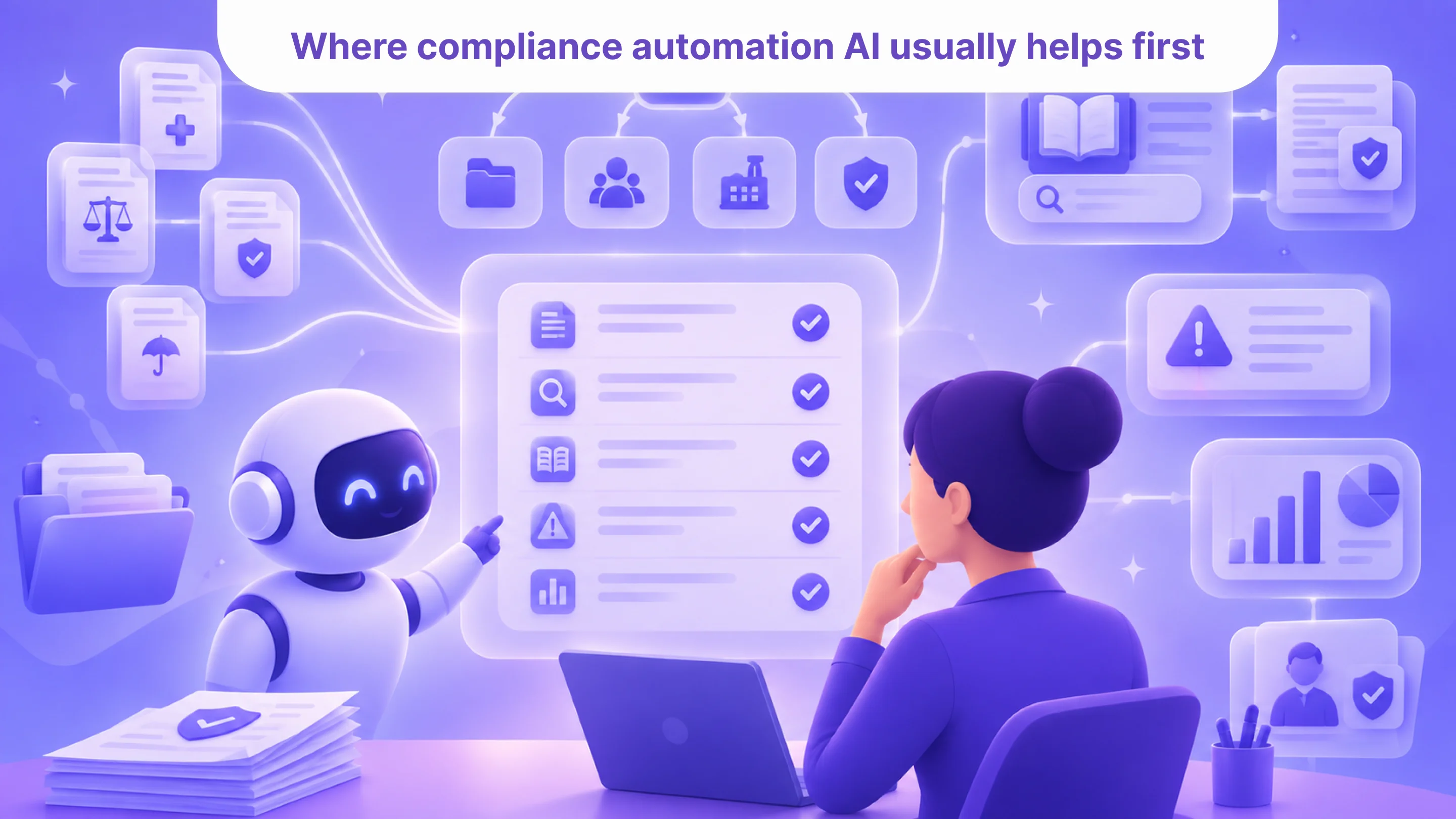
Across healthcare, legal, and insurance, the safest first automation opportunities often look similar.
Document-heavy workflows
AI can classify documents, extract key information, detect missing fields, summarize long files, and prepare review cases.
This applies to referrals, contracts, claims, policies, certificates, forms, case files, and supporting evidence.
Intake and triage
AI can help classify incoming requests and route them to the right team. This is useful for patient intake, legal matter intake, claims intake, customer support, and compliance requests.
The key is to route sensitive or unclear cases to human review.
Internal knowledge support
Regulated teams often rely on policies, SOPs, playbooks, guidelines, and internal rules. AI can help staff search approved sources and find relevant guidance faster.
This works best when answers include source references and access controls.
Exception detection
AI can flag incomplete documents, unusual patterns, conflicting information, missing approvals, urgent language, or cases that fall outside normal workflow logic.
This helps teams catch problems earlier instead of discovering them after delays.
Audit and reporting support
AI can help organize case history, summarize actions, and make bottlenecks visible. For regulated teams, this matters because workflows need to be traceable, not just faster.
What should stay human-led
The most important rule for AI automation in regulated industries is knowing what not to automate fully.
Human review should remain central for:
clinical decisions;
legal interpretation;
coverage decisions;
fraud determinations;
financial approvals;
compliance sign-off;
employment decisions;
high-risk customer or patient communication;
urgent or sensitive escalations.
AI can support these workflows, but it should not quietly own them.
A safe automation model defines what AI can do independently, what it can suggest, what needs approval, and what must be escalated.
How to map healthcare-grade automation patterns to your industry
Operations leaders outside healthcare can use healthcare as a practical model.
Start by mapping the workflow, not the tool. Look at where information enters, which documents or messages are involved, who reviews them, what rules apply, where exceptions happen, and what needs to be logged.
Then identify which healthcare-grade automation patterns apply:
document classification;
missing information detection;
human-in-the-loop review;
role-based access;
escalation rules;
source-based summaries;
audit trails;
workflow dashboards;
task routing;
exception queues.
The goal is not to copy healthcare workflows exactly. The goal is to copy the operating principle: automate preparation, preserve accountability.
From industry-specific tools to regulated workflow design
Healthcare, legal, and insurance do not have identical operations. But they share the same automation constraint: AI must work inside rules, documentation, review, and accountability.
That is why regulated industries need more than generic automation. They need workflows designed around control.
AI can reduce manual effort, summarize documents, route tasks, flag missing information, and make bottlenecks easier to see. But it should not erase the human responsibility behind sensitive decisions.
For operations leaders, the better question is not “Can AI automate this process?” It is: “Which parts of this process can AI prepare, organize, or accelerate while keeping the right people in control?”
That is where AI automation for regulated industries becomes useful and safe.
Faq
What is AI automation for regulated industries?
+AI automation for regulated industries means using AI to support workflows that involve sensitive data, documentation, approvals, audit trails, rules, and human accountability. It is common in healthcare, legal, insurance, fintech, logistics, education, and HR/compliance teams.
Why do healthcare, legal, and insurance have similar AI automation problems?
+They all deal with document-heavy workflows, sensitive information, exceptions, review requirements, and decisions that must remain accountable. AI can help prepare the work, but many final decisions still need human review.
How can AI support legal operations?
+AI can help legal operations teams summarize contracts, classify clauses, route matter intake, search internal policies, extract deadlines, compare documents, and prepare review queues.
How can AI support insurance operations?
+AI can help insurance teams classify claims documents, detect missing information, summarize evidence, triage customer requests, support fraud review, and prepare claims follow-up tasks.
What should not be fully automated in regulated industries?
+Final clinical, legal, coverage, fraud, financial, employment, and compliance decisions should usually remain human-led. AI should support review, not replace accountable decision-makers.
How can operations leaders choose safe AI use cases?
+They should look for workflows that are repetitive, document-heavy, rule-based, measurable, and safe to support with human review. Good first use cases often include document processing, intake triage, knowledge search, exception detection, and reporting.

Tell us about your project
Fill out the form or contact us

Tell us about your project
Thank you
Your submission is received and we will contact you soon
Follow us