
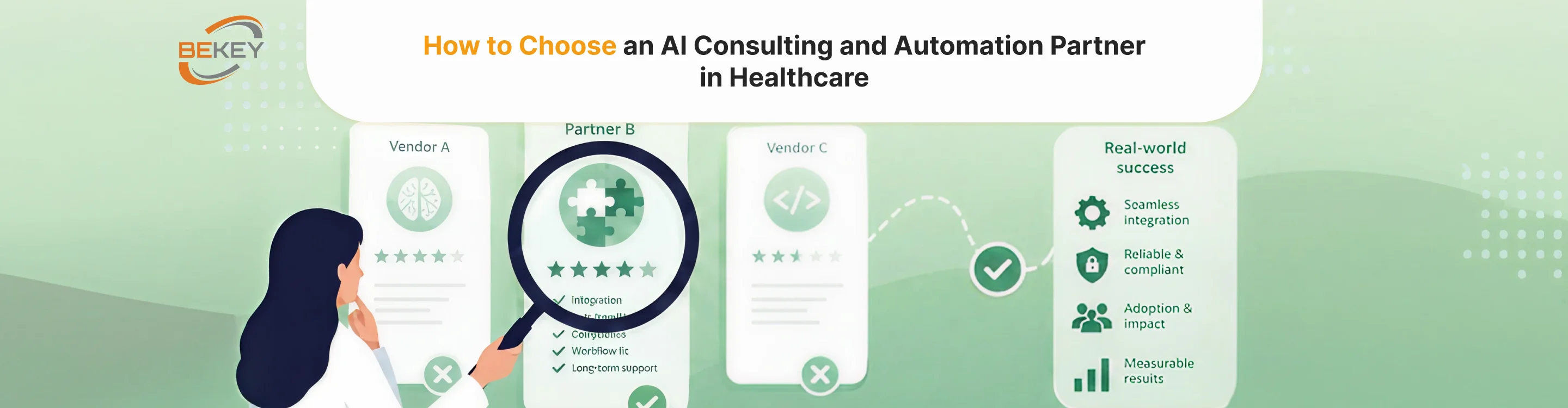
How to Choose an AI Consulting and Automation Partner in Healthcare
Choosing an AI partner in healthcare is less about technology than it looks.
Most vendors can demonstrate working models, show case studies, and speak confidently about automation, assistants, or analytics. At a surface level, many of them look interchangeable. The differences only become visible once work begins.
Some partners can translate use cases into systems that fit real workflows. Others produce prototypes that look convincing but never fully integrate. In some cases, the issue is technical. More often, it comes down to how well the partner understands constraints - data quality, compliance requirements, operational complexity, and the effort required to make something usable in production.
For non-technical buyers, this makes evaluation difficult. The signals are not always obvious, and the risks tend to appear later in the process.
This article outlines how to approach that decision more deliberately, what to look for, what to question, and what usually indicates that a project will struggle long before it is delivered.
Why Most AI Vendors Look Similar at First
At the early stage, most healthcare AI vendors present in a similar way.
They show demos that work under controlled conditions, highlight a set of use cases, and describe how their approach can be adapted to different workflows. From a non-technical perspective, it is difficult to distinguish between teams that can deliver production systems and those that are primarily strong at prototyping.
The demo problem
Demos are designed to remove friction. They use clean data, simplified scenarios, and pre-defined flows. This is useful for illustrating capability, but it hides the complexity that will appear during implementation.
The risk is not that the demo is misleading, but that it does not reflect the conditions under which the system will actually operate.
Case studies without context
Case studies often show outcomes without showing constraints. It is rarely clear what level of customization was required, how long integration took, or how much internal effort was needed to make the system usable.
Without that context, results are difficult to interpret.
Where the real differences appear
In practice, vendors start to diverge once they are asked to work with real data, real systems, and existing workflows. This is where integration effort, data handling, and operational understanding begin to matter more than model capability.
What Actually Differentiates a Good Partner
Strong AI partners tend to approach problems differently from the start.
They spend less time describing what the technology can do in general and more time understanding how a specific workflow operates, where constraints exist, and what trade-offs will be required.
Workflow-first thinking
Instead of starting with a model, they start with the process. Where does the system fit? What step does it replace or simplify? What happens if the output is incorrect?
This often leads to narrower, more focused implementations, but ones that are more likely to be adopted.
Realistic scoping
Good partners are explicit about limitations. They clarify what can be delivered in the first phase, what depends on data quality, and what may require additional integration work.
This tends to reduce early excitement, but it prevents larger issues later.
Integration as a core capability
In healthcare environments, integration is not a secondary concern. It is the main part of the work.
Partners that understand this treat integration with EHRs, CRMs, and internal systems as part of the product, not as an afterthought.
Red Flags to Watch Early
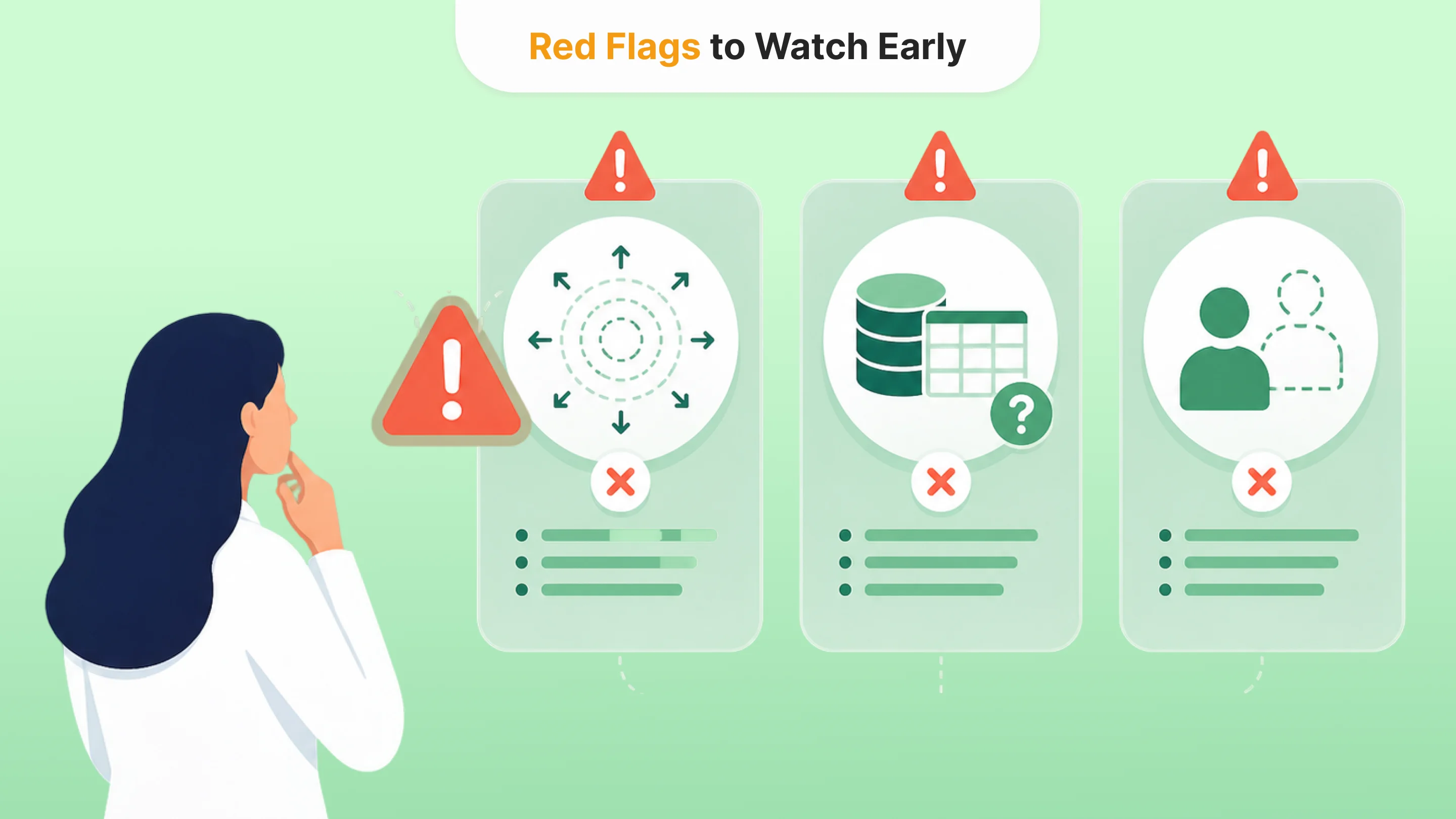
Certain issues tend to appear early, even if they are not immediately obvious.
One of the most common is overly broad positioning. When a vendor presents their solution as widely applicable without clearly defined boundaries, it usually means the complexity of real-world adaptation is underestimated. In practice, most AI systems only work reliably when they are tightly scoped. If everything sounds possible, it is often a sign that the hard trade-offs have not been addressed yet.
Another signal is how data requirements are discussed. Strong teams tend to be specific; they ask about formats, consistency, access, and edge cases early in the conversation. When answers remain high-level or assume that “data can be cleaned later,” it often leads to delays during implementation. In healthcare, data is rarely clean or complete, and treating it as such creates avoidable risk.
A third issue is the lack of a clear ownership model after deployment. AI systems do not remain static once they are in use. Outputs need to be reviewed, edge cases handled, and adjustments made over time. If it is unclear who is responsible for this, on either side, the system may work initially but degrade in reliability.
None of these problems is necessarily visible in a demo. They tend to surface only once real constraints are introduced, which is why it is important to look for them early.
Questions Worth Asking Before You Commit
At this stage, the goal is not to validate every technical detail, but to understand how the partner thinks about implementation.
Questions about workflows are often more revealing than questions about models. A useful starting point is asking how the system fits into an existing process and what, if anything, needs to change on the client side. If the answer assumes a clean insertion without adjustments, it is usually incomplete. Most implementations require at least some redesign of how work is done.
Data-related questions should move quickly from general to specific. Where does the data come from? How consistent is it across cases? What happens when it is incomplete? How is it validated before being used? The way these questions are handled often indicates whether the team has dealt with real-world variability before.
It is also important to ask how performance is evaluated. Accuracy in isolation is rarely enough. What matters is how the system behaves in context, how often outputs need correction, how errors are handled, and whether the system actually reduces effort. Vague answers here usually suggest that evaluation has been limited to controlled scenarios.
Finally, ownership after deployment should be clearly defined. Who monitors outputs? Who handles updates? How are changes in requirements managed? These are not secondary concerns; they determine whether the system remains usable over time.
Aligning Scope, Expectations, and Risk
Many AI projects in healthcare fail not because the idea is wrong, but because expectations are misaligned from the beginning.
A common pattern is starting with a use case that is too broad. It may be conceptually sound, but difficult to implement in a single step. Narrowing the scope early, even if it feels conservative, makes it easier to validate assumptions and adjust based on real feedback.
Another issue is defining success at the wrong level. Model performance metrics can look strong while the overall workflow remains unchanged. What matters is whether the system reduces time, improves accuracy in context, or measurably simplifies a process. Without that link, it is difficult to justify further investment.
There is also a tendency to treat the first phase as a delivery milestone rather than a validation step. In practice, early implementations should confirm that the system fits the workflow, that data assumptions hold, and that outputs can be trusted. Scaling makes sense only after these points are clear.
Choosing a Partner That Can Deliver
In the end, selecting a healthcare AI consulting company is less about identifying the most advanced solution and more about understanding how a team works under real constraints.
Vendors tend to look similar at the beginning because they are evaluated on capability. They become different once the focus shifts to integration, data, and ongoing use. That is where most of the work happens, and where most of the risk sits.
If you are evaluating potential partners and want a more structured way to assess fit, our partner evaluation call helps clarify scope, risks, and realistic next steps before committing to a project.

Tell us about your project
Fill out the form or contact us

Tell us about your project
Thank you
Your submission is received and we will contact you soon
Follow us