
Internal AI Assistants for Healthcare Teams: The Use Case Nobody Talks About Enough
- Why internal AI assistants deserve more attention
- What can an internal AI assistant do?
- What changes for healthcare staff
- Why is this safer than many patient-facing AI use cases
- What a good internal AI assistant needs
- When an internal AI assistant makes sense
- How BeKey Can Help Healthcare Teams Implement Internal AI Assistants
- Conclusion
When healthcare companies talk about AI assistants, the conversation usually goes straight to patients. Patient-facing chatbots, symptom checkers, virtual front desks, and clinical copilots tend to get most of the attention.
But for many healthcare organizations, the safer and more practical first AI assistant may not face patients at all.
It may be an internal AI assistant built for staff: a tool that helps teams find policies, search SOPs, answer administrative questions, support onboarding, summarize meetings, route IT issues, and create internal reports faster.
This use case rarely sounds as exciting as clinical AI. But it often solves a problem healthcare teams feel every day: too much operational knowledge is scattered across documents, tools, Slack threads, emails, spreadsheets, and people’s heads. Staff waste time looking for answers, repeating the same explanations, asking managers for guidance, and switching between systems to complete simple tasks.
An internal AI assistant for healthcare can reduce that friction without taking over clinical decisions or communicating directly with patients. That makes it a strong starting point for organizations that want practical AI automation with lower risk and clearer internal value.
Why internal AI assistants deserve more attention
Healthcare teams often carry a large amount of hidden administrative knowledge. Policies, workflows, compliance rules, onboarding materials, SOPs, IT instructions, HR documents, billing guidelines, and internal process notes may all exist somewhere. The problem is that staff do not always know where to find them.
A new employee may ask how to handle a specific intake exception. A coordinator may need to check the latest scheduling rule. A support specialist may search for approved language for a billing-related question. A compliance team may receive the same policy question again and again. A manager may spend time explaining internal procedures that should already be documented.
None of this looks like a major workflow failure. But across a growing healthcare company, repeated internal questions create a real productivity drain.
An internal knowledge assistant helps by giving staff a faster way to access approved internal information. Instead of searching through folders or interrupting another team member, employees can ask a question and receive a structured answer based on company documentation.
This does not mean the assistant should invent answers or replace leadership judgment. A well-designed healthcare staff AI assistant should retrieve, summarize, and explain approved information, and clearly show when a human should confirm the answer.
What can an internal AI assistant do?
An internal AI assistant for healthcare is not one single feature. It can support several operational use cases depending on the team’s needs, documents, and risk profile.
Internal policy Q&A
Policy questions are one of the most natural use cases. Staff may need quick answers about PTO, incident reporting, data handling, patient communication rules, escalation policies, or internal procedures.
Instead of searching through long documents, employees can ask the assistant a question and receive a concise answer based on approved policy sources. The assistant can also point to the original document or section so the employee can verify the information.
For HR, compliance, and admin teams, this can reduce repeated questions and make policy access more consistent.
SOP search
Standard operating procedures are useful only if people can actually find and follow them. In many healthcare companies, SOPs exist, but they are buried in shared folders, outdated documents, or internal knowledge bases that are difficult to search.
An AI assistant for operations teams can help staff locate the appropriate SOP, summarize the relevant steps, and identify next steps. This is especially useful for recurring workflows such as patient intake, claims follow-up, document review, internal escalation, support routing, and onboarding.
The value is not simply faster search. It is reducing the gap between the documented process and daily execution.
Onboarding support
New employees often depend on managers and experienced team members to learn how work actually happens. Even with onboarding documents, the first few weeks can involve many repeated questions: where to find a template, how to handle a specific request, which tool to use, what a certain status means, or when to escalate a case.
A healthcare staff AI assistant can support onboarding by answering common questions, explaining workflows, linking to relevant materials, and helping new hires understand internal processes faster.
This does not replace human onboarding. It gives new employees a reliable first place to look before interrupting someone else.
Compliance guidance
Compliance teams often answer repeated questions about documentation, access, privacy, data handling, and communication rules. In healthcare, these questions matter because small misunderstandings can create operational and regulatory risk.
An internal AI assistant can help by making approved compliance guidance easier to access. For example, staff can ask whether a certain type of information should be shared through a specific channel, where to find a policy, or what the escalation process is for a suspected incident.
The assistant should not give legal advice or make final compliance decisions. It should provide guidance from approved internal sources and route uncertain or sensitive questions to the appropriate human owner.
IT and helpdesk routing
Many internal support requests are repetitive: password issues, tool access, device problems, software permissions, onboarding setup, or questions about where to report a technical issue.
An internal AI assistant can help employees find troubleshooting steps, collect required details, and route issues to the right IT or helpdesk queue. This reduces noise for support teams and helps staff get faster answers for common problems.
For growing healthcare organizations, this can be especially useful when operations, product, clinical, and admin teams all use different tools.
HR and admin questions
HR and admin teams often receive the same questions about benefits, time off, internal processes, payroll timelines, expenses, equipment, training, or company policies.
An internal assistant can answer routine questions using approved HR documents and admin policies. It can also help employees find forms, understand process steps, and know who to contact when a question requires human support.
This makes internal operations feel more organized and reduces repetitive work for HR and admin leaders.
Meeting summaries and internal reports
Healthcare operations generate a lot of internal communication: team meetings, project updates, compliance discussions, operational reviews, and cross-functional planning. Important decisions can get lost in notes, recordings, chats, or follow-up emails.
An internal AI assistant can summarize meeting notes, extract action items, organize decisions, and help create short internal reports. It can also help managers turn scattered updates into clearer summaries for leadership.
This is not about replacing management. It is about reducing the manual work around documentation and follow-up.
What changes for healthcare staff
The biggest change is that staff no longer need to treat people as the main search engine for internal knowledge.
In a manual environment, employees often ask the same questions repeatedly because information is difficult to find or interpret. Experienced staff members become bottlenecks. Managers spend time answering process questions instead of improving processes. New employees take longer to become independent.
With an internal AI assistant, staff can get faster access to approved information and spend less time searching, waiting, or interrupting colleagues.
This can improve productivity in several ways:
faster answers to routine operational questions;
less repeated work for managers, HR, compliance, and admin teams;
smoother onboarding for new employees;
more consistent use of SOPs and policies;
better internal visibility into recurring questions;
fewer delays caused by unclear ownership or missing information.
The assistant does not need to solve every problem to create value. Even if it only handles routine internal questions and document search, it can reduce friction across multiple departments.
Why is this safer than many patient-facing AI use cases
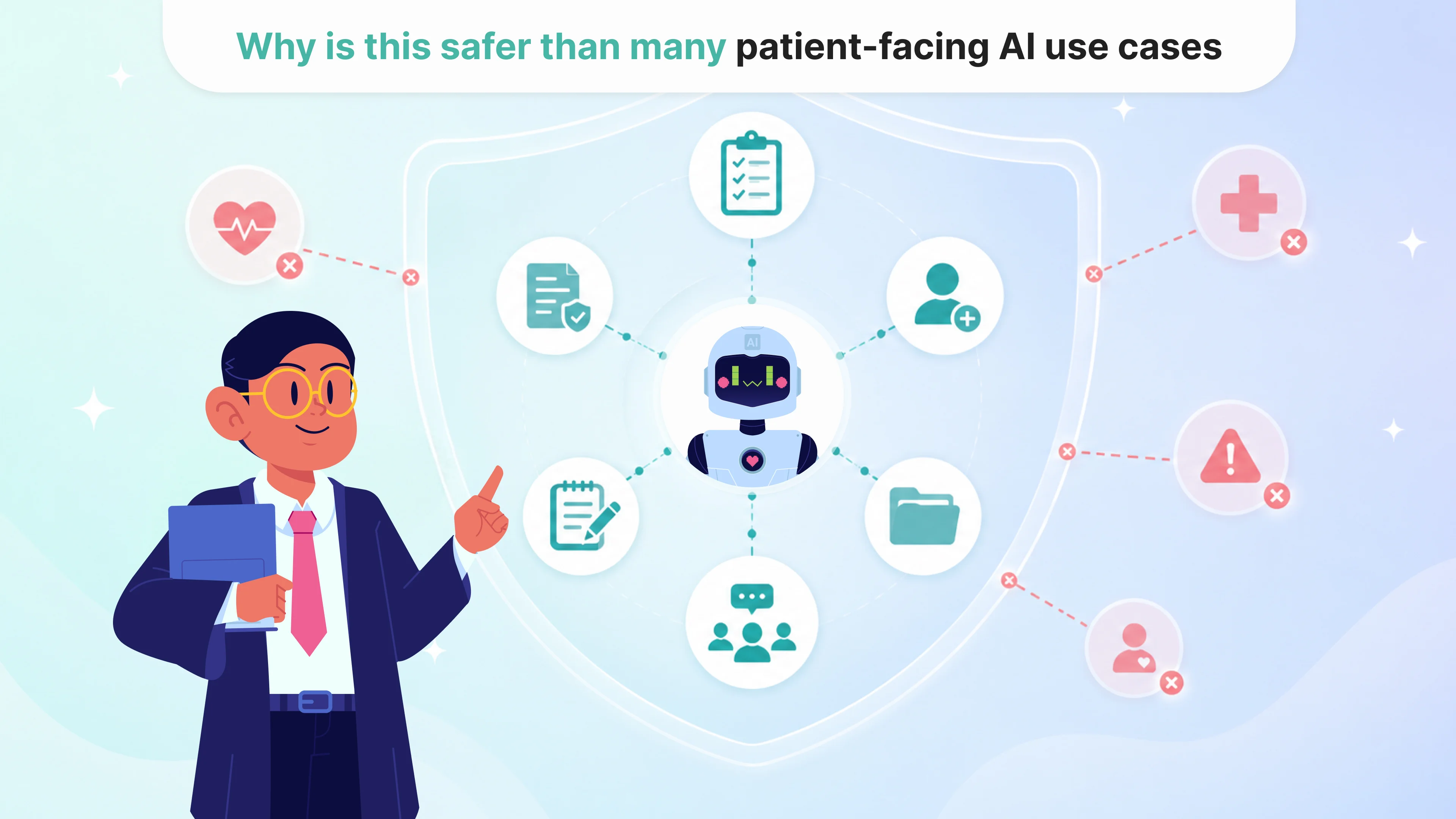
Many healthcare companies want to build patient-facing AI tools first because they are more visible. But patient-facing AI often carries a higher risk. It may involve sensitive communication, clinical concerns, urgent symptoms, emotional context, or expectations of medical guidance.
Internal AI assistants are different. They can start with lower-risk workflows, such as policy search, SOP support, onboarding, internal routing, meeting summaries, and admin questions. These use cases still require careful design, especially if the assistant has access to sensitive information, but they usually avoid direct patient communication and clinical decision-making.
This makes internal assistants a practical first step for healthcare AI adoption.
They help teams learn how to use AI safely inside the organization before exposing AI to patients or clinical workflows. They also create immediate value for staff, which can improve adoption and trust.
What a good internal AI assistant needs
A useful internal AI assistant is not just a chatbot connected to a pile of documents. It needs structure, permissions, and clear boundaries.
First, the assistant should use approved sources. If policies, SOPs, onboarding guides, or compliance documents are outdated, the assistant will only make the problem more visible. Before implementation, teams should review which sources are reliable and who owns them.
Second, the assistant should show where answers come from. Staff need to know whether the response is based on an official policy, an SOP, a help article, or another internal document. Source visibility builds trust and makes verification easier.
Third, access control matters. Not every employee should see every document. A healthcare staff AI assistant may need different permissions for HR, compliance, operations, clinical, product, and admin teams.
Fourth, the assistant needs escalation rules. If a question involves legal risk, compliance uncertainty, sensitive employee information, patient data, or anything outside the assistant’s approved scope, it should route the user to a human owner.
Finally, teams need a feedback loop. If employees frequently ask questions that the assistant cannot answer, that may reveal missing documentation, unclear policies, or broken processes.
When an internal AI assistant makes sense
An internal AI assistant is worth considering when the same operational questions keep appearing across the organization.
Your healthcare team may be ready if:
Staff ask the same policy or process questions repeatedly;
SOPs exist but are hard to find or follow;
Onboarding depends heavily on managers or experienced employees;
HR, admin, IT, or compliance teams handle repetitive internal requests;
meeting notes and action items are often scattered;
Employees use several tools, but still cannot find the right information quickly;
Managers do not know which internal questions create the most friction.
These signs usually mean the company does not only need better documentation. It needs a better way to access and use that documentation in daily work.
How BeKey Can Help Healthcare Teams Implement Internal AI Assistants
For BeKey, internal AI assistants are a strong example of practical, workflow-first AI automation. The value is not in adding another chatbot. The value is in helping healthcare teams reduce repetitive internal work, improve access to knowledge, and make operations easier to scale.
A good implementation starts with discovery. Which teams ask the most repeated questions? Which documents should the assistant use? Which sources are approved? What information is sensitive? Who should access what? Which questions require escalation? How will success be measured?
From there, BeKey can help design and build an internal assistant that fits the organization’s actual workflow. This may include document indexing, retrieval-augmented generation, role-based access, integrations with internal tools, approved answer templates, feedback loops, and human escalation paths.
The goal is not to replace managers, HR teams, compliance specialists, or operations leaders. The goal is to reduce the repetitive knowledge work that keeps them from focusing on higher-value decisions.
Conclusion
Internal AI assistants may not be the loudest healthcare AI use case, but they can be one of the most practical. They help healthcare teams solve a daily problem: internal knowledge is scattered, repeated questions consume time, and staff often wait for answers that should be easier to find.
Unlike many patient-facing AI tools, internal assistants can start with lower-risk workflows and create value inside the organization first. They can support policy Q&A, SOP search, onboarding, compliance guidance, IT routing, HR questions, meeting summaries, and internal reporting.
For operations leaders, HR/admin leaders, and compliance teams, the question is not whether AI should talk to patients. A better first question may be: could AI help our staff find the right information faster and reduce the repetitive questions slowing everyone down?
That is where internal AI assistants can create real operational value.
Not sure where an internal AI assistant could help your team first?
BeKey’s team is ready to help and identify repeated questions, scattered knowledge sources, onboarding gaps, compliance support needs, and safe internal workflows for AI-assisted automation.

Tell us about your project
Fill out the form or contact us

Tell us about your project
Thank you
Your submission is received and we will contact you soon
Follow us