
Mobile Apps for Tracking Longevity Biomarkers and Promoting Healthy Behaviors
The pursuit of extending not just lifespan but healthspan has become more tangible thanks to the rise of mobile technologies. These apps are transcending the era of simple step counters or calorie diaries, evolving into sophisticated platforms that capture and interpret longevity biomarkersм - indicators such as biological age, organ-specific aging rates, and resilience to stress.
A striking recent development illustrates this shift: researchers at the University of Washington School of Medicine unveiled the Health Octo Tool, dubbed the "body clock," designed to more holistically gauge biological aging and mortality risk. Published in Nature Communications in May 2025, this tool processes eight clinical and blood metrics to estimate both overall and organ-specific aging, including metrics like Speed-Body Clock (gait speed) and Disability-Body Age (cognitive and physical decline). Remarkably, it promises over 90% accuracy in predicting age-related functional decline or mortality. The team even plans a future mobile app version that lets users track their body's aging trends and responses to lifestyle changes in real time.
This example showcases how media-covered scientific breakthroughs are driving a paradigm shift: mobile apps are becoming not just behavior trackers but accessible platforms for insightful, personalized longevity feedback. They carry the promise of turning clinical-grade assessments into everyday health companions if navigated carefully amid the blurred lines between innovation and oversimplification.
From Step Counters to Biomarker Ecosystems
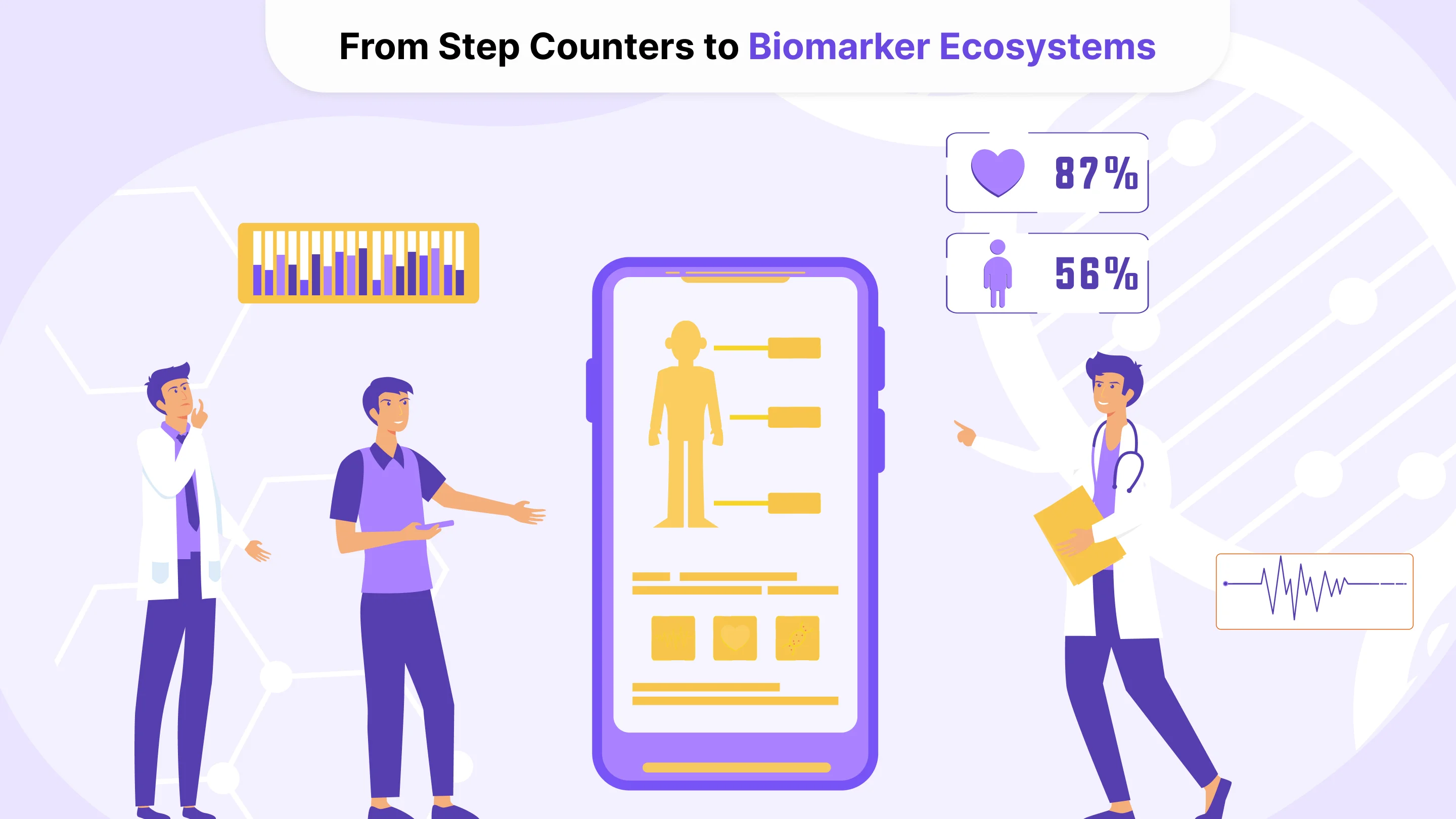
The earliest generation of health apps focused on surface-level data: counting steps, logging meals, and tracking hours of sleep. These functions were motivational but often failed to capture the deeper biological mechanisms behind health and aging. Today, however, apps are integrating with wearables, continuous monitors, and even lab results to create what might be called biomarker ecosystems.
Consider how metrics like heart rate variability, blood glucose, cortisol levels, or inflammatory markers are increasingly accessible outside clinical settings. By embedding these data points into user-friendly mobile platforms, developers are shifting from descriptive tracking to predictive modeling. This means users are no longer just seeing what happened yesterday; they are gaining insights into what might happen tomorrow if certain patterns persist.
Yet this evolution raises critical questions. Do these digital snapshots of longevity truly reflect complex biological aging, or do they risk oversimplifying it for mass consumption? Scientific validation remains uneven: while some measures like glucose variability or resting heart rate are well established, others, such as "biological age" scores, are still experimental. The power of these apps lies not only in data collection but also in how responsibly they translate science into everyday decisions.
Evolution of Evidence: From Digital Biomarkers to Predictive Health Insights
The rise of mobile platforms today empowers users not just to collect data, but to interpret it meaningfully. Digital biomarkers - measurable physiological signals like heart rate variability, sleep patterns, or stress indicators - are now central to many mHealth applications. These allow mobile tools to become more than just trackers; they can offer predictive modeling and actionable insights.
One compelling example is the cStress model, which aggregates real-time data, such as heart rate, heart rate variability, and interbeat intervals, to estimate stress levels in minute-by-minute windows. Built using MD2K’s Cerebral Cortex big-data infrastructure, this approach illustrates how mobile diagnostics can move toward dynamic, context-aware wellness monitoring.
Yet, the concept of measuring aging goes even deeper. Research in deep aging clocks, leveraging machine learning and neural networks, shows that tools trained on complex data types like MRI or transcriptomics can estimate a person's biological age, disease risk, or even response to treatments. These methods are rapidly making their way into mobile diagnostics, enabling early detection and personalization in longevity strategies.
Still, many consumer-facing apps focused on "biological age" remain academic or early-stage products, with variable reliability. For instance, the “Longevity Biomarkers” app claims to compute one’s biological age from user-inputted test results, yet its algorithms, transparency, and validation remain uncertain
Meanwhile, other domains show uneven evidence. In sleep-tracking apps, a 2024 meta-analysis found only moderate improvements in insomnia symptoms among users of app-based interventions. Critically, many commercially available sleep apps lack clinical validation and even risk inducing "orthosomnia" - anxiety fueled by obsessing over sleep metrics.
Nudging Behavior: The Real Challenge of Longevity Apps
While biomarkers provide the raw material for longevity insights, the true power of mobile apps lies in shaping behavior. Studies consistently show that simply presenting users with health data rarely leads to sustained change. What matters is how that data is contextualized and how effectively an app can translate it into action.
A 2023 systematic review in JMIR mHealth found that apps that incorporated behavioral change techniques (BCTs), such as goal setting, progress feedback, and social accountability, were significantly more effective in promoting healthy habits than those limited to data dashboards. For example, subtle nudges like reminders to stand after long sedentary periods or notifications linking elevated stress levels to recent sleep patterns can meaningfully influence daily choices.
Moreover, apps that integrate gamification elements (badges, streaks, or virtual rewards) show increased user retention, especially among younger demographics. However, reliance on extrinsic motivators risks “nudge fatigue,” where constant notifications become noise rather than guidance. Long-term adherence requires personalization, aligning nudges with an individual’s motivations, routines, and even cultural context.
Still, behavioral design carries risks. For example, research on sleep-tracking technologies shows that overemphasis on metrics can backfire: the phenomenon known as orthosomnia describes anxiety and even poorer sleep quality caused by obsessing over nightly scores provided by apps and wearables. Similar effects could emerge in longevity apps if users are constantly reminded of “aging risks” without balanced, supportive guidance.
Ultimately, the success of these apps depends less on how many biomarkers they can measure and more on how responsibly they guide users toward sustainable, meaningful health behaviors, without reducing the complexity of aging to a series of pings and alerts.
Conclusion
Mobile apps are evolving from simple step counters into powerful tools that tap into longevity science, offering access to digital biomarkers and tailored health insights. When grounded in evidence-based behavioral strategies, they hold real potential to help people live not just longer, but better.
Yet the real test lies in their integration into everyday life. Apps must go beyond novelty to maintain engagement, uphold scientific credibility, and empower users, rather than overwhelming them with unverified claims. If they remain isolated gadgets, disconnected from clinical practice and broader social support, their impact will remain limited.
As Nobel Laureate Venki Ramakrishnan cautions, aging is not a genetically pre-programmed demise, but rather a complex interplay of biology and environment, and “promises of eternal youth lack evidence”.
The most meaningful contribution of longevity apps, then, isn’t delivering a perfect “biological age,” but gently steering daily choices - better sleep, less stress, balanced nutrition, and regular activity. That’s where their greatest value lies.

Tell us about your project
Fill out the form or contact us

Tell us about your project
Thank you
Your submission is received and we will contact you soon
Follow us