
Patient Intake Automation: How to Reduce Manual Work Before the First Appointment
- Why patient intake becomes a bottleneck
- What patient intake automation actually means
- Where manual work usually appears in intake
- What a good AI-assisted intake workflow looks like
- What should not be automated?
- Why intake automation matters for digital health startups
- How to decide whether your intake workflow is ready
- Turning Intake Into a Scalable Process
Patient intake is often described as a form. In reality, it is one of the first operational stress tests in a healthcare company.
Before a patient ever enters a clinic, joins a virtual visit, starts a care program, or uses a digital health platform, several things need to happen. The patient has to submit information. Documents may need to be uploaded. Insurance details may need to be checked. The team may need to review symptoms, eligibility, consent forms, referral details, or previous records. Someone may need to decide where the request goes next and what information is still missing.
When this process works well, patients move forward smoothly. When it does not, staff spend hours chasing incomplete information, correcting errors, copying data between tools, and manually preparing each case for the next step.
This is why patient intake automation is one of the strongest AI use cases for healthcare companies. It is specific, repetitive, measurable, and directly connected to both patient experience and operational efficiency. For digital health founders, clinic operators, and product teams, improving intake can reduce manual work before the first appointment and create a more scalable workflow from day one.
Why patient intake becomes a bottleneck
Patient intake looks simple from the outside: collect information, review it, and move the patient forward. But inside healthcare operations, intake often touches multiple systems, teams, and decision points.
A single intake workflow may include demographic information, medical history, insurance details, consent forms, referral documents, uploaded PDFs, patient messages, eligibility rules, scheduling preferences, and internal triage. Some of this information is structured. Much of it is not.
The challenge is not only collecting data. The real work begins after submission. Staff need to check whether the form is complete, whether uploaded documents are readable, whether the patient selected the right service, whether anything requires clinical review, and whether the next team has enough information to act.
This creates hidden administrative work before the first appointment. Teams may spend time on tasks such as:
reviewing incomplete forms;
requesting missing documents;
copying patient details into another system;
checking insurance or eligibility information;
sorting requests by urgency or service type;
summarizing patient notes for a provider;
preparing internal tasks for scheduling, billing, or care teams.
At a small scale, this manual work may feel manageable. But as volume grows, intake becomes one of the first workflows to break. Every new patient adds more coordination. Every missing field creates another follow-up. Every disconnected system adds another manual step.
What patient intake automation actually means
Patient intake automation does not mean removing humans from the process. It means using AI and workflow automation to reduce repetitive administrative work and help staff move patients through intake faster.
Common examples include:
identifying missing or inconsistent information;
classifying uploaded documents;
extracting key details from forms and PDFs;
routing requests to the right team;
generating intake summaries;
preparing follow-up messages.
The goal is not to automate care decisions. The goal is to reduce the time spent reviewing, sorting, and re-entering information.
Where manual work usually appears in intake
Most intake inefficiencies fall into three categories:
Missing information
Patients frequently submit incomplete forms or forget required documents. Staff then need to follow up manually before the process can continue.
AI can automatically detect missing fields, identify required documents, and prepare follow-up requests.
Document review
Referrals, insurance cards, medical records, and consent forms often arrive as PDFs or images. Staff must open each file, determine its contents, and extract relevant details.
AI can classify documents, extract key information, and flag unreadable or incomplete uploads.
Routing requests
Once intake is complete, someone still needs to decide what happens next. Requests may need scheduling, billing review, care coordination, or clinical review.
AI can suggest routing based on predefined rules while escalating uncertain or clinically sensitive cases to human reviewers.
What a good AI-assisted intake workflow looks like
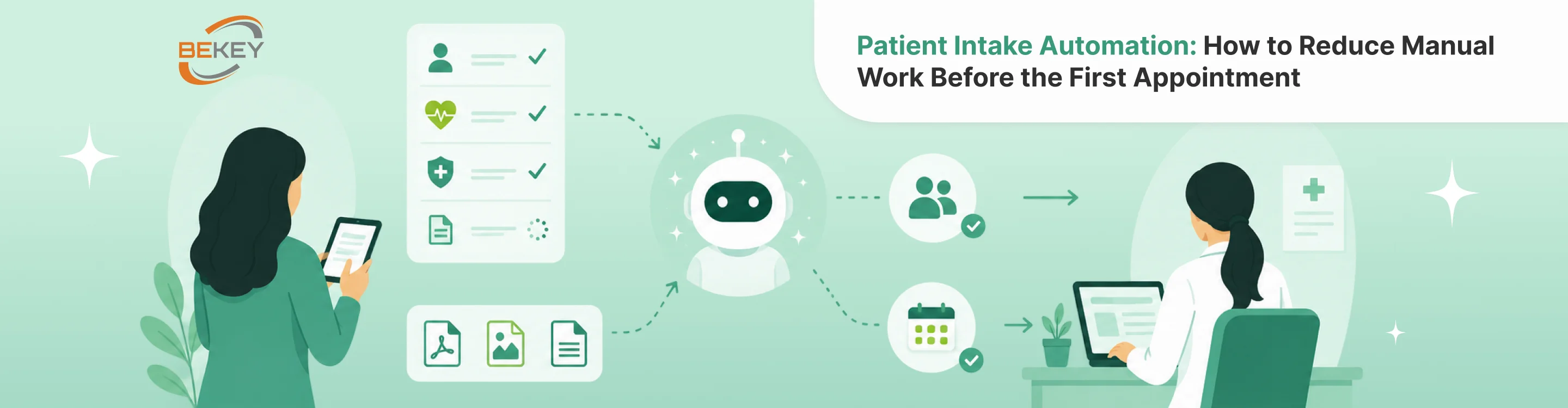
A practical intake workflow does not require dozens of AI features. In most cases, it follows a simple pattern:
Patient submits forms and documents.
The system checks for missing information.
AI processes uploaded documents and summarizes key details.
Requests are routed to the appropriate team.
Staff review exceptions and take action.
The biggest gains usually come from catching incomplete submissions early and reducing manual document review.
Human oversight should remain part of the process, especially when clinical information or urgent concerns are involved.
What should not be automated?
Patient intake automation has clear limits.
AI can support administrative tasks such as document classification, completeness checks, routing suggestions, and summary generation. It should not independently diagnose conditions, determine medical necessity, approve treatment, or make clinical decisions.
A safe intake workflow should include:
clear boundaries between administrative and clinical tasks;
escalation rules for urgent concerns;
human review for uncertain cases;
audit trails for AI-assisted actions.
The goal is to reduce repetitive work, not replace professional judgment.
Why intake automation matters for digital health startups
For digital health startups, intake often becomes a scaling challenge.
Early-stage teams can manually review every submission. As volume grows, that approach becomes expensive and difficult to maintain. Every new patient adds operational work.
Automating intake helps reduce manual review, improve onboarding consistency, and create a smoother patient experience without increasing headcount at the same pace.
For clinics, the benefits are similar: fewer incomplete appointments, less administrative back-and-forth, and better-prepared staff.
How to decide whether your intake workflow is ready

Your intake process may be ready for automation if:
Staff manually review every submission;
Patients frequently submit incomplete information;
Document review takes significant time;
Follow-up messages are repetitive;
Requests are routed manually;
Intake delays affect scheduling or revenue.
The first step is to map the workflow and identify where staff spend the most time. Those bottlenecks are usually the best automation opportunities.
Turning Intake Into a Scalable Process
Patient intake is one of the most practical areas for healthcare AI automation because it combines high volume, repetitive tasks, and measurable operational impact.
When intake relies on manual review, document checking, and repeated follow-ups, teams lose valuable time before care even begins. AI can help by identifying missing information, processing documents, routing requests, and preparing summaries for staff.
The most effective solutions focus on workflow improvement rather than automation for its own sake. The goal is not to replace human judgment but to remove unnecessary administrative work before the first appointment.
If your organization is exploring ways to streamline patient intake, BeKey can help design and implement AI-assisted workflows that reduce manual effort while keeping healthcare teams in control.

Tell us about your project
Fill out the form or contact us

Tell us about your project
Thank you
Your submission is received and we will contact you soon
Follow us