
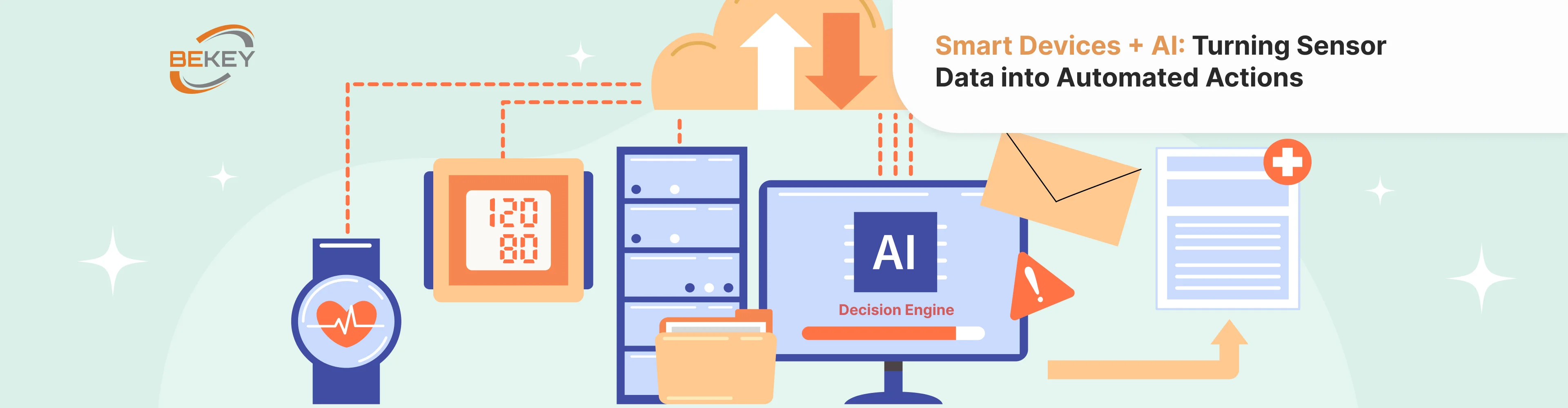
Smart Devices + AI: Turning Sensor Data into Automated Actions
In digital health, collecting data is no longer the hard part.
Most connected devices already work as expected. Wearables, remote monitoring tools, and medical IoT systems continuously track patient metrics - heart rate, oxygen levels, glucose, activity, sleep. The data is there, and there is a lot of it.
The problem starts after that.
In many cases, this data doesn’t actually change what happens in care delivery. It gets visualized in dashboards, triggers alerts, or gets reviewed manually. But instead of reducing workload, it often creates more of it. Clinicians end up monitoring systems that were supposed to automate monitoring.
This is where most medical device AI initiatives fall short.
The challenge isn’t extracting insights from sensor data. It’s deciding what should happen next, and designing systems that can act on those signals without overwhelming clinical teams.
That requires dealing with very practical constraints. Devices don’t have unlimited processing power. Not everything can run on-device. Sending everything to the cloud creates latency and noise. And if every anomaly turns into an alert, the system quickly becomes unusable.
So the real question is not how to collect more data, but how to turn the data you already have into decisions and actions that fit into real clinical workflows.
Why Sensor Data Alone Doesn’t Create Value
More Data Does Not Equal Better Outcomes
In remote patient monitoring and healthcare IoT systems, the assumption is often that more data will naturally lead to better outcomes. In practice, the relationship is not that straightforward.
Continuous sensor data introduces a large volume of signals, many of which reflect normal physiological variation rather than clinically relevant events. Heart rate, oxygen saturation, glucose levels, and activity patterns fluctuate throughout the day. Without proper filtering, these variations can generate alerts that require review but do not require intervention. As data volume increases, so does the risk of overwhelming clinical teams with low-value signals.
Monitoring Without Action Increases Workload
This creates a common failure mode in medical device AI systems. Instead of reducing workload, the system shifts it. Clinicians move from direct observation to reviewing dashboards and alert feeds, but the underlying decision-making burden remains unchanged. Each alert still requires interpretation, and the responsibility for determining its significance remains with the clinician.
Another limitation is that many systems stop at detection. They identify anomalies or trends but do not define the appropriate response. In these cases, the AI layer functions as a monitoring tool rather than an operational one. The workflow still depends on manual triage and decision-making, which limits the system’s ability to scale.
Value Comes From Defined Actions
Value emerges only when sensor data is connected to clearly defined actions. This requires establishing thresholds that reflect clinical relevance, filtering out non-actionable variation, and integrating signals into workflows where responses are predefined. In more advanced systems, certain categories of events can trigger automated actions, reducing the need for continuous human review.
For healthcare IoT AI systems, the goal is not to maximize the amount of data collected or the number of insights generated. It is to reduce the number of decisions that must be made manually while maintaining clinical safety. Without that shift, additional data tends to increase operational complexity rather than reduce it.
Firmware Constraints: What Devices Can (and Cannot) Do
Devices Are Not Designed for Heavy Computation
Many discussions around medical device AI assume that models can run anywhere in the system. In practice, connected medical devices operate under strict hardware and firmware constraints.
Most devices are optimized for reliability, battery life, and regulatory stability, not for running complex models. Processing power is limited, memory is constrained, and firmware updates are tightly controlled. These constraints make it difficult to deploy advanced AI logic directly on the device.
As a result, the role of on-device intelligence is usually narrow. Devices can perform basic signal processing, threshold detection, or lightweight anomaly filtering, but more complex inference often needs to happen elsewhere.
Firmware Stability Limits Iteration
Unlike cloud systems, firmware cannot be updated frequently or informally. Changes to device behavior may require validation, certification, and controlled deployment cycles.
This creates a practical limitation for AI systems that depend on continuous iteration. Models that require frequent updates or tuning are difficult to maintain at the firmware level. Even small changes can introduce regulatory or operational risks.
Because of this, most production systems separate stable, deterministic logic on the device from more flexible AI components in upstream systems.
Designing Around Device Constraints
Effective healthcare IoT AI architectures are built with these constraints in mind. Rather than attempting to push all intelligence to the edge, they define clear boundaries between what happens on the device and what happens in the cloud or backend systems.
Devices handle signal capture, basic filtering, and reliable data transmission. More complex processing, including pattern recognition, contextual analysis, and decision support, is handled in environments where models can be updated, monitored, and validated more easily.
This separation allows organizations to maintain device reliability while still evolving AI capabilities over time.
Edge vs Cloud AI: Where Decisions Actually Happen
Not All Decisions Belong in the Same Layer
Once device constraints are clear, the next question is where AI processing should take place. In healthcare IoT AI systems, this typically comes down to a balance between edge and cloud.
Edge processing happens on or near the device. Cloud processing happens in centralized infrastructure where data can be aggregated, enriched, and analyzed at scale.
The distinction is not just technical. It directly affects latency, reliability, and how decisions fit into clinical workflows.
When Edge Processing Makes Sense
Edge AI is most useful when decisions need to happen immediately or when connectivity cannot be guaranteed. Basic anomaly detection, threshold-based alerts, and safety-related triggers are often handled at the device level.
For example, if a wearable detects a critical physiological change, the system may need to trigger an alert without waiting for cloud processing. In these cases, latency matters more than model complexity.
However, edge processing is limited by the same constraints discussed earlier: limited compute, restricted update cycles, and reduced flexibility.
When Cloud AI Is Required
More complex decision-making typically happens in the cloud. This includes aggregating data over time, combining signals from multiple sources, and applying models that require more computational resources.
Cloud-based AI can incorporate patient history, contextual data, and cross-patient patterns that are not available at the device level. It also allows for continuous model updates, monitoring, and performance evaluation.
For most remote patient monitoring AI systems, meaningful insights emerge only after data is processed in this broader context.
Designing Hybrid Architectures
In practice, effective systems combine both approaches. Devices handle immediate, safety-critical logic, while cloud systems perform deeper analysis and coordinate responses.
The challenge is not choosing one over the other, but defining clear boundaries. If too much logic is pushed to the edge, systems become rigid and difficult to update. If everything is centralized, latency increases and signal quality may degrade.
A well-designed architecture ensures that decisions happen at the layer where they are both reliable and actionable within the clinical workflow.
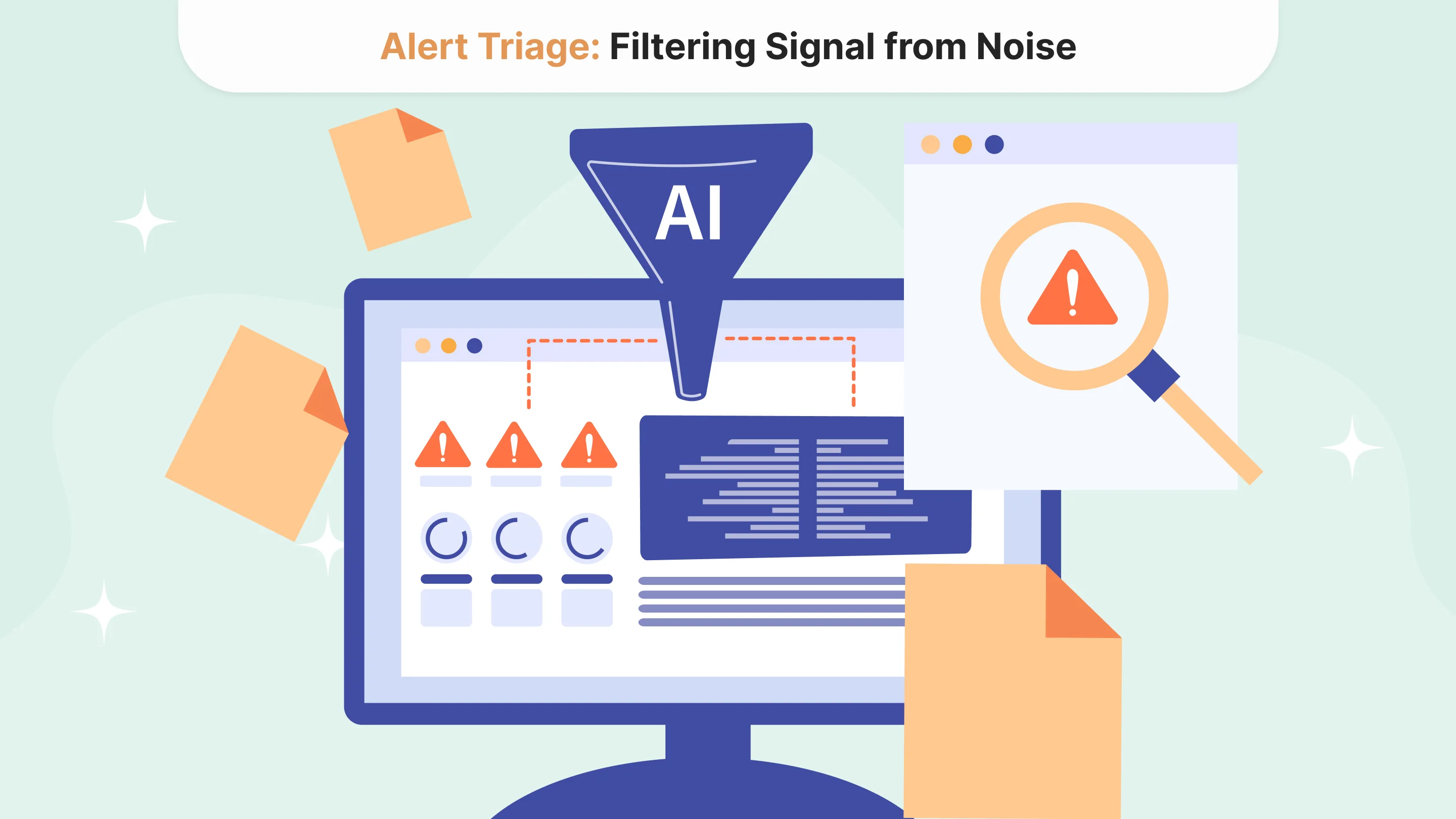
Alert Triage: Filtering Signal from Noise
Too Many Alerts Break the System
One of the most common failure points in remote patient monitoring AI systems is alert volume.
When every deviation in sensor data is treated as a potential issue, systems quickly generate more alerts than clinical teams can reasonably process. Even if individual alerts are technically valid, the overall volume makes the system impractical to use.
Over time, this leads to alert fatigue. Clinicians begin to ignore notifications, delay responses, or rely on their own judgment instead of the system. At that point, the value of medical device AI is significantly reduced.
Not All Signals Require the Same Response
Effective alert triage starts with recognizing that not every signal should trigger the same type of action. Some events require immediate attention. Others may only need to be logged, monitored over time, or incorporated into broader trends.
This requires structuring alerts into tiers based on clinical relevance and urgency. Instead of sending all signals directly to clinicians, systems can filter, aggregate, or delay lower-priority events while escalating only those that meet predefined criteria.
From Alerts to Workflows
The most effective systems do not stop at alert generation. They connect alerts to workflows.
This may involve routing signals to the appropriate team, triggering predefined follow-up actions, or integrating with care management systems. In some cases, non-critical events can be handled through automated communication or monitoring protocols without requiring direct clinician intervention.
The goal is to ensure that each alert results in a clear and appropriate response, rather than creating an additional decision point.
From Data to Action: Making Medical Device AI Operational
The value of healthcare IoT AI does not come from collecting more data or generating more alerts. It comes from reducing the gap between signal and action.
That requires aligning several layers of the system. Devices must reliably capture and transmit data within firmware constraints. AI processing must be distributed between edge and cloud in a way that balances latency and flexibility. Alerting systems must filter noise and connect signals to structured workflows.
When these elements are aligned, sensor data becomes part of an operational system rather than a reporting layer. Decisions become more consistent, responses become more timely, and the burden on clinical teams decreases.
For digital health and medtech organizations, this is the difference between building monitoring tools and building systems that actively support care delivery.
If you are designing or scaling medical device AI solutions and need to define how sensor data translates into actionable workflows, our medtech + AI consulting services can help assess architecture, alert design, and integration with clinical workflows

Tell us about your project
Fill out the form or contact us

Tell us about your project
Thank you
Your submission is received and we will contact you soon
Follow us