
The Cost of Missed Follow-Ups in Digital Health — and How AI Can Help
- Why missed patient follow-ups happen
- The real cost of missed follow-ups
- Missed follow-ups vs poor patient engagement
- How AI can help with patient follow-up automation
- What follow-ups are safe to automate?
- What a practical AI-assisted follow-up workflow looks like
- Signs your follow-up workflow needs automation
- From missed follow-ups to structured patient engagement
Missed patient follow-ups are easy to underestimate.
In a digital health company, they rarely look like one major failure. More often, they appear as small delays: a patient does not receive the next instruction, a care team forgets to check in after onboarding, a referral update sits in a queue, or a support message never becomes a task.
Each missed follow-up may seem minor. But across hundreds or thousands of patients, these gaps can affect engagement, retention, outcomes, staff workload, and trust.
For founders, care teams, and patient success teams, missed patient follow-ups are not only a communication problem. They are an operational risk. And in many cases, they happen because follow-up workflows still depend too much on manual tracking, individual memory, spreadsheets, or disconnected tools.
This is where broader healthcare AI automation solutions can help, not by replacing care teams, but by making follow-up needs more visible, structured, and easier to act on.
Why missed patient follow-ups happen
Digital health teams often interact with patients across many channels: apps, portals, SMS, email, video visits, support tools, scheduling systems, intake forms, and care management platforms.
A patient may complete one step but wait for the next. A coordinator may need to review a document before outreach. A coach may need to check in after a missed session. A patient success team may need to re-engage users who stopped responding.
When these signals are spread across different systems, follow-up becomes difficult to manage manually. This is often part of a broader care coordination problem, where teams need better visibility into patient status, next steps, and ownership across the workflow.
Missed follow-ups usually happen when:
ownership is unclear;
tasks are not created automatically;
patient status is not visible in one place;
messages and clinical notes are separated;
teams rely on spreadsheets or reminders;
follow-up rules differ between staff members;
managers cannot easily see who is waiting.
The issue is not that teams do not care. It is that the workflow makes it too easy for patients to fall through the cracks.
The real cost of missed follow-ups
A missed follow-up can create several types of cost for a digital health business.
Lower patient engagement
Many digital health products depend on consistent patient participation. If a patient signs up but does not receive timely guidance, reminders, or next steps, engagement can drop quickly.
The longer the silence, the harder it becomes to re-engage the patient.
Poorer patient experience
Patients may not know whether their information was received, whether someone reviewed their case, or what they should do next. This creates confusion and frustration.
In digital care models, where trust is often built through remote communication, unclear follow-up can make the experience feel impersonal or unreliable.
More manual work for care teams
Missed follow-ups often create more work later. Staff may need to search through messages, reconstruct the patient journey, respond to complaints, or manually restart a process that should have continued earlier.
Instead of preventing delays, teams spend time fixing them.
Retention and revenue risk
For subscription-based, employer-sponsored, or value-based digital health models, follow-up gaps can affect retention. Patients who feel unsupported are less likely to continue using the product.
For founders, this makes follow-up quality part of the business model, not just an operations detail.
Limited visibility for managers
When follow-ups are tracked manually, leaders may not know where the process breaks down. They may see lower engagement or higher churn but not understand which workflow gaps caused them.
Without visibility, it is hard to improve the system.
Missed follow-ups vs poor patient engagement
Missed patient follow-ups and poor engagement are closely connected, but they are not the same problem.
Poor engagement is often treated as a patient behavior issue: the patient did not respond, did not log in, did not complete the program, or did not attend the next session.
But sometimes engagement drops because the system failed to guide the patient forward.
A patient may not know the next step. A care team may not notice that a form is incomplete. A follow-up message may be delayed. A support request may not be routed to the right person. A missed appointment may not trigger re-engagement.
This is why AI patient engagement should not only focus on sending more messages. It should help teams understand where follow-up is missing, which patients need attention, and what type of outreach is appropriate.
How AI can help with patient follow-up automation
AI can support follow-up workflows by identifying signals, organizing tasks, and helping staff act faster.
Identifying patients who need follow-up
AI can help detect patients who may need attention based on workflow status, recent activity, missed appointments, incomplete forms, unanswered messages, or delayed next steps.
For example, a system may flag patients who completed intake but were not scheduled, patients who missed a session, or patients who stopped responding after onboarding.
Summarizing patient context
Before reaching out, staff often need to understand what happened. AI can summarize recent interactions, open tasks, missing information, and previous outreach attempts.
This helps care teams avoid sending generic or poorly timed messages.
Preparing follow-up messages
AI can help draft administrative follow-up messages for staff review. These may include reminders about missing forms, scheduling next steps, appointment follow-up, or re-engagement after inactivity.
The message should still follow approved templates and avoid medical advice unless reviewed by qualified staff.
Routing follow-up tasks
Not every follow-up belongs to the same team. Some should go to patient success, some to care coordination, some to billing, some to clinical review, and some to support.
AI can suggest routing based on the type of issue, patient status, and escalation rules.
Creating visibility into bottlenecks
AI can help managers see where follow-ups are delayed most often: after intake, after a missed appointment, after document submission, during referral review, or after support interactions.
This helps teams fix the workflow, not just handle individual cases.
What follow-ups are safe to automate?
Not all follow-ups carry the same risk.
Many administrative follow-ups are good candidates for automation or AI-assisted drafting. These may include:
reminders about missing forms;
appointment scheduling prompts;
document upload reminders;
onboarding check-ins;
inactive user re-engagement;
status updates;
missed appointment follow-up;
reminders to complete non-clinical steps.
More sensitive follow-ups need human review. These may include messages involving symptoms, medication, clinical advice, urgent concerns, mental health risk, treatment decisions, or medical necessity.
A safe automation strategy separates administrative communication from clinical judgment.
AI can help prepare and prioritize the work. Humans should stay responsible for decisions that affect care.
What a practical AI-assisted follow-up workflow looks like
A strong follow-up workflow does not need to be complicated.
It may look like this:
The system tracks patient status across key workflow steps.
AI identifies patients with missing or delayed next steps.
The system classifies the follow-up type.
Low-risk administrative follow-ups are prepared using approved templates.
Sensitive or uncertain cases are routed to human review.
Staff approve, edit, or send follow-up messages.
Follow-up outcomes are tracked.
Managers review patterns and bottlenecks.
This kind of workflow helps teams move from reactive outreach to structured follow-up management.
Signs your follow-up workflow needs automation
Your digital health company may be ready for patient follow-up automation if:
follow-ups depend on spreadsheets or manual reminders;
patients frequently ask what happens next;
missed appointments do not trigger consistent outreach;
onboarding drop-offs are hard to track;
care teams spend time searching for patient context;
patient success teams send many repetitive messages;
managers cannot see which patients are waiting;
engagement issues appear, but the cause is unclear.
These signs suggest that the problem is not only patient motivation. It may be a coordination problem.
From missed follow-ups to structured patient engagement
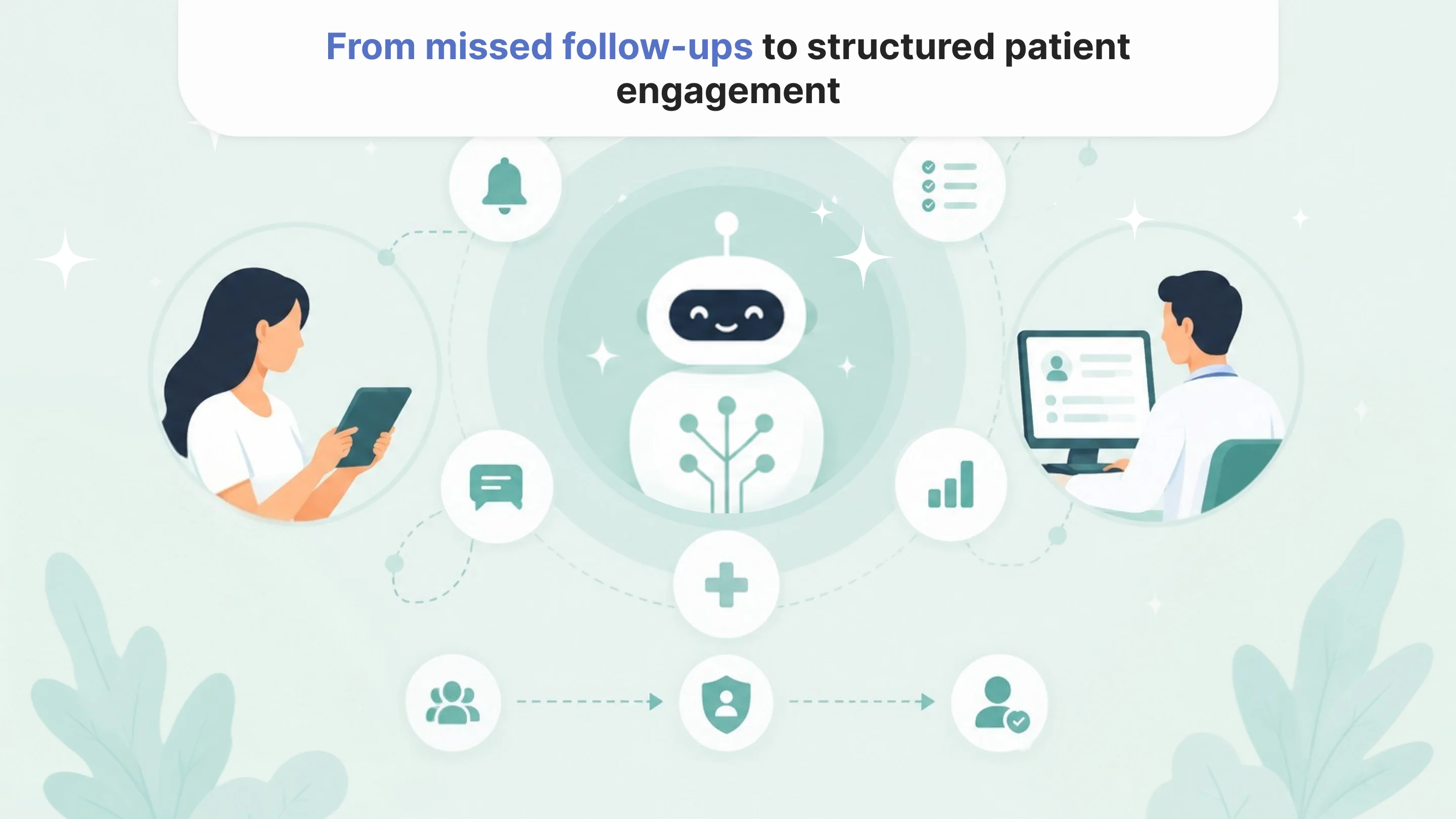
Missed patient follow-ups are not just small communication gaps. In digital health, they can affect engagement, retention, trust, and operational efficiency.
AI can help by making follow-up needs more visible and easier to manage. It can flag patients who need attention, summarize context, prepare administrative messages, route tasks, and help leaders understand where delays happen.
But the strongest approach is not full automation. It is structured, human-supervised follow-up support.
For digital health teams, the right question is not “Can AI message patients for us?” It is: “Which follow-up workflows are repetitive, low-risk, and safe to automate, and which ones should always stay human-led?”
That is where AI can create real value for patient engagement.
Faq
What are missed patient follow-ups?
+Missed patient follow-ups happen when a patient does not receive the next expected outreach, reminder, status update, or care coordination step. In digital health, this can happen after intake, onboarding, missed appointments, document submission, support requests, or program inactivity.
Why do missed follow-ups matter in digital health?
+They can reduce patient engagement, create confusion, increase staff workload, affect retention, and make the care experience feel fragmented. For digital health companies, follow-up quality is directly connected to patient trust and product usage.
Can AI automate patient follow-ups?
+AI can help automate or assist with low-risk administrative follow-ups, such as reminders, scheduling prompts, missing document requests, and re-engagement messages. Sensitive or clinical follow-ups should include human review.
How does AI patient engagement help care teams?
+AI patient engagement can help care teams identify patients who need attention, summarize context, prepare follow-up messages, route tasks, and track follow-up outcomes.
What follow-ups should not be fully automated?
+Follow-ups involving symptoms, urgent concerns, medication, treatment decisions, mental health risk, or clinical advice should not be fully automated. These cases should be escalated to qualified human staff.

Tell us about your project
Fill out the form or contact us

Tell us about your project
Thank you
Your submission is received and we will contact you soon
Follow us