
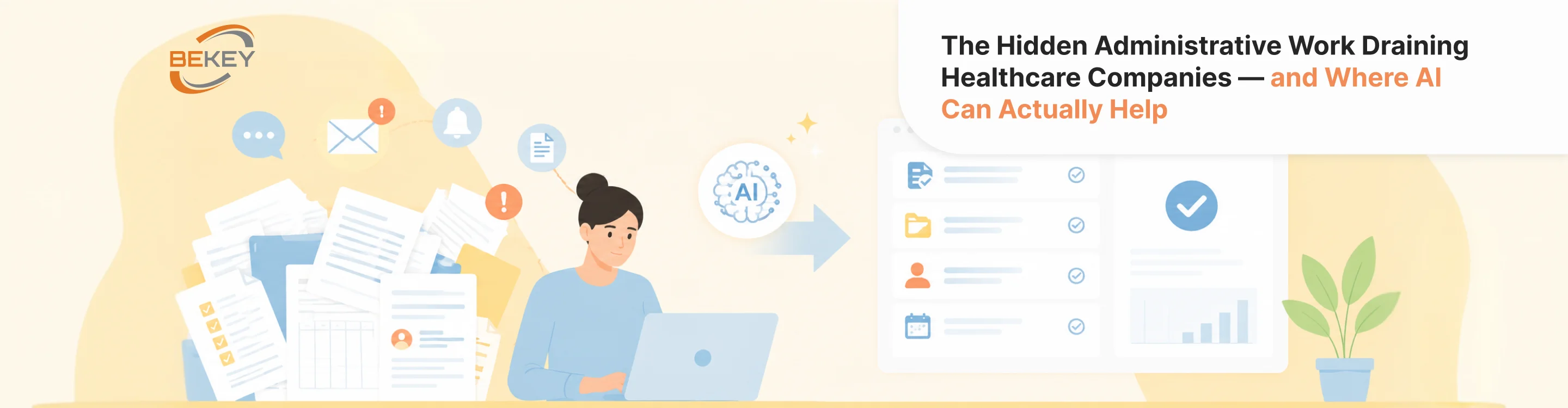
The Hidden Administrative Work Draining Healthcare Companies — and Where AI Can Actually Help
- The real cost of invisible administrative work
- Why traditional automation is not always enough
- Where hidden administrative work usually lives
- Where AI can actually help
- Where AI should not take over
- Why the workflow matters more than the model
- How to identify the right first use case
- What BeKey’s approach should emphasize
- Conclusion: the best AI opportunities may be hiding in plain sight
Healthcare companies are often slowed down not by one major operational failure, but by dozens of small administrative tasks repeated every day: checking forms, chasing missing documents, updating systems, routing messages, preparing claims, or answering the same internal questions again and again. Each task may seem minor, but together they drain staff capacity, delay patient access, increase burnout, and make growth harder to sustain.
This is where the healthcare AI conversation is becoming more practical. While clinical AI still gets much of the attention, many organizations are seeing faster, clearer value in less glamorous workflows: intake, documentation, scheduling, claims follow-up, eligibility checks, internal support, and back-office coordination. The opportunity is not simply to “add AI” to healthcare, but to identify where administrative work is quietly consuming time and decide where AI can safely reduce friction without creating new risk.
The real cost of invisible administrative work
Administrative burden usually appears in small, fragmented tasks. A patient success team manually reviews incoming forms. A billing team checks claim statuses across payer portals. A care coordinator follows up on missing referrals. A support team answers the same questions about scheduling, benefits, or documentation requirements. A manager exports data from several tools just to understand what happened during the week.
Because this work is spread across departments, it often escapes measurement. Leaders may know their teams are busy, but they do not always know where the time is going. As a result, staff becomes the connective tissue between disconnected systems, payer rules, patient needs, and internal processes.
The consequences are not only operational. Manual follow-ups can delay patient access. Duplicated work can create errors. Slow claims processing can affect revenue. Repetitive low-value tasks can increase burnout. For growing healthcare companies, this creates a difficult problem: every new patient, client, provider, or transaction adds more coordination work unless the workflow itself changes.
Why traditional automation is not always enough
Healthcare has already invested in electronic forms, EHR workflows, CRMs, scheduling tools, patient portals, billing systems, and RPA. These tools have improved parts of the process, but they have not removed the underlying friction.
The reason is simple: healthcare workflows are rarely clean or linear. They involve incomplete information, exceptions, documents, payer requirements, patient behavior, and multiple systems that do not always communicate well. A rule-based automation can move data from one field to another, but it cannot always understand whether a referral packet is incomplete, whether a patient message should go to billing or clinical support, or whether a claim denial needs a routine follow-up or escalation.
Much of healthcare administration is semi-structured. It includes PDFs, scanned forms, portal messages, call notes, insurance responses, and internal comments. This is where AI can be useful. It can summarize, classify, extract, compare, detect missing information, draft responses, and suggest next steps.
But AI should not replace human judgment. In healthcare, the safest and most useful AI systems usually work as operational copilots: they prepare information, reduce repetitive work, and keep humans responsible for sensitive decisions.
Where hidden administrative work usually lives
Patient intake
Patient intake is often treated as a form, but in reality, it is a workflow. Patients submit incomplete information, upload unclear documents, skip fields, or ask questions before the first appointment. Staff then have to verify completeness, request missing details, check eligibility, update internal systems, and prepare the next team member.
AI can help by summarizing intake responses, detecting missing fields, classifying documents, routing cases, and preparing follow-up messages. The goal is not to remove staff from the process, but to reduce the amount of repetitive preparation they need to do.
Documentation and handoffs
Healthcare teams spend a lot of time turning conversations, forms, notes, and documents into usable information. This happens in clinical documentation, billing support, care coordination, internal reporting, and patient communication.
AI can assist with summarization, document classification, information extraction, coding suggestions, and handoff summaries. Instead of asking staff to read and reformat the same information repeatedly, AI can prepare a cleaner version for review.
Support and patient communication
Many patient support requests are administrative rather than clinical. They involve appointment logistics, billing status, account access, preparation instructions, document requirements, or product guidance.
AI can help classify requests, retrieve approved information, draft responses, and route messages to the right team. The boundary is important: AI should not improvise medical advice. But it can reduce the workload around routine communication when escalation rules are clear.
Revenue cycle and document-heavy workflows
Revenue cycle work is full of repetitive coordination: eligibility checks, claims follow-up, denial tracking, payer correspondence, and payment status updates. These tasks are strong AI candidates because their value is measurable: fewer manual touches, shorter turnaround time, reduced backlog, and faster revenue recovery.
The same applies to document-heavy workflows. Healthcare companies still receive lab reports, referrals, insurance letters, consent forms, claims attachments, and onboarding documents as PDFs, scans, or uploads. AI document processing can help extract and classify information, but only if it is connected to workflow logic. OCR alone is not enough. The system needs to know what the document is, what information matters, what is missing, and who should review it.
Where AI can actually help
AI is most useful when it removes a clear bottleneck. A good use case usually has four qualities: the task happens often, it is repetitive, it requires reading or routing information, and the result can be reviewed by a human if needed.
For example, AI can flag incomplete intake forms before staff open them. It can summarize long patient messages and suggest whether they belong to support, billing, scheduling, or care coordination. It can extract key fields from documents and prepare them for review. It can help revenue cycle teams interpret payer responses faster. It can draft follow-up messages based on approved templates. It can also power internal knowledge assistants that answer staff questions using company policies and SOPs.
The important point is that AI should be tied to the workflow. A standalone chatbot rarely solves an operational problem by itself. A useful AI system needs to fit into how work actually moves: from request to review, from document to structured data, from claim status to next action, from internal question to approved answer.
Where AI should not take over
The fact that AI can process administrative work does not mean it should act without limits. In healthcare, administrative tasks can quickly touch clinical, billing, or compliance risk. A message that starts as a scheduling question may include symptoms. A prior authorization packet may involve medical necessity. A support request may require escalation.
That is why healthcare AI needs clear boundaries. If a message includes symptoms, urgent language, medication questions, or clinical uncertainty, the system should route it to a human. If document extraction is incomplete or low-confidence, it should be flagged for review. If an output affects billing, compliance, or care quality, the process should include an audit trail.
The goal is not full autonomy everywhere. The goal is appropriate automation. In many cases, the best design is not “AI replaces staff,” but “AI removes repetitive preparation work so staff can focus on exceptions, decisions, and patient-facing value.”
Why the workflow matters more than the model
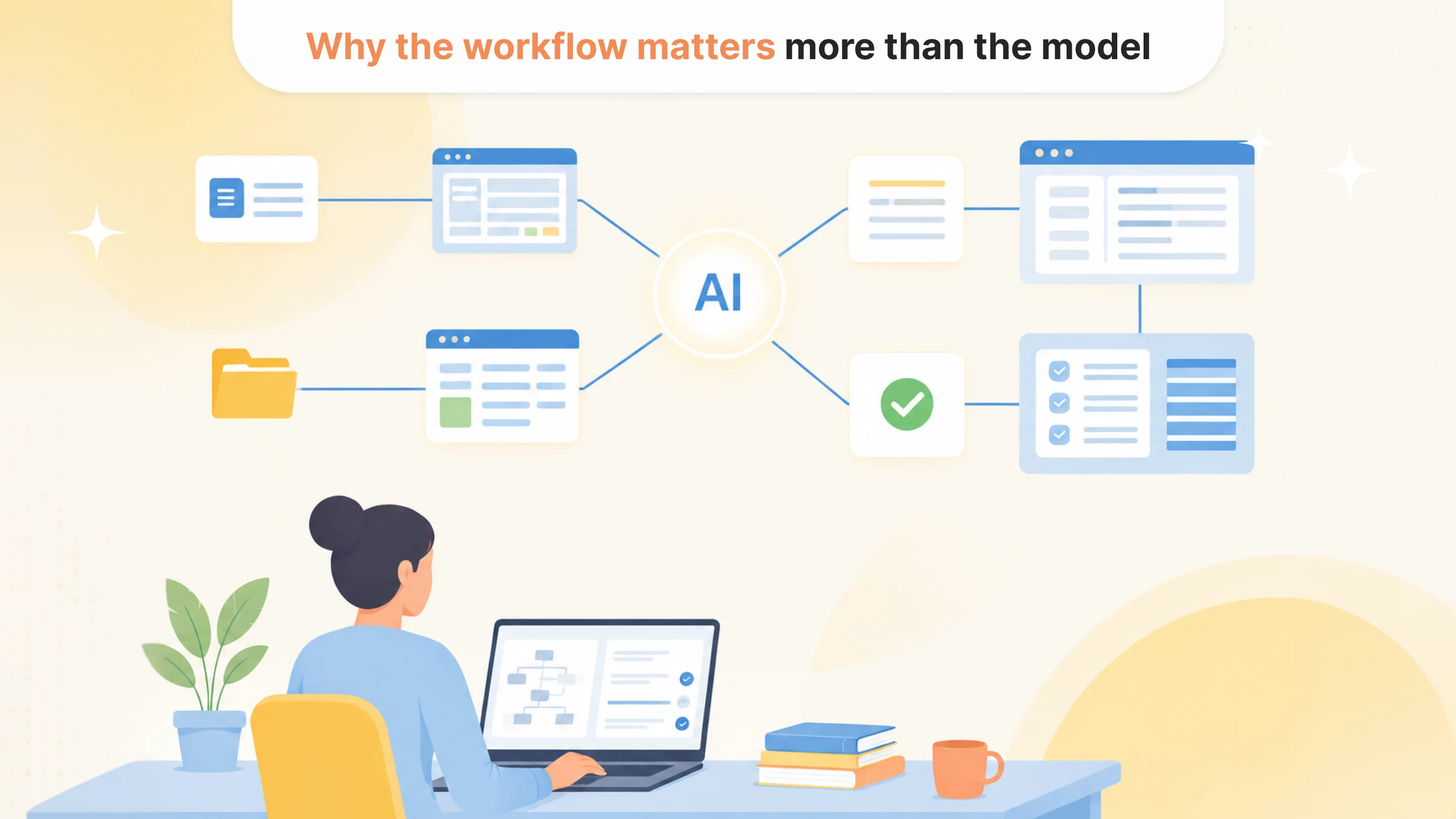
Many companies start AI projects by asking which model to use or which chatbot to build. In healthcare operations, the better first question is: where is the work getting stuck?
A good AI automation project starts with workflow discovery. What task is repeated every day? Who does it? What information do they need? Which systems are involved? What happens when information is missing? What should be reviewed by a human? How will success be measured?
Without this mapping, AI can become an expensive layer on top of a broken process. It may generate summaries no one uses, automate the wrong step, or create outputs that still need to be checked manually from scratch.
This is especially important for growing healthcare companies. Early-stage teams often rely on spreadsheets, Slack messages, manual review, and informal knowledge. That may work at a small scale, but as the company grows, these habits turn into operational debt. AI can help, but only when paired with process redesign.
How to identify the right first use case
The safest starting point is often not the most ambitious AI idea. It is the workflow that is painful, repetitive, measurable, and low enough risk to automate in stages.
A strong first use case usually has visible volume and cost. It may involve staff hours, delayed revenue, slow response times, patient drop-off, or backlog. It should also have a clear before-and-after metric: reduced intake review time, faster claims follow-up, fewer incomplete forms, shorter response time, or lower manual document processing effort.
The workflow should also have a manageable risk profile. Internal administrative assistants, intake preparation, document classification, status summaries, and routing support are often safer first steps than patient-facing clinical advice.
Most importantly, the use case should connect to a business outcome. “We want to use AI” is not a strategy. “We want to reduce manual intake work so our team can handle more patients without adding headcount” is much stronger.
What BeKey’s approach should emphasize
For BeKey, the strongest positioning is not simply “we build AI tools.” The stronger position is: BeKey helps healthcare and complex operations teams find the administrative work worth automating, design safe AI-assisted workflows, and ship systems that work in real environments.
That means starting with an audit, not a demo. Before building anything, teams need to understand where time is being lost, what data is available, which systems need to connect, where risk sits, and which tasks are suitable for AI assistance.
This is where BeKey can differentiate itself from generic AI vendors. Healthcare workflows are not just productivity workflows. They involve compliance, patient trust, role-based access, sensitive data, payer rules, and operational nuance. Generic automation tools can help with isolated tasks, but they often struggle when the workflow touches PHI, clinical escalation, internal permissions, or multi-system integration.
BeKey’s value is in connecting AI capability with healthcare-specific workflow design and delivery. The goal is not to automate everything. The goal is to identify where AI can safely reduce manual work, improve speed, and create measurable operational value.
Conclusion: the best AI opportunities may be hiding in plain sight
Healthcare companies do not need to chase the most futuristic AI use case to see value. In many organizations, the better opportunity is already visible in the work teams that are tired of doing things manually: reviewing forms, checking documents, routing messages, updating systems, following up on claims, answering repeated questions, and preparing information for the next person in the workflow.
This work may be hidden, but it is not harmless. It drains capacity, slows growth, delays care, increases burnout, and creates avoidable costs. AI can help, but only when it is applied carefully: with workflow mapping, human oversight, compliance-aware architecture, measurable outcomes, and a clear understanding of what should and should not be automated.
The right first question is not “What AI tool should we buy?” It is: “Which administrative workflow is costing us the most time, and what would change if we removed half of that manual work?”
Not sure where administrative work is draining your team?
BeKey can help you map repetitive workflows, identify safe AI automation opportunities, and prioritize the use cases most likely to deliver measurable ROI. Start with a Hidden Admin Work Audit to find the first workflows worth automating.

Tell us about your project
Fill out the form or contact us

Tell us about your project
Thank you
Your submission is received and we will contact you soon
Follow us