

The Hidden Cost of Manual Workflows in Healthcare and How AI Fixes Them
In healthcare, some of the most expensive problems don’t show up in clinical outcomes or patient satisfaction scores. They sit quietly inside manual workflows: prior authorizations faxed back and forth, discharge summaries typed twice into different systems, nurses tracking down missing orders, billing teams reworking the same claim for the third time. None of this looks like innovation debt. But collectively, it is.
According to multiple industry analyses, administrative work now accounts for roughly 25–30% of total healthcare spending in the United States. A significant share of that cost is driven not by regulation itself, but by how work is executed: fragmented systems, human handoffs, duplicate data entry, and workflows designed decades ago for paper-based care. These processes persist not because they are effective, but because replacing them has historically been risky, slow, and politically difficult.
Manual workflows create hidden costs that compound over time. They delay care, increase staff burnout, introduce errors, and quietly cap how much volume a health system can absorb. A nurse spending hours on documentation is a staffing problem. A billing specialist reworking denied claims is a revenue problem. A physician waiting for prior authorization approval is a throughput problem. All of them are, at their core, workflow problems.
What’s changed is not the existence of these inefficiencies, but the feasibility of fixing them. Recent advances in applied AI, especially in automation, document understanding, and task orchestration, make it possible to remove human effort from parts of healthcare operations that never required clinical judgment in the first place. Unlike clinical AI, these systems don’t need to diagnose disease or recommend treatment. They need to move information accurately, consistently, and at scale.
Over the past months, we’ve explored AI in healthcare from multiple angles: clinical decision support, virtual care, data governance, and operational automation. Each piece focused on a specific layer of the system. But taken together, they point to a broader pattern worth examining more directly.
This article looks at where manual workflows quietly drain time and money from healthcare organizations, why traditional digitization failed to solve the problem, and how a new generation of AI-driven operational tools is finally making these costs visible and fixable.
Where Manual Workflows Actually Drive Cost, Delay, and Failure
Manual workflows are not a background inefficiency in healthcare. They are a primary driver of cost, delay, and operational fragility.
Take prior authorization. In most U.S. health systems, approval for routine procedures still depends on phone calls, faxed forms, and manual data reconciliation across payer portals. According to the American Medical Association, physicians and their staff spend more than 13 hours per week per provider dealing with prior authorizations alone. Nearly 90% report that these delays lead to postponed or abandoned care. This is not administrative overhead in the abstract. It is lost capacity, delayed revenue, and clinical time diverted to paperwork.
Claims processing exposes the same pattern. Industry data consistently shows initial denial rates between 10 and 20%, often caused by missing documentation or simple data mismatches. Each denial triggers a rework loop: staff review the claim, pull supporting records, correct formatting, resubmit, and wait again. For large health systems processing millions of claims, this creates a standing backlog of manual labor that scales linearly with volume. Revenue cycle teams grow, but cash flow does not improve proportionally.
Discharge workflows compound the problem on the clinical side. Nurses and case managers spend hours coordinating medication reconciliation, follow-up instructions, transport, and documentation across multiple systems. When discharges stall, beds remain occupied longer than medically necessary. That reduces effective bed capacity, backs up emergency departments, and forces hospitals to defer admissions and procedures. In operational terms, this is a throughput failure, not a care quality issue.
Scheduling and eligibility verification add another layer of waste. Appointments are booked before coverage is confirmed, then canceled or rescheduled after staff discover eligibility gaps. The result is unused capacity, frustrated patients, and staff time spent repairing preventable errors. Missed appointments cost the U.S. healthcare system tens of billions of dollars annually, much of it driven by front-end administrative breakdown rather than patient behavior.
What connects these examples is not technology gaps, but process design. These workflows rely on human intervention for tasks that are rules-based, repetitive, and predictable. Every handoff introduces delay. Every manual check introduces variance. Over time, organizations normalize this friction and staff around it, rather than eliminating it.
This is where operational AI enters the picture. Not as intelligence layered on top of broken processes, but as a mechanism to remove unnecessary human labor from workflows that never required judgment to begin with.
How AI Removes Friction from Healthcare Operations Without Touching Clinical Judgment
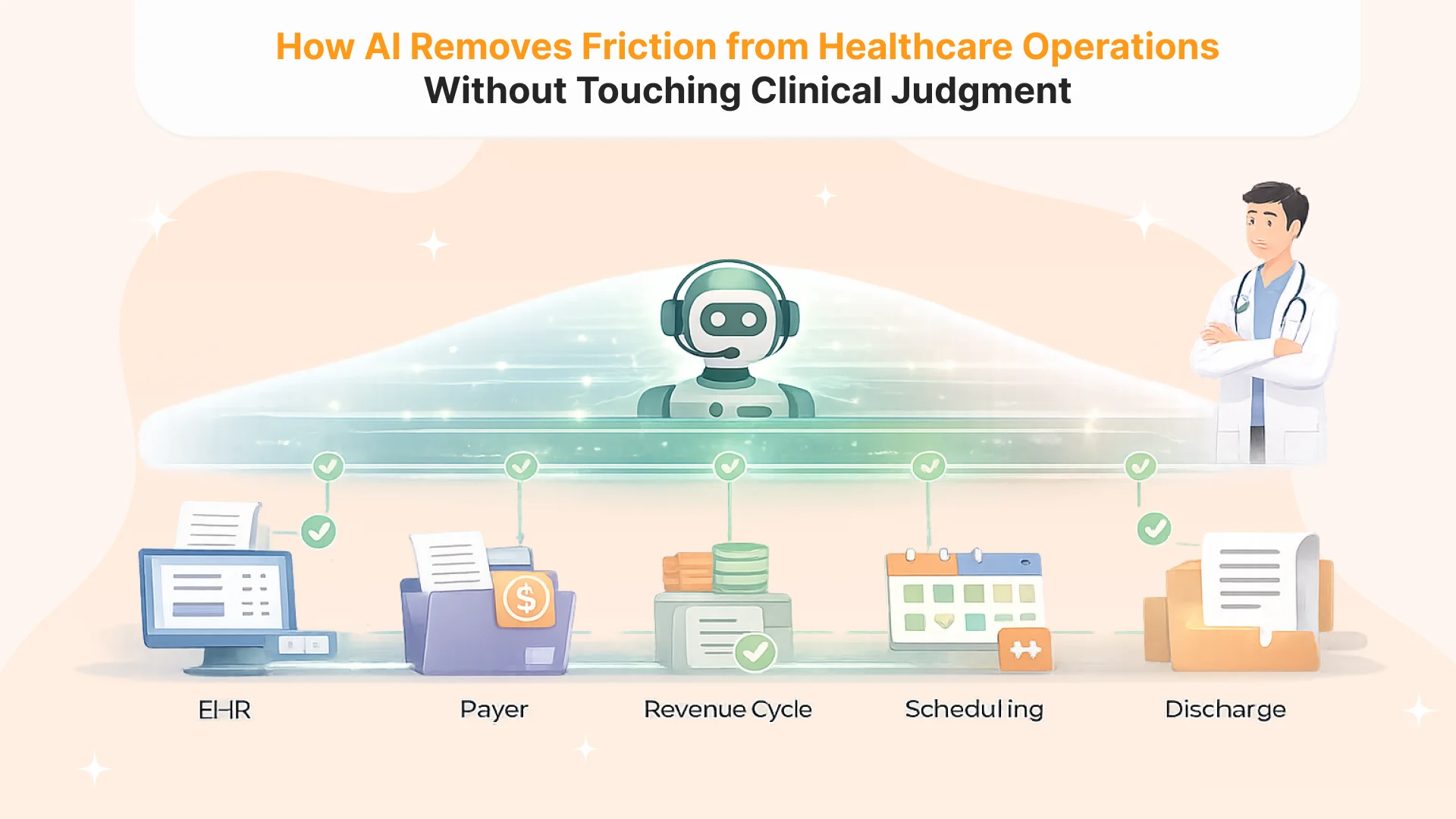
The reason AI works in operational healthcare workflows is simple: these processes are rules-based, repetitive, and already standardized by policy, even if execution is manual. Prior authorizations follow payer-specific criteria. Claims follow formatting and coding rules. Eligibility checks depend on structured coverage data. None of this requires interpretation of symptoms or medical nuance. It requires consistency, speed, and error tolerance at scale.
Modern AI systems are increasingly used as orchestration layers rather than decision-makers. In prior authorization, for example, AI can automatically extract required clinical elements from the EHR, map them to payer rules, assemble the submission, and route exceptions to humans only when criteria are unclear. Health systems deploying this approach report measurable reductions in turnaround time, fewer resubmissions, and less staff time spent chasing approvals.
In revenue cycle operations, AI-driven document understanding and claim validation reduce denial rates by catching errors before submission. Instead of discovering missing information after a claim is rejected, systems flag gaps upfront, when correction is cheapest. The result is not just higher first-pass acceptance, but more predictable cash flow. Revenue teams spend less time reworking claims and more time resolving true exceptions.
Discharge workflows benefit similarly. AI can coordinate tasks across systems, track completion status, and surface bottlenecks before they delay patient flow. Rather than relying on nurses or case managers to manually check multiple dashboards, automation ensures that documentation, orders, follow-ups, and transport are aligned in real time. This does not replace clinical oversight. It removes the need for constant status checking.
Scheduling and eligibility verification are other areas where AI consistently outperforms manual processes. Automated eligibility checks before appointment booking prevent downstream cancellations. AI-driven scheduling systems adjust in real time based on no-show risk, staffing availability, and patient constraints. This increases utilization without adding staff or extending hours.
What distinguishes these systems from earlier “digitization” efforts is feedback. Traditional software replicated manual steps in digital form. AI-driven workflows adapt based on outcomes. When denials spike, rules are updated. When discharge delays cluster around a specific step, the system flags it. Over time, operations become measurable and improvable, rather than reactive.
Critically, none of this requires AI to practice medicine. These tools operate below the clinical layer, where risk is lower, regulatory pathways are clearer, and return on investment is immediate. That is why many health systems see faster adoption and stronger buy-in for operational AI than for clinical decision support.
In healthcare, the fastest gains rarely come from replacing expertise. They come from removing friction that prevents expertise from being used where it matters.
AI in Healthcare Is Not a Feature, It’s an Operating Discipline
Across digital health, AI has already shown up in almost every layer of the system: clinical documentation, revenue cycle, scheduling, remote monitoring, imaging, triage, and virtual nursing. Each use case is often discussed in isolation, as if value can be captured through a single deployment or a well-scoped pilot. In practice, that is rarely how impact materializes.
The usefulness of AI in healthcare compounds over time, but only if organizations treat implementation as an ongoing operational process rather than a one-time upgrade. Workflows change. Payer rules evolve. Staffing models shift. Regulatory expectations tighten. Systems that automate today’s processes without the ability to adapt quickly become tomorrow’s bottlenecks.
This is especially visible in operational AI. Automating prior authorizations, claims, or discharge flows is not a finish line. As policies change and volumes grow, automation logic must be revisited, retrained, and governed. Health systems that see AI as static tooling often struggle when performance drifts or edge cases accumulate. Those that treat it as infrastructure build internal capability to monitor, adjust, and scale responsibly.
The same dynamic applies across clinical and non-clinical domains. AI documentation tools must adapt to new compliance standards. Remote monitoring systems must respond to changes in care models and reimbursement. Decision-support tools must align with updated guidelines and shifting liability frameworks. The technology does not stand still, and neither does the environment in which it operates.
What this means in practice is that AI adoption in healthcare is less about technical readiness and more about organizational maturity. Success depends on governance, ownership, and a willingness to continuously refine workflows rather than defend legacy ones. Health systems that invest in this capability gain leverage over time. Those that do not end up layering complexity on top of complexity.
Manual workflows persist in healthcare not because better tools do not exist, but because change is hard and accountability is diffuse. AI makes the cost of that inertia harder to ignore. It exposes where human effort is misallocated and where systems are held together by workarounds instead of design.
The long-term value of AI in healthcare will not come from replacing people or making bold promises. It will come from reducing friction, increasing resilience, and allowing clinical and operational expertise to be applied where it actually matters. That is not a moment of transformation. It is a continuous adjustment, and there is no opting out.

Tell us about your project
Fill out the form or contact us

Tell us about your project
Thank you
Your submission is received and we will contact you soon
Follow us