
What Happens After Implementation: A Postmortem of Failed AI Pilots in Hospitals
Over the past few years, hospitals worldwide have been eager to test artificial intelligence. The promise has been clear: faster diagnostics, predictive care, streamlined workflows, and reduced administrative burden. For healthcare leaders under pressure from rising patient volumes, staffing shortages, and increasing costs, the vision of an AI-powered hospital has been compelling.
Pilots often seemed like a smart entry point. They offered a low-risk way to explore innovation, test new tools on a small scale, and potentially demonstrate quick wins. Vendors encouraged this “try before you buy” approach, often offering discounted programs in exchange for early adoption.
Yet, the results have been mixed. Some pilots deliver genuine improvements and scale successfully, but many stall after a few months, struggling with data readiness, workflow misalignment, or limited clinician adoption. A recent MIT report highlighted that nearly 95% of AI pilots across industries fail to deliver measurable outcomes - a number that forces hospital executives to think carefully about where and how to invest.
The lesson is not that AI lacks potential, but that generic tools rarely survive the complexity of real-world healthcare environments. The challenge for leaders is to move beyond hype-driven experimentation toward pilots designed for scalability, measurable ROI, and long-term integration.
The Rise of AI Pilots in Hospitals
The growing interest in AI across healthcare is no coincidence. Over the last decade, hospitals have faced mounting pressure: rising patient volumes, clinician shortages, and escalating costs. At the same time, the AI market has expanded rapidly, offering solutions that promise to optimize workflows, enhance diagnostics, and reduce administrative burden.
For many executives, pilot projects seemed like the most pragmatic entry point. A limited trial in one ward or department felt like a low-risk way to explore innovation without committing major upfront investments. Vendors actively encouraged this approach, often providing discounted pilot programs to showcase early impact and build momentum for broader adoption.
In some cases, this strategy worked - pilots generated valuable insights and created excitement within organizations. But results have been mixed. A widely discussed example is the Epic Sepsis Model, deployed across hundreds of U.S. hospitals, including Michigan Medicine. Initially promoted as a breakthrough in early detection, independent studies later revealed that the model frequently missed the majority of sepsis cases while generating false alerts, contributing to alert fatigue among clinicians and limiting its clinical value.
Another example comes from the Royal Free Hospital in London, which piloted an AI system for acute kidney injury monitoring in partnership with Google DeepMind. While the technology showed promise, the project became the subject of scrutiny after the UK Information Commissioner’s Office found that patient data had been shared without proper consent. The resulting backlash not only slowed adoption but also underscored how data governance and trust are as critical to success as the technology itself.
These cases highlight a broader reality: many pilots are launched with optimism but without a clear path to scale. Projects often operate in isolation, disconnected from core hospital systems such as EHRs, financial platforms, or regulatory frameworks. Without addressing integration, governance, and clinician workflows from the outset, even the most promising technologies struggle to deliver long-term value.
Typical Failure Points — Patterns That Repeat
While every AI pilot has its own context, the reasons for failure often fall into a small set of recurring themes. Recognizing these patterns is essential for avoiding wasted investments and for building projects that can scale.
1. Data Readiness Gaps
Many solutions perform well in controlled research environments but falter in real-world hospitals. Incomplete, fragmented, or inconsistent electronic health records (EHRs) undermine model accuracy and reliability. When algorithms generate inconsistent outputs, clinicians lose confidence, and adoption drops quickly.
2. Workflow Misalignment
Even well-designed tools can fail if they do not integrate seamlessly into daily clinical routines. Systems that require extra logins, additional clicks, or generate alerts at inappropriate times create friction instead of efficiency. Under time pressure, clinicians will often bypass or ignore such tools, no matter their potential benefits.
3. Lack of Transparency and Trust
Black-box models create significant barriers in medicine. If clinicians cannot understand how or why a system generates its recommendations, they are unlikely to act on them. In high-stakes environments, explainability and interpretability are as important as accuracy for achieving trust and adoption.
4. Governance and Compliance Risks
Technology partnerships can fail not because of performance issues, but due to data privacy, consent, or regulatory missteps. When patients or regulators discover that data was used in ways they did not approve, the reputational and legal consequences can outweigh any technical promise.
What is notable is not the uniqueness of these failures, but their repetition across geographies and hospital types. Unless organizations acknowledge these recurring themes early, they risk repeating the same costly mistakes as their peers.
The Human Side of Failure
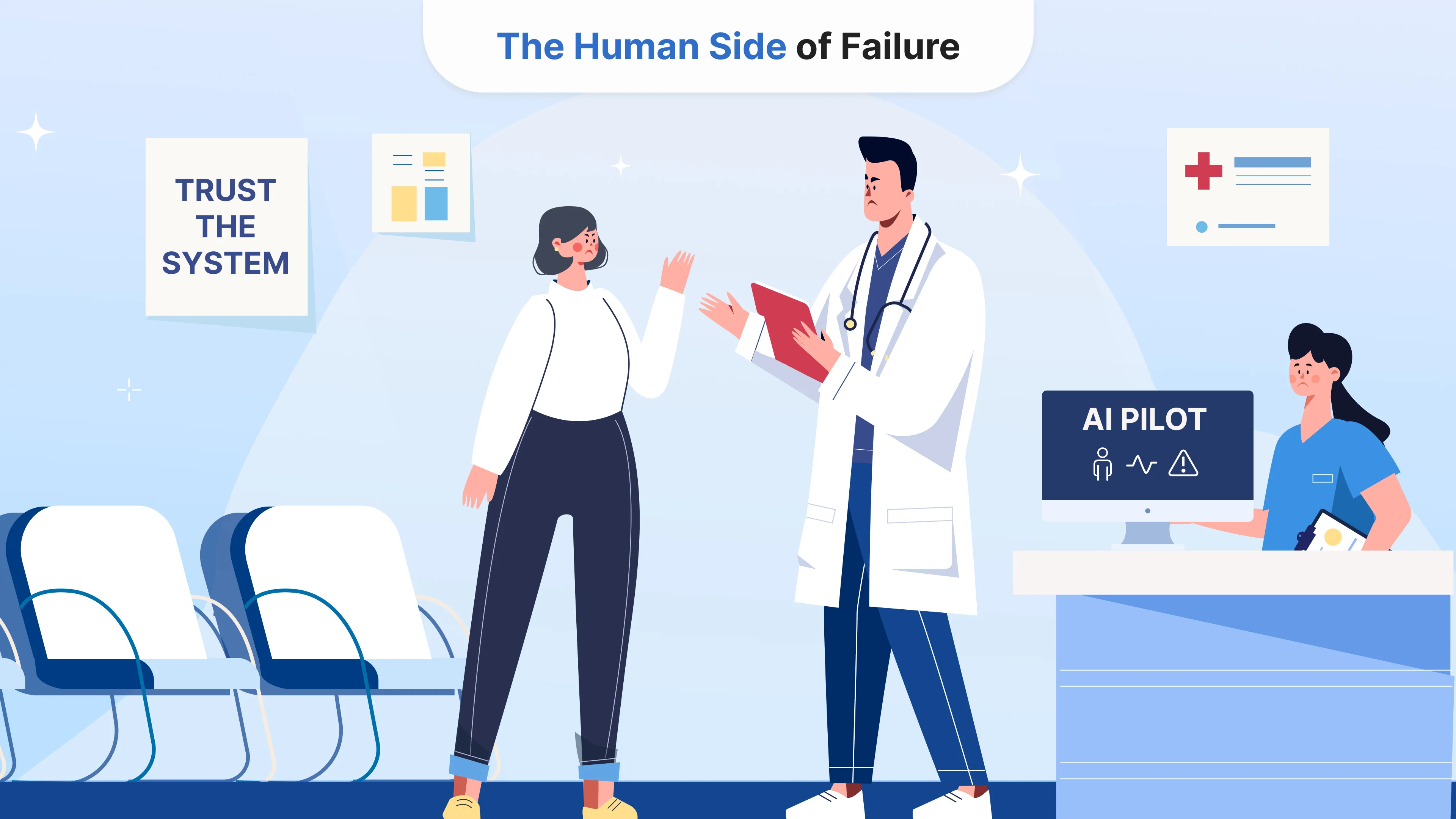
Walk into a hospital ward during an AI pilot, and the promise feels tangible. A new interface glows on the nursing station monitor. Posters encourage staff to “trust the system.” There’s talk of how this will free up time for patient care.
Fast-forward a few weeks, and the mood often shifts. Nurses complain about yet another set of pop-ups. A resident mutters that the alerts always seem to trigger at the wrong time, forcing them to override the system just to keep pace with patient rounds. In the break room, someone jokes that the AI is like “a student who’s read half the textbook but still wants to run the class.” The enthusiasm that once fueled the pilot is replaced with eye-rolls and workarounds.
For clinicians, these failed experiments carry a cost. Trust, once lost, is hard to regain. Every system that over-promises and under-delivers adds to a creeping skepticism: Will the next tool actually help, or will it just slow us down again? Burnout deepens when pilots pile onto existing workloads instead of easing them. And when projects vanish without explanation, staff are left wondering why their time was spent adapting to something that disappeared overnight.
Patients, too, feel the ripple effects. Some notice delays when clinicians wrestle with new interfaces. Others are uneasy when doctors seem distracted by alerts on the screen rather than focusing fully on them. A pilot that promised “better care” but delivers friction instead risks damaging not just efficiency, but the human connection at the core of healthcare.
And then there are the politics. When one department embraces a system while another resists, tensions emerge. IT may champion the technology, while physicians push back. Executives may want to showcase “innovation,” while frontline staff quietly disengage. The cracks left by a failed pilot are not just technical — they are cultural.
In the end, the human side of failure is about more than inconvenience. It’s about trust, morale, and the willingness to try again. If staff begin to view every new AI initiative as “just another experiment that won’t last,” the real innovation cost is far higher than a single failed pilot; it’s the erosion of the hospital’s collective capacity to change.
What Hospitals Do After a Failed Pilot
When an AI pilot fails, hospitals rarely talk about it openly. More often, the technology is quietly retired - the system switched off, the vendor thanked, and staff left to return to old routines. On the surface, it looks as if nothing ever happened, but the experience lingers. Clinicians who invested time in learning a new tool often feel their efforts were wasted, and executives become more cautious about signing off on the next experiment.
In other cases, failure leads not to silence but to compromise. A project that promised to predict sepsis or patient deterioration might survive in a reduced form, reborn as a simple dashboard or monitoring tool. The “AI” branding fades, but fragments of the pilot remain, integrated into workflows in ways that are less ambitious but more usable. This kind of adaptation shows that even failed projects can leave behind useful traces, provided hospitals are willing to salvage rather than discard.
Sometimes, the breakdown is blamed on the technology provider rather than the concept of AI itself. Hospitals swap vendors, hoping a different partner will succeed where the first one fell short. The cycle begins again, but ideally with lessons applied - stricter contracts, more transparent validation, and clearer definitions of what success looks like.
And occasionally, failure sparks genuine reflection. Instead of moving on quickly, leadership and frontline staff ask uncomfortable but necessary questions: Was the data ready? Did the tool align with clinical workflows? Did the hospital provide enough training and support? When these postmortems are done well, they help create a culture where pilots are not just experiments but learning opportunities. Though painful in the short term, this approach builds resilience. It shifts hospitals from chasing hype to systematically understanding how technology fits into patient care.
What happens after failure, then, is just as important as why failure occurred. A failed pilot can either deepen cynicism and stall innovation, or it can become the foundation for more thoughtful, sustainable adoption. The choice depends less on the technology itself than on how the organization responds once the excitement has faded and the hard lessons remain.
From Failure to Maturity
The collapse of AI pilots in hospitals is not simply a story of wasted time or money. It is a mirror reflecting the deep structural challenges of bringing new technology into medicine. When projects unravel, they reveal patterns that go far beyond a single vendor or algorithm. Poor data readiness, misaligned workflows, lack of clinician trust, and weak governance - each failure leaves behind lessons about what it actually takes to integrate innovation into one of the most complex and sensitive environments we have.
If there is a common thread, it is that scalability must be part of the design from the very beginning. Too often, pilots are built as isolated experiments, optimized for controlled conditions but unprepared for the chaotic realities of hospitals. By the time they reach the ward, they cannot connect with existing systems or sustain performance over time. Likewise, no project will thrive without clinicians as co-designers. When doctors and nurses feel like reluctant testers rather than partners, adoption falters. Trust is further strained when systems act as black boxes, offering predictions without explanations. Hospitals that take failure seriously increasingly demand not only performance but also transparency and interpretability.
Another lesson is that technology alone is never the full solution. Data infrastructure, governance, and organizational culture matter just as much as algorithms. The Epic Sepsis Model reminded everyone that AI trained on clean datasets can stumble when confronted with fragmented medical records. These failures teach hospitals that innovation cannot be outsourced to vendors alone; it requires internal readiness, from cleaned data pipelines to staff education and leadership willing to learn from mistakes.
A recent MIT report underscored how widespread this problem is, revealing that 95% of AI pilots across industries fail to deliver tangible results. For healthcare, this statistic should not simply alarm investors; it should push leadership to rethink what pilots are for. Instead of treating them as shortcuts to innovation, hospitals can use them as structured learning exercises: a way to identify gaps, pressure-test workflows, and build the foundations for genuine adoption. Failure, in this sense, is not the end of the story but the necessary prelude to maturity.
The future of AI in hospitals will not be decided by the brilliance of individual algorithms but by the willingness of organizations to learn from missteps. Every failed pilot adds to a collective body of knowledge about what it really takes to make technology serve care. Hospitals that embrace this cycle - experiment, fail, reflect, adapt are the ones most likely to turn today’s setbacks into tomorrow’s breakthroughs. Progress will not come from flawless first attempts. It will come from the resilience built in the aftermath of failure.

Tell us about your project
Fill out the form or contact us

Tell us about your project
Thank you
Your submission is received and we will contact you soon
Follow us