
What Happens During an AI Automation Discovery Call?
- What is an AI automation discovery call?
- Why companies book an AI automation discovery call
- What happens before the call?
- What happens during the call?
- What you do not need to know before the call
- What questions you may be asked
- What happens after the call?
- How to prepare for an AI automation discovery call
- Red flags in a discovery call
- Why BeKey starts with discovery
- From hesitation to clarity
Many companies are interested in AI automation but hesitate before booking a call. The hesitation is understandable. A founder, COO, or operations lead may know that manual work is slowing the team down, but still be unsure whether the problem is specific enough for AI, whether the company has the right data, or whether the conversation will turn into a generic sales pitch.
That uncertainty often stops people from taking the next step. An AI automation discovery call is meant to remove that uncertainty. It is not a commitment to build anything. It is a structured conversation to understand your workflow, identify where manual work creates friction, and see whether AI automation is actually a practical fit.
The goal is simple: to help both sides understand whether there is a real automation opportunity worth exploring further.
What is an AI automation discovery call?
An AI automation discovery call is an initial conversation between your team and an AI consulting or automation partner. It focuses on your current workflows, operational bottlenecks, manual tasks, systems, data sources, and business goals.
Unlike a general product demo, the call should not start with a tool. It should start with your workflow.
A useful discovery call looks at how work happens today: where requests come from, who handles them, which systems are involved, what steps are repetitive, where delays appear, and which decisions need human review.
For warm leads and hesitant buyers, this matters because the first call should not pressure you into a solution. It should clarify whether AI can help, what kind of automation may be realistic, and what questions need to be answered before implementation.
Why companies book an AI automation discovery call
Companies usually book an AI automation discovery call when they know something in operations is not scaling, but they are not sure what the right fix should be.
Common reasons include:
teams spend too much time on repetitive manual tasks;
staff copy data between systems;
documents, forms, or messages require too much manual review;
customer, patient, or internal requests are routed manually;
reporting depends on spreadsheets;
follow-ups are missed or delayed;
existing tools cover only part of the workflow;
leadership wants to explore AI but does not know where to start.
The call helps turn a broad concern into a clearer operational question.
Instead of saying, “We need AI,” the team can start asking, “Which workflow is creating the most friction, and could AI reduce it safely?”
What happens before the call?
Before the call, you usually do not need a perfect technical brief. In many cases, a short description of the workflow problem is enough.
For example:
“Our team spends too much time reviewing intake forms.”
“We receive many documents and still process them manually.”
“Customer support keeps answering the same operational questions.”
“Our managers cannot see where cases get stuck.”
“We use several tools, but staff still copy information between them.”
“We want to understand whether AI automation makes sense for this workflow.”
If you already have process maps, screenshots, sample forms, reports, or examples of repeated tasks, they can be useful. But they are not required for the first conversation.
The discovery call exists partly because many companies do not yet know how to describe the problem in technical terms.
What happens during the call?
A good AI consulting discovery call usually has several parts.
1. Understanding the business context
The conversation often starts with the bigger business goal. This helps connect automation to something measurable.
The goal may be reducing operational workload, improving turnaround time, scaling without hiring at the same rate, improving customer experience, reducing missed follow-ups, increasing visibility, or preparing a product workflow for growth.
This matters because AI automation should not be implemented just because it is possible. It should support a real business or operational outcome.
2. Mapping the current workflow
Next, the team discusses how the workflow works today.
This includes where the process starts, what information enters the workflow, which people or teams handle it, which systems are used, what steps happen manually, and where delays or errors appear.
For example, if the workflow involves document processing, the discussion may include document types, formats, volume, review steps, missing information, routing rules, and where the extracted data needs to go.
If the workflow involves support or internal requests, the discussion may include request categories, repeated questions, escalation rules, approval needs, and current response processes.
The goal is not to document every detail immediately. The goal is to understand whether the workflow has enough structure for AI automation assessment.
3. Identifying repetitive work
AI automation is most useful when there is repeated work that follows recognizable patterns.
During the call, the team may identify tasks such as summarizing documents, classifying requests, extracting data, drafting responses, checking for missing information, routing cases, searching internal knowledge, preparing reports, or tracking follow-ups.
This step helps separate real automation opportunities from tasks that are too rare, too unclear, or too judgment-heavy to automate first.
4. Discussing data and systems
The call also covers the systems and data involved.
This may include CRMs, EHRs, ERPs, billing platforms, support tools, scheduling systems, document storage, email, internal databases, product backends, spreadsheets, or dashboards.
The key questions are: where does the input live, where should the output go, and which systems need to be connected?
This part of the call helps identify whether the project would require integration, workflow redesign, custom development, or a smaller automation layer.
5. Defining human review and risk
AI automation does not mean removing people from every step.
For many workflows, especially in healthcare, legal, insurance, fintech, HR, and other sensitive operations, human review remains essential.
During the discovery call, the team should discuss which outputs can be automated, which ones should be suggested, which cases need approval, and which situations must be escalated.
This helps avoid unrealistic expectations and makes the automation safer from the beginning.
6. Clarifying what success would look like
A discovery call should also help define how success might be measured.
Depending on the workflow, useful metrics may include reduced manual review time, faster processing, fewer repeated questions, lower backlog, fewer missed follow-ups, better completion rates, improved visibility, or reduced dependency on spreadsheets.
This matters because AI automation should create measurable value, not just produce impressive outputs.
What you do not need to know before the call
You do not need to know which AI model to use, whether the solution should be built, bought, or integrated, you do not need to prepare a technical specification, and you do not need to have every workflow documented perfectly.
A discovery call is meant to help clarify these questions. The most useful thing you can bring is a real workflow problem: where work is slow, manual, repetitive, unclear, or hard to scale.
What questions you may be asked
During an automation assessment call, you may be asked questions such as:
What workflow are you hoping to improve?
Who handles this process today?
How often does this task happen?
What systems or tools are involved?
What information does the team need to complete the task?
Where does the process slow down?
Which steps are manual or repetitive?
What exceptions happen often?
What should stay human-led?
What would make this project successful?
What happens if this workflow does not improve?
These questions are not meant to test your preparation. They help uncover whether the workflow is a good candidate for automation.
What happens after the call?
After an AI automation discovery call, the next step depends on what was learned.
Sometimes the outcome is a recommendation to start with a deeper workflow audit or AI opportunity assessment. Sometimes the next step is a small prototype, integration plan, or technical discovery. Sometimes the conclusion is that the workflow needs redesign before automation. And sometimes AI may not be the best first solution.
A useful call should leave you with more clarity than you had before.
You should understand whether the workflow is likely to be a good automation candidate, what information is still needed, what risks or constraints matter, and what next step would make sense.
How to prepare for an AI automation discovery call
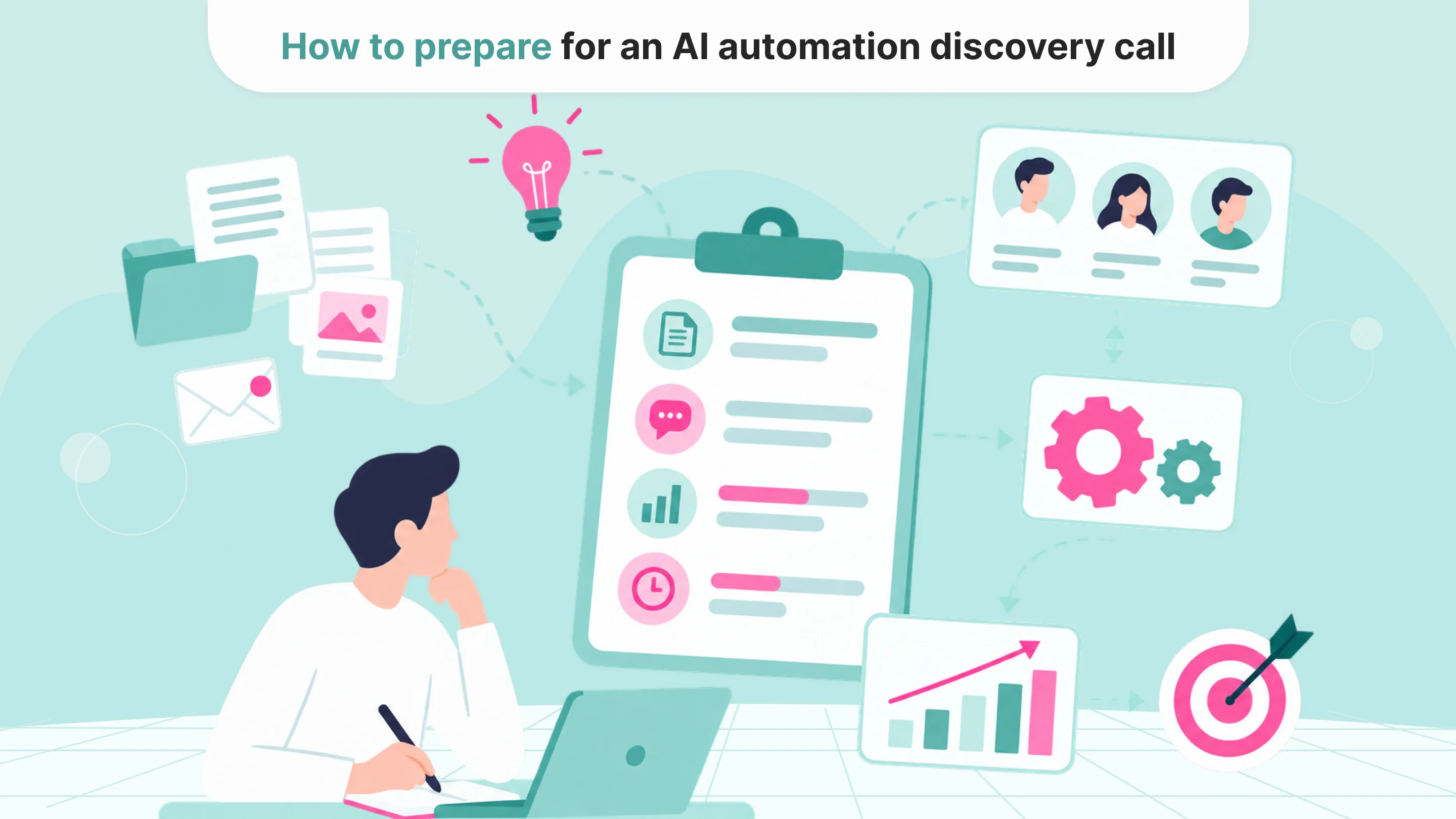
You can prepare by thinking through a few practical points.
First, choose one or two workflows that create visible friction. These may involve documents, intake, support, reporting, follow-ups, internal requests, or manual coordination.
Second, estimate how often the workflow happens and who is involved. Exact numbers are not always necessary, but rough volume helps evaluate potential value.
Third, identify what makes the workflow difficult today. Is the problem missing information, repeated review, disconnected tools, unclear ownership, too many exceptions, or lack of visibility?
Fourth, think about what outcome would matter. Faster processing, fewer manual steps, better routing, reduced backlog, improved customer experience, or clearer reporting are all valid goals.
This preparation helps make the call more specific and useful.
Red flags in a discovery call
Not every discovery call is equally helpful.
A weak call may jump immediately into a product demo, push one tool before understanding the workflow, ignore data and integration realities, avoid questions about human review, or promise full automation without discussing risk.
A strong discovery call should feel more like an operational conversation than a sales script.
The partner should ask about workflows, systems, bottlenecks, exceptions, review needs, success metrics, and business goals. They should also be willing to say when AI is not the right first step.
Why BeKey starts with discovery
BeKey uses discovery calls to understand the workflow before recommending a solution.
That matters because AI automation can take different forms. Some companies need a workflow audit. Some need custom AI development. Some need integration between existing tools. Some need an internal AI assistant, a document automation system, a support workflow, or a product-level AI feature.
The right next step depends on the workflow, the data, the systems, the risk level, and the business goal.
An AI automation discovery call helps define that next step clearly, without assuming the answer before the conversation starts.
From hesitation to clarity
Booking an AI automation discovery call does not mean committing to a large project. It means taking a practical first step toward understanding whether AI automation makes sense for your workflow.
For hesitant buyers, this can be the most useful part of the process. The call helps turn a vague idea like “we should use AI” into a clearer view of where AI may help, what needs to be prepared, and what should happen next.
The goal is not to automate everything. The goal is to find the right starting point.
Faq
What is an AI automation discovery call?
+An AI automation discovery call is an initial conversation focused on your workflows, manual tasks, systems, data, bottlenecks, and business goals. It helps determine whether AI automation is a practical fit.
Do I need a technical brief before the call?
+No. A short description of the workflow problem is usually enough. The call is designed to help clarify technical and operational requirements.
What happens during an AI consulting discovery call?
+The call usually covers business goals, current workflows, repetitive tasks, systems and data, human review needs, risks, success metrics, and possible next steps.
Will I get a solution during the first call?
+You may get an initial direction, but a full solution usually requires deeper workflow review or technical discovery. The first call is mainly for understanding fit and next steps.
What types of workflows can be discussed?
+Common workflows include document processing, intake, customer or patient support, internal knowledge search, reporting, follow-up tracking, task routing, and operational coordination.
Is a discovery call only for companies ready to build immediately?
+No. It is also useful for companies that are exploring AI automation, comparing options, or trying to understand whether a workflow is worth automating.

Tell us about your project
Fill out the form or contact us

Tell us about your project
Thank you
Your submission is received and we will contact you soon
Follow us