
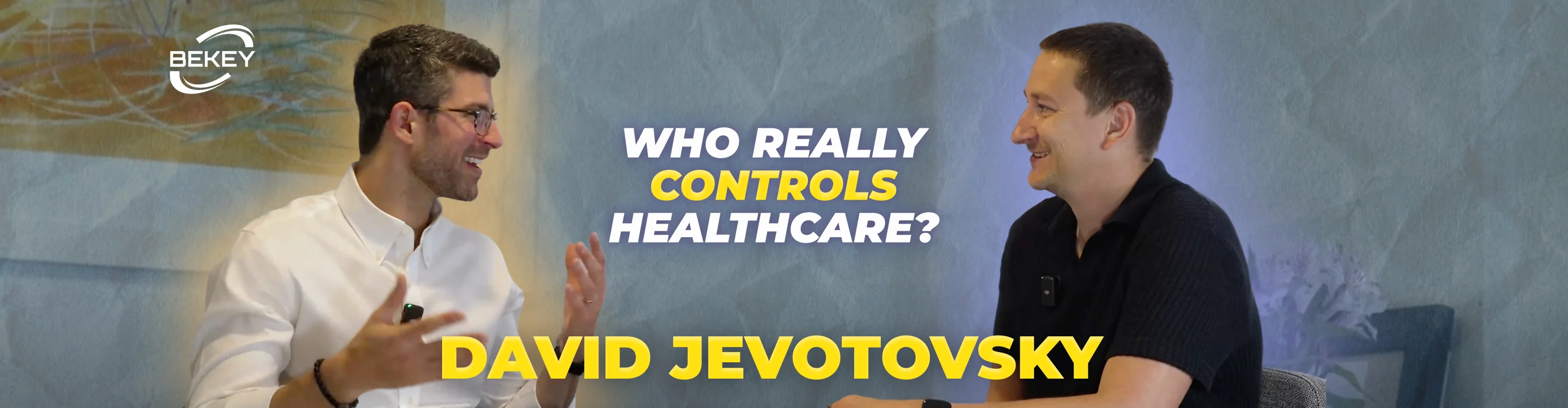
Who Really Controls Healthcare? A Doctor’s Honest Take with David Jevotovsky
In a recent episode of Digital Health Interviews, we spoke with David Jevotovsky, a soon-to-be pain medicine fellow with an MD/MBA background, currently completing his residency in physical medicine and rehabilitation. His path sits at the intersection of clinical care and system-level thinking, and that dual perspective shapes how he sees both the problems and opportunities in healthcare today.
What makes this conversation particularly compelling is not just the range of topics, from burnout to AI, from payer dynamics to hackathons, but the coherence of his worldview. For Jevotovsky, healthcare is not broken in a single place. It’s structurally misaligned. And fixing it requires more than better tools; it requires rethinking who holds power in the system.
The Core Tension: Who Actually Controls Care?
One of the clearest threads in the conversation is the question of control.
Healthcare, as Jevotovsky describes it, has moved away from physician-led decision-making toward a system where payers and hospital networks increasingly dictate what care patients receive. This shift creates a fundamental tension in clinical practice: the doctor sitting across from the patient may know what needs to be done, but that decision is often constrained by external approvals, reimbursement rules, and institutional processes.
This is not framed as a simple “good vs bad” dynamic. Payers and hospital systems exist for a reason - financial sustainability matters. But the imbalance creates friction at the exact point where trust is most critical: the patient-physician relationship.
For Jevotovsky, the real challenge is not removing stakeholders, but rebalancing them. The future of healthcare depends on whether these actors can move from competing priorities to a more collaborative model, one where clinical insight, financial reality, and patient outcomes are aligned rather than in conflict.
Why Many Physicians Are Looking Beyond the Clinic
Jevotovsky’s MD/MBA background is not incidental; it reflects a broader trend.
More physicians are stepping into operational, entrepreneurial, and leadership roles not because they want to leave medicine, but because they want to scale their impact. The traditional model, seeing patients one by one, is deeply meaningful, but inherently limited.
As he puts it, the one-on-one connection is irreplaceable. But the systemic barriers that prevent patients from accessing care, long wait times, insurance denials, and fragmented workflows cannot be solved at the bedside alone.
This is why physician-led startups and digital health companies are gaining traction. They combine clinical understanding with system awareness, allowing them to target the root causes of inefficiency rather than just the symptoms.
Burnout Isn’t Just About Workload
When the conversation turns to burnout, Jevotovsky offers a perspective that goes beyond the usual narrative.
It’s not simply about long hours or heavy workloads, although those exist. The deeper issue is structural misalignment between effort, reward, and life progression. Medical training demands years of delayed gratification, financial debt, and personal sacrifice, while peers in other fields move ahead more quickly in terms of income, stability, and life milestones.
This creates a psychological tension that isn’t easily solved by policy tweaks or wellness programs.
At the same time, he makes it clear: most physicians would still choose the profession again. The problem is not the meaning of the work; it’s the system surrounding it.
Technology: Both the Problem and the Attempted Fix
The discussion around technology is one of the most nuanced parts of the interview.
Electronic health records (EHRs), originally designed to improve efficiency, have had the opposite effect in many cases. By making documentation easier, they have enabled systems to demand more documentation. The result is an expanded administrative burden rather than a reduced one.
This is where the “Frankenstein” effect emerges: new layers of technology are introduced to fix the problems created by previous layers.
AI scribes are a perfect example. They are not solving a fundamentally new problem; they are trying to reclaim time lost to earlier digital systems. And yet, despite that irony, Jevotovsky remains cautiously optimistic.
He sees AI not as another burden, but as a potential correction mechanism. Ambient listening tools, for instance, could restore something that has been eroded over time: the ability for physicians to focus fully on the patient during the visit.
Instead of typing into a screen, the doctor can maintain eye contact, listen actively, and engage more naturally, while the system handles documentation in the background.
That shift, even if incremental, has outsized implications for both patient experience and physician satisfaction.
Will AI Replace Doctors? Not Quite, But It Will Reshape the Role
On the question of AI replacing physicians, Jevotovsky takes a balanced stance.
He acknowledges that AI can handle certain categories of care, especially low-complexity, high-volume cases like minor acute conditions. In those scenarios, automation can improve efficiency without compromising quality.
But he draws a clear line when it comes to complex care.
Medicine is not purely data-driven. Physical examination, contextual judgment, and the ability to interpret inconsistencies between imaging and symptoms remain deeply human skills. Training a system to fully replicate that level of reasoning, especially in edge cases, is far from straightforward.
Rather than replacement, the more realistic future is redistribution. AI will absorb routine tasks, triage simpler cases, and augment decision-making, allowing physicians to focus on the areas where human expertise is most valuable.
Clinical Decision Support and the Trust Problem
Another area of interest is clinical decision support systems.
These tools can aggregate patient data, analyze patterns, and suggest potential diagnoses or treatment pathways. In theory, they offer a powerful layer of guidance, especially in environments where physicians lack immediate peer support, such as rural settings.
But adoption is not just a technical issue. It’s a trust issue.
Healthcare is historically slow to adopt new technologies, not because of resistance to innovation, but because the cost of error is high. For these systems to gain traction, they need to demonstrate not just accuracy, but reliability, transparency, and alignment with clinical workflows.
Jevotovsky sees them as valuable guides, not replacements for judgment. The physician remains the final decision-maker, but better tools can expand the information available at that moment.
Innovation from the Ground Up: Hackathons as a Catalyst
One of the most distinctive parts of Jevotovsky’s work is his involvement in innovation initiatives like PainConnect and the Hacking Pain hackathon.
Unlike traditional startup competitions that showcase existing companies, these hackathons start earlier in the process. Participants, often students, are introduced to real problems in pain medicine, interact with stakeholders across the ecosystem, and then build solutions from scratch within a short timeframe.
What makes this model powerful is its inclusivity.
It brings together physicians, engineers, designers, patients, investors, and system representatives into the same space. That cross-functional collaboration is where meaningful innovation tends to emerge, not in isolated silos, but at the intersection of perspectives.
The fact that some of these projects evolve into actual companies shortly after the event is not just a success metric; it’s a signal that the problems being addressed are real and the solutions are grounded in actual needs.
Advice to Founders: Start with Conversations, Not Code
When asked what advice he would give to digital health founders, Jevotovsky doesn’t talk about fundraising, growth tactics, or product-market fit.
He talks about conversations.
Reaching out to experts, asking questions, and learning from different stakeholders, these are the steps that shape better ideas and more viable businesses. In a space as complex as healthcare, assumptions are expensive. Direct insight is invaluable.
This aligns closely with broader investor perspectives in the field, where depth of understanding, not speed of execution, often determines success.
The founders who succeed are not the ones who build fastest, but the ones who take the time to understand how the system actually works.
A System That Needs Alignment, Not Just Innovation
What emerges from this conversation is a clear takeaway: healthcare does not lack ideas, tools, or talent.
What it lacks is alignment. Between physicians and payers. Between technology and workflows. Between innovation and real-world constraints.
AI, startups, and new care models can all contribute to progress, but only if they engage with the system as it is, not as we wish it to be.
Jevotovsky’s perspective reflects a generation of clinicians who are no longer content to operate within existing constraints. They are stepping into hybrid roles, building new solutions, and pushing for a system that works better, not just for providers, but for patients.
And if there is one consistent thread across everything he says, it’s this: meaningful change in healthcare doesn’t happen in isolation.
It happens when the right people start talking to each other.

Tell us about your project
Fill out the form or contact us

Tell us about your project
Thank you
Your submission is received and we will contact you soon
Follow us