

Why AI Adoption Challenges Stall Projects Between Idea and Implementation
- The gap between “AI could help” and “we know what to do next”
- Why broad AI ideas are hard to approve
- The meeting loop problem
- Internal alignment is often the real blocker
- The hidden fear of choosing the wrong first use case
- When “we need more data” becomes one of the barriers to AI adoption
- Security and compliance should shape the project, not stop it late
- Tool research can create false progress
- The missing bridge: from idea to AI implementation roadmap
- How companies can restart a stalled AI project
- What leaders should decide before implementation
- What AI automated task planning can and cannot solve
- From stalled idea to focused next step
Most AI projects do not begin with resistance. They begin with agreement. A founder sees a workflow that takes too much manual effort. A COO sees teams losing time between systems, spreadsheets, and repeated follow-ups. A product leader sees a feature that could make the product smarter or more useful. Someone says, “AI could help with this,” and almost everyone in the room agrees. Then nothing happens.
The idea is discussed again in the next meeting. Someone suggests looking at tools. Someone else asks about data, security, cost, or integration. The team agrees that the opportunity is worth exploring, but no one is sure what the next step should be. Weeks pass, the idea remains in a planning document, and the company moves on to more urgent work.
This is one of the most common AI adoption challenges. Projects rarely stall because teams lack ideas. They stall because the idea never becomes a clear operational decision. That is why many teams need an AI readiness check before moving deeper into planning: it helps clarify whether the workflow, data, systems, ownership, and review rules are prepared enough for implementation.
The gap between “AI could help” and “we know what to do next”
The early stage of an AI project often feels productive because the problem is easy to recognize. Teams know where work is slow. They can point to repeated support questions, manual reporting, document review, customer intake, internal knowledge search, or status updates that consume too much time.
But recognizing friction is not the same as defining an implementation path. “AI could help with support” is an idea. “We want AI to classify incoming support tickets, draft responses for low-risk requests, and escalate sensitive cases to human review inside our existing support platform” is an implementation direction.
That difference matters. Many companies stay stuck because their AI conversations remain at the first level. The team agrees that AI could be useful, but the idea is too broad to assign, scope, budget, or approve.
This is where the project starts to lose momentum. Not because it is a bad idea, but because it is not specific enough to move forward.
Why broad AI ideas are hard to approve
Executives and founders often want AI projects to be practical, measurable, and connected to business value. But many AI ideas arrive in vague language: automate operations, improve support, use AI for documents, add an assistant, make reporting smarter, reduce manual work.
These ideas are directionally useful, but they are difficult to approve because they leave too many questions open. What exactly will change? Who will use it? What workflow will it affect? What will AI produce? What systems will be involved? What will happen after the output? How will the company know if it worked?
When those answers are missing, leadership may not reject the idea, but they also may not fund it. The project remains “interesting,” which is often where AI initiatives go to die.
A strong AI automation planning process needs to turn broad interest into a concrete decision: what workflow, what outcome, what risk level, what owner, and what next step.
The meeting loop problem
One reason AI projects stall is that they create too many conversations but not enough decisions.
A typical stalled project moves through the same loop several times. The business team describes the pain point. The technical team asks for more clarity. Leadership asks for expected ROI. Security or compliance asks what data will be used. Product or operations asks how this will fit into the existing workflow. Everyone raises valid questions, but no one owns the process of turning them into a decision.
The result is not disagreement. It is drift. The idea keeps being discussed, but every conversation ends with another unresolved question. Should the team buy a tool or build something custom? Is the data ready? Is this a workflow problem or a product feature? Is the first use case too risky? Should the company start with a prototype or a deeper assessment?
Without a clear decision framework, the project becomes hard to move forward even when everyone believes the problem is real.
Internal alignment is often the real blocker
AI projects touch several parts of the company at once, which makes alignment harder than it looks.
A founder may want speed and differentiation. A COO may want fewer manual tasks and better visibility. A product leader may want a feature that improves user experience. Engineering may worry about system complexity. Compliance may focus on risk and review. Finance may need a clearer business case. End users may simply want the process to become less frustrating.
All of these perspectives can be valid, but they often point in different directions. This is why AI project failures often start before anything is built. The project does not fail because the model is weak. It fails because stakeholders are not aligned on what the project is supposed to achieve.
A support automation idea can become a chatbot, an internal assistant, a routing system, a knowledge search tool, or a response-drafting workflow. Each option has different costs, risks, integrations, and success metrics. Until the team agrees on which problem is being solved, implementation cannot begin properly.
The hidden fear of choosing the wrong first use case
Many companies also stall because they are afraid of choosing the wrong AI project. This fear is reasonable. The first AI initiative often carries extra pressure. It may influence leadership confidence, team adoption, vendor decisions, and future budget. If the first project fails, the company may become more hesitant about AI overall.
Because of that, teams sometimes overanalyze the decision. They compare too many use cases, explore too many tools, and wait for perfect certainty. But perfect certainty rarely comes before implementation. What companies need instead is a structured way to compare opportunities.
A first AI project does not need to transform the whole company. It needs to solve a specific, repeated, measurable problem with manageable risk and a clear path to use.
The best first use case is usually not the most ambitious one. It is the one that can prove value quickly and teach the organization how to implement AI responsibly.
When “we need more data” becomes one of the barriers to AI adoption
Data readiness matters, but it can also become a vague reason for delay.
Many AI projects stop at the phrase “our data is not ready.” Sometimes that is true. The company may have scattered systems, incomplete records, outdated documentation, or no clear data access rules. But in other cases, the team has not yet defined what data is actually needed for the first use case.
Not every AI project requires a perfect data environment. A workflow-specific automation may only need a limited set of documents, tickets, forms, messages, or knowledge sources to start. The question should not be “Is all our company data ready for AI?” The better question is “What data does this specific workflow need, and is it good enough for a controlled first version?”
This shift helps teams move from abstract concern to practical assessment. Instead of treating data as a general blocker, they can define the minimum viable data set, identify gaps, and decide whether the project should move forward, narrow its scope, or start with cleanup.
Security and compliance should shape the project, not stop it late
Security and compliance questions often appear after an AI idea has already gained momentum. That timing creates frustration because the project may suddenly feel blocked by risk concerns.
In reality, these questions should not be treated as late-stage approvals. They should shape the project from the beginning.
For sensitive or regulated workflows, the team needs to understand what data AI can access, what outputs it can generate, who can review them, where logs are stored, how escalation works, and what the system should never do independently. These questions do not necessarily make the project impossible. They define the boundaries that make implementation safer.
A project stalls when risk is either ignored too long or discussed too broadly. A better approach is to define risk around the specific use case. Automating internal document summaries is different from generating patient-facing messages. Drafting a low-risk response is different from making a coverage, legal, clinical, or financial decision.
When risk is specific, it becomes easier to design around it.
Tool research can create false progress
Another reason AI projects stall is that teams start researching tools before they have defined the workflow.
Tool research feels like progress. Teams compare platforms, schedule demos, read vendor pages, and collect pricing. But if the workflow is still unclear, tool research can create more confusion instead of clarity.
One vendor may offer a chatbot. Another may offer document extraction. Another may offer workflow automation. Another may offer an internal assistant. Each tool frames the problem differently, and the team may start adapting its needs to whatever the tool can do.
This is how companies end up with an almost-right solution: a tool that covers part of the workflow but leaves the most important operational gaps manual.
Tool selection should come after the company understands the use case. Sometimes the answer is SaaS. Sometimes it is integration. Sometimes it is custom development. Sometimes the workflow needs redesign before any tool makes sense. This is where AI automation services can help teams move from tool comparison to a clearer implementation path.
The missing bridge: from idea to AI implementation roadmap
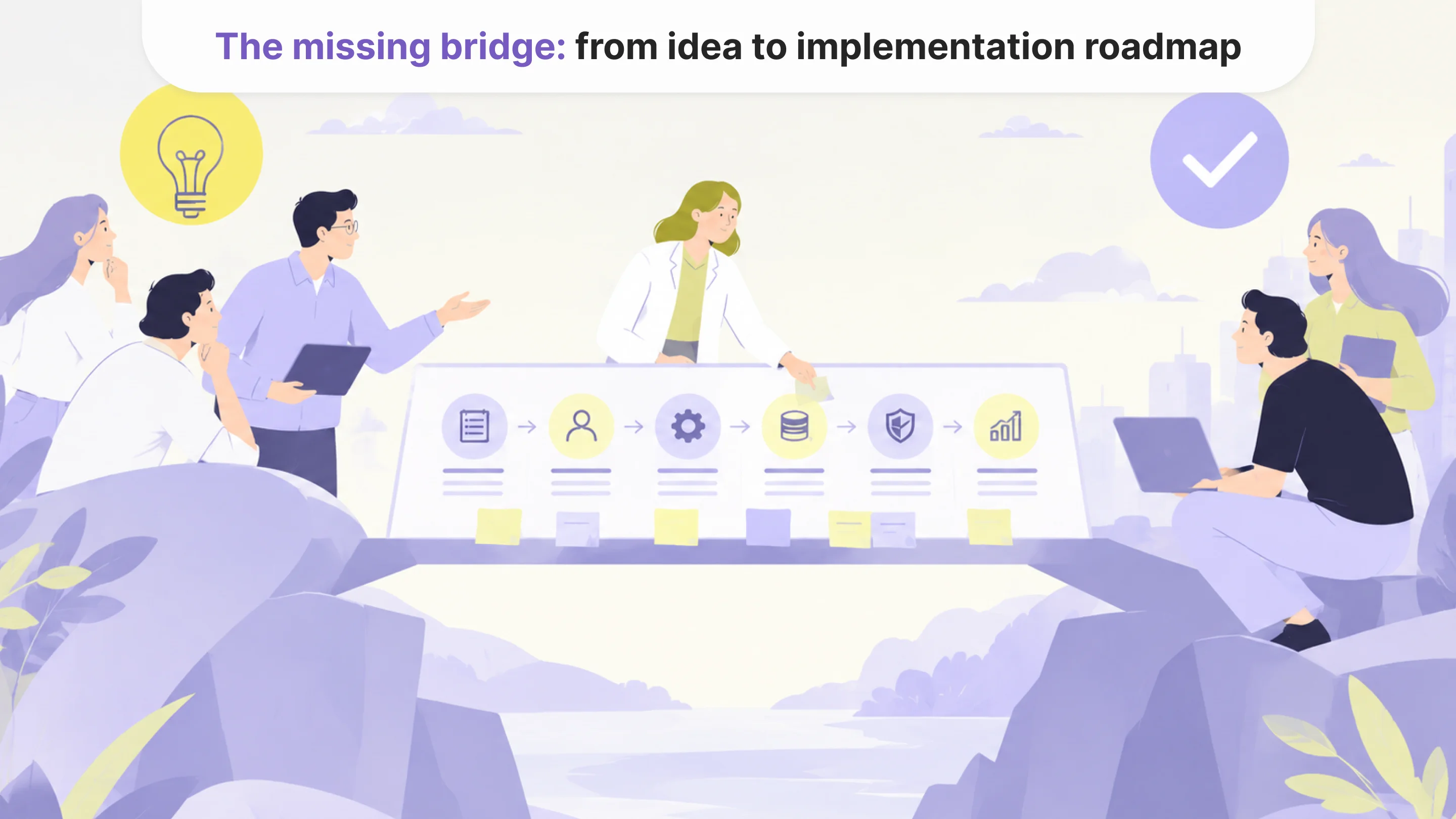
The reason many AI projects stall is that companies skip the bridge between idea and execution.
They move from “we should use AI here” directly to “what tool should we buy?” or “can engineering build this?” But there needs to be a middle step: turning the idea into an AI implementation roadmap.
That roadmap does not need to be long or complex. It should answer a few practical questions. What workflow are we improving? Who owns it? What part of the process should AI support? What data is required? What systems are involved? What needs human review? What is the smallest useful version? How will success be measured? What should happen after the first version works?
This bridge is what turns AI from a conversation into a project. Without it, teams either stay in discussion or jump into execution too early. Both paths create risk. One leads to no progress. The other leads to a prototype that does not fit real operations.
How companies can restart a stalled AI project
A stalled AI project does not always need to be abandoned. In many cases, it needs to be narrowed.
Instead of trying to revive the full idea, teams can return to the workflow and define one practical starting point. For example, “AI for support” may become “classify incoming requests and suggest routing.” “AI for documents” may become “extract key fields from one document type and flag missing information.” “AI for reporting” may become “summarize weekly operational updates from approved sources.”
This narrowing makes the project easier to evaluate. It reduces the number of stakeholders, clarifies the data needed, lowers risk, and creates a more realistic first step.
From there, the team can decide whether the project needs a discovery call, workflow audit, prototype, integration plan, vendor comparison, or internal process cleanup.
The goal is not to make the AI idea smaller forever. The goal is to make the first step clear enough to move.
What leaders should decide before implementation
Before an AI project moves into implementation, leadership should make several decisions explicit.
They should decide which workflow matters most, what business outcome the project should support, who owns the workflow, what AI should and should not do, which systems need to be connected, what review rules are required, and how success will be measured.
These decisions do not need to answer every technical question. But they should give the team enough direction to stop circling the same idea.
A useful implementation roadmap gives everyone a shared understanding of what is being built, why it matters, what is out of scope, and what must be true for the project to continue.
This is especially important for founders, COOs, and product leaders because they are often responsible for translating AI ambition into practical operational work.
What AI automated task planning can and cannot solve
AI automated task planning can help when the workflow already has enough structure. For example, AI can help suggest next steps, create task queues, assign routine follow-ups, prioritize requests, or surface cases that need review.
But task planning does not fix unclear strategy by itself. If the team has not defined the workflow, owner, rules, systems, and success metrics, AI may simply create more tasks around an already messy process.
This is why AI automated task planning should usually come after the company has clarified the use case. The goal is not to make AI generate activity. The goal is to make sure the right work moves forward in the right order.
From stalled idea to focused next step
AI projects rarely stall because the original idea is useless. More often, they stall because the idea remains too broad, too unowned, or too disconnected from a concrete workflow decision.
The companies that move faster are not always the ones with the most advanced AI strategy. They are the ones that can turn interest into a focused next step: assess this workflow, validate this use case, prepare this data set, design this review process, connect these systems, or test this first version.
That is the real difference between AI enthusiasm and AI implementation. A useful AI idea should not stay trapped in meetings, planning documents, or tool comparisons. It should become a clear decision about what workflow to improve first and what needs to happen next.

Tell us about your project
Fill out the form or contact us

Tell us about your project
Thank you
Your submission is received and we will contact you soon
Follow us