
Why Revenue Leakage Is Often an Operations Problem, Not a Billing Problem
- Revenue leakage often starts before billing
- Where RCM bottlenecks usually appear
- The spreadsheet problem
- Why adding more people does not always fix leakage
- How operations leaders should look at revenue leakage
- Where AI can help
- What should stay human-owned
- How to find where revenue is leaking
- From billing fixes to operational control
When healthcare organizations talk about revenue leakage, the conversation often starts with billing. Was the claim coded correctly? Was the payer billed on time? Was the denial handled properly? Did the team miss an appeal window?
Those questions matter. But they do not always reveal the full problem.
In many healthcare companies, revenue leakage is not caused by one billing error. It happens because of operational friction around the billing process: missing documents, unclear ownership, delayed handoffs, manual status checks, disconnected systems, and claims that sit too long before someone knows what to do next.
That makes healthcare revenue leakage a broader operations issue, not just a billing issue.
For CFOs, COOs, and RCM leaders, this distinction is important. If leakage is treated only as a billing department problem, companies may add more billing staff, tighten review rules, or push teams to work faster. But if the real issue is workflow design, those fixes may not solve the root cause.
Revenue leakage often starts before billing
Revenue leakage does not begin only after a claim is submitted. In many cases, the problem starts earlier in the workflow.
A missing authorization, incomplete intake form, unclear eligibility information, incorrect patient details, missing documentation, or delayed provider note can all create downstream revenue risk. By the time the billing team sees the issue, the organization may already be dealing with preventable friction.
This is why revenue cycle operations need to be viewed as an end-to-end workflow, not a set of isolated billing tasks.
A claim depends on what happened before it reached the billing team: intake quality, documentation completeness, scheduling accuracy, payer requirements, clinical notes, internal communication, and timely handoffs. If any of these steps break down, revenue may be delayed, denied, underpaid, or written off later.
The billing team may be the one trying to fix the issue, but they are not always the team that created it.
Where RCM bottlenecks usually appear
Revenue cycle problems often hide in small operational gaps. Each gap may seem manageable on its own, but together they slow down cash flow and increase the amount of manual work needed to collect revenue.
Common RCM bottlenecks include:
incomplete patient or insurance information;
missing or delayed documentation;
unclear handoffs between intake, clinical, billing, and operations teams;
manual claim status checks;
payer responses that require repeated review;
follow-up tasks tracked in spreadsheets;
denial reasons that are not grouped or analyzed;
unclear ownership for stuck claims;
limited visibility into aging accounts and next actions.
These are not purely billing issues. They are process issues. They show that information is not moving clearly from one step to the next.
For example, if a claim is denied because documentation is missing, the denial may appear in the billing queue. But the root cause may be an intake workflow, provider documentation delay, or document routing problem. If leaders only look at the billing queue, they may miss the operational source of the leakage.
The spreadsheet problem
One of the clearest signs of revenue cycle friction is spreadsheet dependence.
Spreadsheets are often used to track claims that need follow-up, payer responses, missing documents, appeals, denial categories, or high-priority accounts. They are flexible and easy to start with, but they become risky when revenue-impacting work depends on manual updates.
A spreadsheet may not show the latest payer response. A claim may be assigned to the wrong person. A follow-up date may be missed. A high-value claim may sit behind lower-value tasks. Managers may not know which accounts are stuck or why.
This does not mean spreadsheets are the enemy. It means they are often a symptom that the workflow has outgrown its tools.
When RCM teams rely on spreadsheets to keep revenue moving, the organization should ask a deeper question: why is the main system not giving the team enough visibility, prioritization, or workflow support?
Why adding more people does not always fix leakage
When revenue cycle teams fall behind, the first instinct is often to add staff. More people can help in some cases, especially when claim volume has increased. But hiring alone does not fix a broken workflow.
If the process is fragmented, more staff may simply mean more people checking portals, updating spreadsheets, searching for missing documents, and asking other teams for clarification. The organization increases labor cost without reducing the operational causes of leakage.
The better question is not only “Do we need more people?” but “Why does this work require so much manual effort?”
If staff spend hours identifying what happened, locating documents, interpreting payer responses, or deciding who owns the next step, the workflow needs better structure. That may involve process redesign, automation, better integrations, clearer ownership, or AI-assisted support.
Revenue leakage often decreases when teams reduce unnecessary manual work, not when they simply add more people to perform it.
How operations leaders should look at revenue leakage
For COOs, healthcare revenue leakage should be treated as a workflow visibility problem.
The key questions are operational:
Where does revenue-impacting work slow down?
Which claims require the most manual follow-up?
Which payer responses create the most confusion?
Which documents are most often missing?
Which handoffs create delays?
Which tasks are tracked outside the system?
Which teams are repeatedly waiting on each other?
Which claims age before anyone takes action?
Answering these questions helps leaders see whether leakage is caused by billing errors, process delays, documentation gaps, or coordination failures.
It also helps separate symptoms from root causes. A denial is a symptom. A missed follow-up is a symptom. A claim aging in a queue is a symptom. The root cause may be upstream documentation, poor routing, unclear ownership, lack of prioritization, or disconnected systems.
Where AI can help
AI is not a complete solution for revenue leakage. But it can help healthcare teams reduce some of the operational friction that causes leakage.
AI can support revenue cycle operations by:
summarizing payer responses;
classifying denial reasons;
detecting missing documents;
flagging claims that need attention;
prioritizing high-value or time-sensitive accounts;
preparing follow-up drafts;
grouping similar issues for root-cause analysis;
helping managers see where claims are stuck.
The value of AI is not that it magically fixes billing. Its value is in making work more visible, structured, and easier to act on.
For example, if staff spend too much time reading payer notes, AI can summarize them. If claims are delayed because required documents are missing, AI can help detect those gaps earlier. If managers cannot see why accounts are aging, AI-assisted classification can reveal common bottlenecks.
The best use of AI in this context is not replacing RCM expertise. It is helping RCM teams use that expertise faster and more consistently.
What should stay human-owned
Revenue cycle workflows affect payment, compliance, documentation, and sometimes patient financial responsibility. That means AI should not make final decisions without human review.
AI should not independently decide whether to write off a claim, approve an appeal, determine medical necessity, or override payer rules. These decisions require policy, expertise, and accountability.
A safer approach is to use AI for preparation and prioritization. It can organize information, flag issues, and suggest next steps, while humans make final decisions on sensitive or high-value actions.
This distinction matters. The goal is not to automate the entire revenue cycle. The goal is to reduce the avoidable operational friction that slows the cycle down.
How to find where revenue is leaking
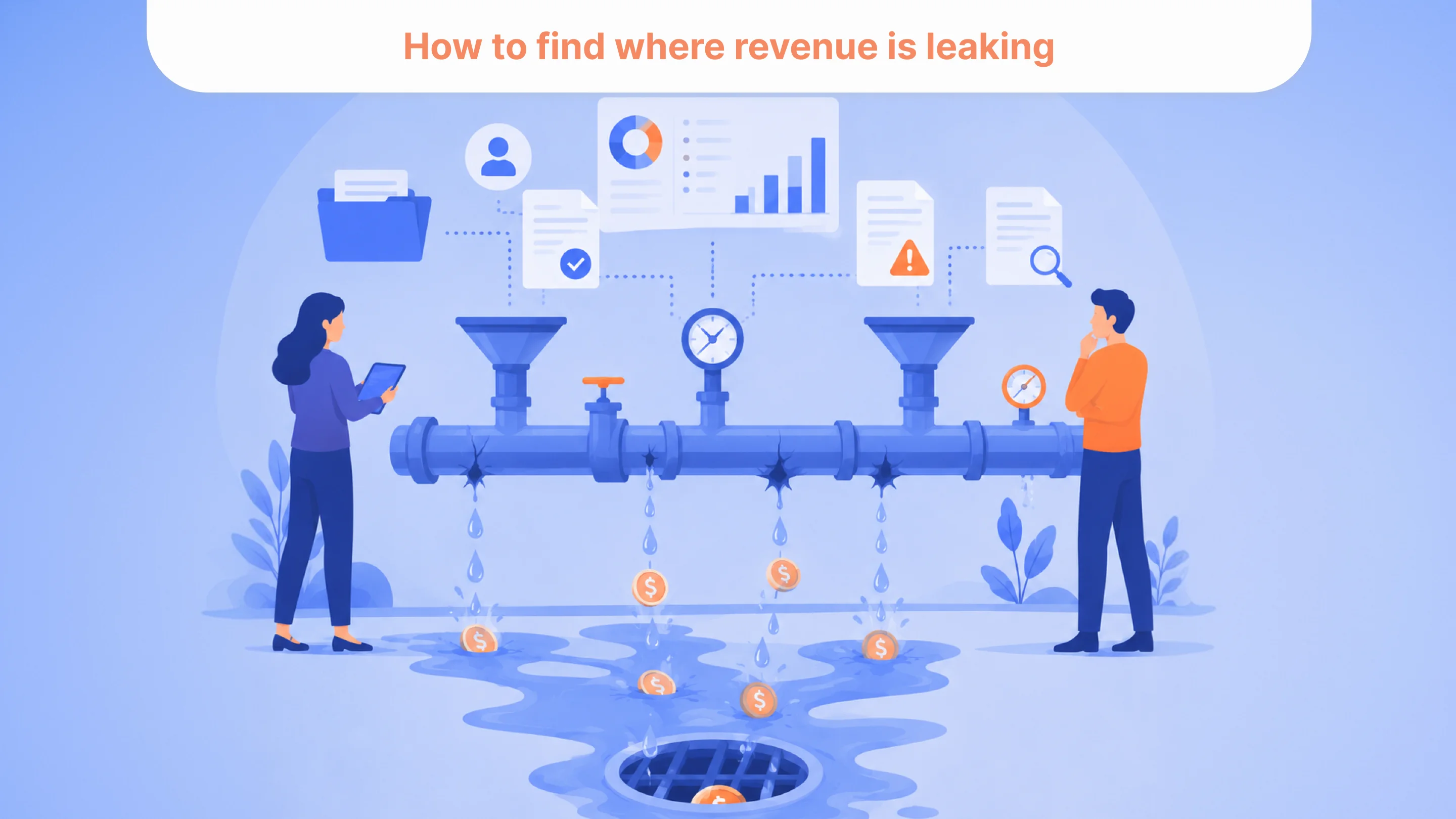
The first step is not buying a tool. It is mapping the workflow.
Healthcare teams should look at the full path from patient intake to payment. Where does information enter the system? Where is it checked? Where does it wait? Which teams touch it? Which documents are required? Which tasks are repeated? Which statuses are unclear? Which claims need the most manual effort?
A simple revenue leakage map should include:
intake and eligibility issues;
documentation delays;
authorization gaps;
claim submission problems;
payer response handling;
denial follow-up;
appeal workflows;
payment posting and reconciliation;
aging accounts and write-offs.
This map helps leaders see whether leakage is concentrated in billing execution or spread across operations.
In many cases, the biggest opportunities are not where teams expected. A company may assume the billing team is the bottleneck, only to find that missing intake data, delayed documentation, or manual routing is creating most of the downstream work.
From billing fixes to operational control
Healthcare revenue leakage is often treated as a billing problem because that is where the financial impact becomes visible. But the causes often begin earlier and spread wider: intake errors, missing documents, delayed handoffs, unclear ownership, manual tracking, and limited visibility.
Fixing leakage requires more than asking billing teams to work faster. It requires looking at revenue cycle operations as a connected workflow.
When teams understand where revenue gets stuck, they can prioritize the right improvements: better intake checks, clearer documentation flows, smarter routing, AI-assisted follow-up, or stronger visibility into aging claims.
For CFOs, COOs, and RCM leaders, the most useful question is not only “How much revenue are we losing?” It is: “Where in the workflow is revenue leaking, and what would change if we fixed that step first?
That is where better revenue protection begins.

Tell us about your project
Fill out the form or contact us

Tell us about your project
Thank you
Your submission is received and we will contact you soon
Follow us