

Your First 6 Months of AI Adoption: A Roadmap for Healthcare and Ops Teams
AI adoption in healthcare rarely fails at the point of technical feasibility. Most organizations are able to identify relevant use cases, test models, and launch initial pilots without significant difficulty.
The challenge emerges after that initial phase.
Early experiments often remain isolated. Systems are tested but not integrated into workflows. Outputs are generated but not consistently used. Over time, what began as a promising initiative turns into a set of disconnected tools with limited operational impact.
This pattern is not caused by a lack of capability. It is the result of unclear sequencing.
AI adoption is not a single implementation step. It requires coordinated changes across operations, data infrastructure, and governance. Without a structured approach, even well-defined use cases struggle to move beyond pilot environments.
This is particularly relevant in operational workflows. Areas such as documentation, coding, scheduling, and back-office processes offer clear opportunities for automation, but realizing that value depends on how AI is introduced into existing systems, not just on model performance.
This article outlines a structured roadmap for the first six months of AI adoption. It focuses on how healthcare and operations teams move from initial discovery to production systems that are embedded in day-to-day workflows.
The emphasis is not on individual tools, but on sequencing, what needs to happen at each stage, and how decisions made early in the process affect the ability to scale later.
Month 0–1: From Ideas to Real Use Cases
The first stage of AI adoption is often treated as an exploration phase. Teams generate ideas, review potential applications, and evaluate what seems technically possible.
In practice, the primary task at this stage is selection, not exploration.
Most organizations identify more use cases than they can realistically implement. Without prioritization, efforts become fragmented, and resources are spread across initiatives that do not reach production.
Focusing on Operational Friction
Effective use case selection starts with identifying areas where manual effort is highest and outcomes are measurable. In healthcare operations, this typically includes documentation workflows, coding processes, scheduling coordination, and back-office tasks.
These areas share two important characteristics. First, they involve repetitive work that can be partially automated. Second, they are directly tied to operational metrics such as time spent, error rates, or revenue cycle performance.
Use cases that are difficult to measure or loosely connected to workflows tend to stall, even if they appear technically interesting.
Defining Scope and Constraints Early
At this stage, it is also important to define boundaries. What data will be used? Which systems will be involved? What level of accuracy is required? How will outputs be validated?
These questions are often deferred, but they determine whether a use case can move beyond experimentation.
A narrowly defined use case with clear inputs, outputs, and success criteria is more likely to reach production than a broader initiative without operational constraints.
Establishing Baselines
Before any implementation begins, teams need to understand the current state of the workflow they are trying to improve. This includes measuring time spent on tasks, identifying common failure points, and documenting how work is currently performed.
Without this baseline, it becomes difficult to evaluate whether AI is actually improving the process.
The outcome of the first month should not be a working system, but a clearly defined use case with measurable objectives and realistic constraints. This becomes the foundation for the next phase.
Month 2–3: Pilot and Early Validation
Once a use case is clearly defined, the next step is to validate it in practice.
At this stage, the objective is not to build a complete system, but to test whether the proposed approach works under real conditions. This includes evaluating model outputs, understanding failure modes, and identifying gaps between expected and actual behavior.
Testing Against Real Workflows
Pilots who rely on idealized data or controlled scenarios tend to produce misleading results. Validation must reflect how the system will be used in production.
This means testing with real inputs, real users, and real workflow constraints. Documentation systems should be evaluated on actual clinical conversations. Coding tools should be tested against real claims. Back-office automation should interact with live processes, even if in a limited scope.
The goal is to understand how the system behaves when exposed to the variability of real operations.
Identifying Failure Patterns
Early validation is as much about identifying what does not work as it is about confirming what does.
Where does the system produce incorrect outputs?
Which edge cases create problems?
How often does human intervention become necessary?
These questions define the boundaries of the system. Without this understanding, it is difficult to design reliable workflows around AI outputs.
Defining Acceptance Criteria
At the end of this phase, teams need to decide whether the system is ready to move forward.
This decision should be based on defined criteria, not subjective impressions. What level of accuracy is required? How much manual correction is acceptable? Does the system reduce effort or simply shift it?
Clear acceptance thresholds help prevent premature scaling of systems that are not yet stable.
The outcome of months two and three should be a validated use case with known limitations, not a fully optimized solution.
Month 3–4: Integration into Workflows
The transition from pilot to workflow integration is where most AI initiatives lose momentum.
A system that performs well in isolation does not automatically create value. It must be embedded into the way work is actually done.
From Output to Action
During the pilot phase, AI systems generate outputs - summaries, coding suggestions, classifications. At this stage, those outputs are typically reviewed separately from the core workflow.
Integration requires connecting outputs to decisions.
Who uses the output?
At what point in the process?
What action follows?
If these questions are not clearly defined, the system remains an additional step rather than a replacement for existing work.
Reducing, Not Shifting Work
A common failure pattern at this stage is that AI introduces new review steps without removing existing ones.
For example, documentation may be generated automatically, but clinicians still need to rewrite or heavily edit it. Coding suggestions may be provided, but coders still perform the same level of review. In these cases, the system increases complexity instead of reducing it.
Effective integration requires redesigning the workflow so that AI outputs replace specific tasks, not just assist them.
Defining Ownership
Another critical aspect of integration is ownership:
Who is responsible for validating outputs?
Who handles exceptions?
Who maintains the system over time?
Without clear ownership, issues remain unresolved, and the system gradually loses trust among users.
Making the System Usable
At this stage, usability becomes as important as accuracy.
If the system requires switching between tools, navigating additional interfaces, or interpreting unclear outputs, adoption will remain low regardless of performance.
The outcome of this phase should be a system that is part of the workflow, not adjacent to it. Outputs are used consistently, actions are clearly defined, and the system reduces the effort required to complete tasks.
Month 4–5: Monitoring and Governance
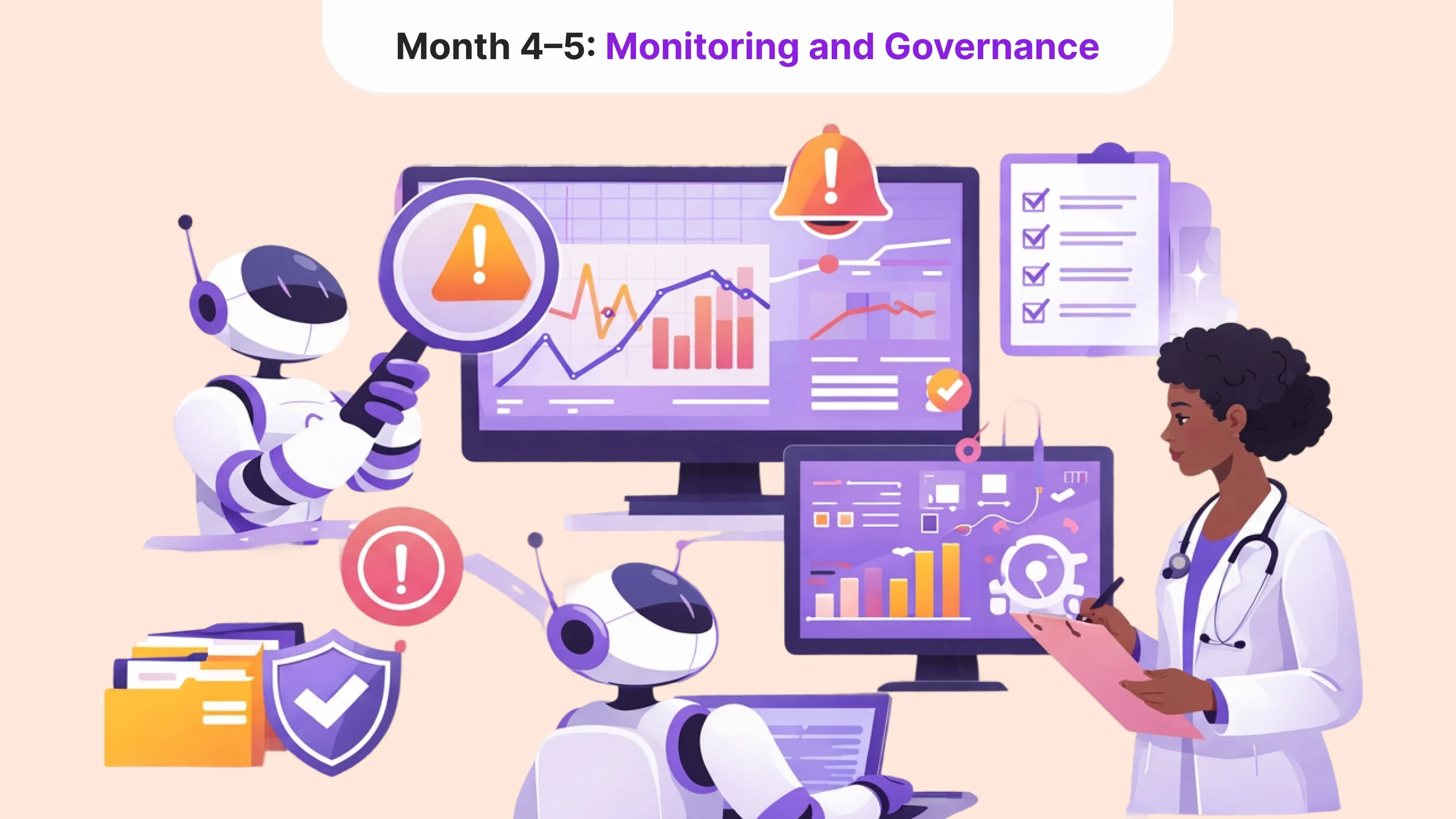
Once AI systems are integrated into workflows, the focus shifts from implementation to control.
At this stage, the primary question is not whether the system works, but whether it continues to work as expected over time.
Tracking System Behavior
AI systems in healthcare operations do not remain static. Documentation patterns evolve, coding rules change, and workflows are adjusted. These changes affect how the system performs, even if the model itself does not change.
Monitoring must therefore focus on outputs, not just system performance. Are documentation summaries complete and accurate? Do coding suggestions align with current requirements? Are automated workflows producing the expected results?
Without this visibility, systems can degrade without being noticed.
Detecting Drift Early
One of the key risks at this stage is gradual misalignment.
Outputs may remain acceptable at a surface level while becoming less accurate or less compliant over time. This type of drift is difficult to detect without a structured evaluation.
Regular sampling, review processes, and comparison against defined baselines are required to identify these changes early.
Establishing Governance Processes
Governance at this stage is operational, not theoretical.
It includes defining how often systems are reviewed, who is responsible for evaluation, and how updates are managed. It also involves maintaining traceability, being able to understand how outputs were generated and how decisions were made.
These processes ensure that AI systems remain aligned with both operational needs and regulatory requirements.
The outcome of this phase is not a “finished” system, but a controlled one, a system that can be monitored, adjusted, and trusted as it evolves.
Month 5–6: Scaling What Works
By this stage, the organization has at least one use case that is integrated, monitored, and delivering measurable value.
The focus shifts to scaling, but not in the sense of expanding everything at once.
Scaling Through Replication
The most effective approach is to replicate what already works.
Instead of introducing entirely new use cases, teams extend existing patterns to adjacent workflows. A documentation system may be applied to additional departments. A coding workflow may be expanded to new service lines. A back-office automation tool may be adapted for other internal processes.
This approach reduces risk because it builds on validated systems rather than starting from scratch.
Avoiding Premature Expansion
A common mistake at this stage is attempting to scale too quickly.
Introducing multiple new use cases at once can recreate the fragmentation seen in early stages. Systems become harder to manage, governance processes are stretched, and consistency is lost.
Scaling should follow demonstrated stability, not initial success.
Building Internal Capability
Long-term scaling depends on internal ownership.
Teams need the ability to monitor systems, evaluate performance, and manage updates without relying entirely on external support. This includes both technical capabilities and operational understanding.
Without this, scaling remains dependent on individual initiatives rather than becoming part of the organization’s operating model.
From Pilot to Operational System
The first six months of AI adoption determine whether AI remains an experiment or becomes part of everyday operations.
Successful initiatives follow a clear progression: focused use case selection, realistic validation, integration into workflows, ongoing monitoring, and controlled scaling.
Each stage builds on the previous one. Skipping steps or compressing timelines typically leads to systems that perform well in isolation but fail to deliver sustained value.
For healthcare and operations leaders, the challenge is not identifying where AI can be applied, but managing how it is introduced into the organization..
If you are planning or evaluating AI adoption across your organization, our AI adoption roadmap engagement can help define a structured path from early use cases to scalable systems.

Tell us about your project
Fill out the form or contact us

Tell us about your project
Thank you
Your submission is received and we will contact you soon
Follow us