
Edge vs Cloud AI in Medical Devices: What Actually Works
In discussions about medical device AI, the question of where AI should run often comes up early. Should processing happen on the device, or in the cloud?
In theory, both options are viable. In practice, the choice is rarely binary.
Healthcare IoT systems operate under constraints that make this decision more complex than a typical architecture trade-off. Latency matters when signals require immediate response. Safety matters when device behavior can affect patient outcomes. Regulatory considerations limit how quickly systems can be updated or modified.
At the same time, not all decisions require real-time processing, and not all models can run within device constraints.
As a result, most production systems do not rely exclusively on edge or cloud AI. They combine both, assigning different responsibilities to each layer based on what the system needs to do.
This article examines what actually works in practice when designing edge AI healthcare systems for medical devices. We focus on how latency, safety, and regulatory constraints shape architectural decisions, and why hybrid approaches are often the most reliable option.
Why “Edge vs Cloud” Is the Wrong Question
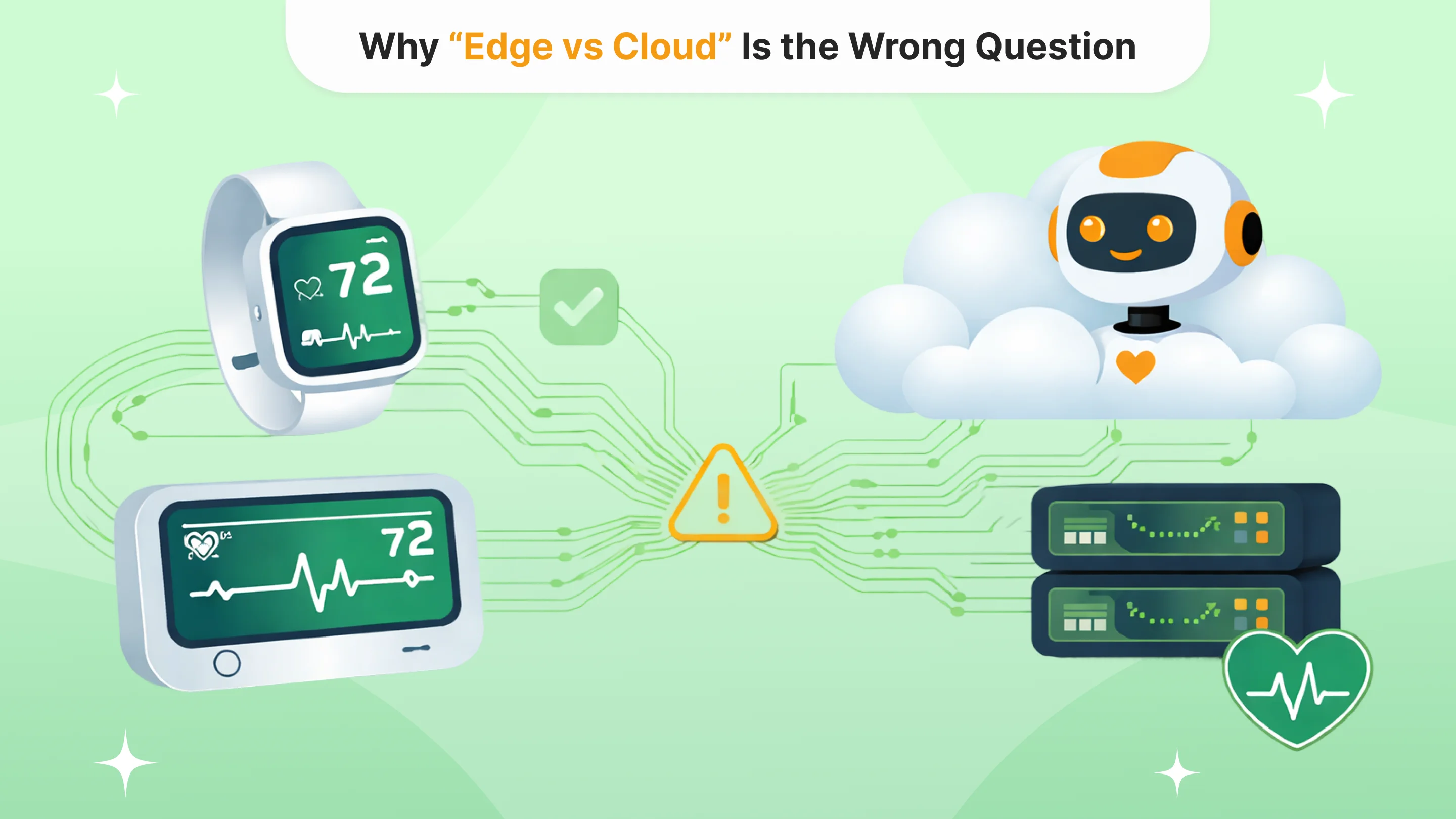
In discussions about medical device AI, the question of where intelligence should run is often framed as a binary choice: on the device or in the cloud. In practice, this framing leads to weak architectures.
Edge and cloud solve different problems, and trying to force everything into one layer usually creates trade-offs that affect reliability, performance, or maintainability. Most production systems combine both, assigning responsibilities based on what the system needs to do.
On-device processing exists to ensure immediacy and reliability. Devices must be able to capture signals, apply basic logic, and respond to critical conditions without depending on connectivity. However, firmware is constrained by limited compute, memory, and strict validation requirements, which makes it unsuitable for complex or frequently changing models.
Cloud-based processing allows for aggregation of data over time, integration across systems, and execution of more advanced models. It also supports continuous monitoring and iteration. At the same time, it introduces latency and dependency on network availability.
The practical task is to define which decisions belong in each layer. Immediate, safety-critical responses should remain on the device. Context-dependent analysis and optimization should happen in the cloud.
Systems that fail to make this distinction tend to break in predictable ways. Pushing too much logic to the edge makes systems rigid and hard to update. Centralizing everything in the cloud increases latency and reduces reliability. Effective architectures start by mapping decision types to system constraints, not by choosing one environment over the other.
Latency: Where Timing Actually Matters
Latency in medical device AI is not just a technical parameter. It directly affects how the system behaves in real conditions.
Not all signals require the same response time. Some events demand immediate action, while others can be processed with delay without affecting outcomes.
For example, a critical physiological change may require the system to trigger an alert instantly. In these cases, relying on cloud processing introduces risk. Even small delays caused by network latency or connectivity issues can be unacceptable. Edge processing becomes necessary to ensure that the system can respond in real time and remain functional under all conditions.
At the same time, many decisions benefit from additional context and do not require immediate response. Identifying trends, analyzing patterns over time, or combining multiple signals typically requires historical data and more computational resources. These tasks are better handled in the cloud, where models can operate with a broader context and be updated continuously.
The challenge is not minimizing latency everywhere, but applying it correctly. Systems that treat all signals as time-critical tend to overload the device, while systems that rely entirely on the cloud introduce unnecessary delays.
Effective architectures classify events based on urgency and context requirements. Immediate, safety-related actions remain on the edge. Context-driven analysis is handled in the cloud. This separation allows systems to remain both responsive and adaptable.
Safety: What Must Never Depend on the Cloud
In medical device AI systems, not every function can be treated equally. Some parts of the system directly affect patient safety, and those parts cannot depend on external conditions such as connectivity or system availability.
Safety-Critical Logic Must Be Deterministic
Any logic that is responsible for detecting critical conditions or triggering immediate alerts must behave predictably. This includes threshold-based triggers, basic anomaly detection, and safety-related responses.
If these functions depend on cloud processing, the system introduces a point of failure. Network latency, outages, or data transmission delays can prevent the system from responding in time. In safety-critical scenarios, this is not an acceptable trade-off.
For this reason, core safety logic is typically implemented on the device or as close to the device as possible. This ensures that the system can operate independently and respond immediately when needed.
Cloud Dependency Introduces Risk
Cloud systems are valuable for analysis and coordination, but they are not guaranteed to be available at all times. Even in well-designed architectures, there can be delays, partial outages, or integration issues.
When critical decisions depend on cloud availability, the system becomes less reliable under real-world conditions. This is especially relevant in remote patient monitoring AI, where devices may operate in environments with unstable connectivity.
The design principle is straightforward: if a delayed response can affect patient safety, that logic should not depend on the cloud.
Separating Safety from Optimization
At the same time, not all decisions carry the same level of risk. Many AI-driven features are intended to improve efficiency, detect trends, or optimize workflows rather than respond to immediate threats.
These functions can safely rely on cloud-based processing. They benefit from additional context, more complex models, and continuous updates. Separating safety-critical logic from optimization logic allows the system to remain both reliable and flexible.
Clear boundaries between these layers are essential. Without them, systems either become overly constrained or introduce unnecessary risk.
Regulatory Constraints: Why Updates Are Hard
Beyond technical considerations, medical device AI systems operate under regulatory constraints that significantly affect how architectures can evolve.
Firmware Is Not Easily Changed
Updates to device firmware are not equivalent to deploying changes in a typical software system. Modifications may require validation, certification, and controlled rollout processes. Even relatively small changes can trigger regulatory review, depending on the device classification and jurisdiction.
This makes frequent iteration at the device level difficult.
As a result, logic embedded in firmware is expected to remain stable over time. Systems that depend on frequent model updates or rapid experimentation are poorly suited for this layer.
Cloud Enables Iteration
Cloud-based components operate under a different model. They allow teams to update models, adjust thresholds, monitor performance, and iterate more quickly. This flexibility is critical for improving AI systems over time.
For many healthcare IoT AI architectures, the cloud becomes the primary environment for model evolution, while the device maintains stable, validated behavior.
Designing for Regulatory Reality
Effective systems are designed with this separation in mind. Stable, safety-critical logic is kept on the device, where changes are controlled and infrequent. More adaptive components are placed in environments where iteration is possible without introducing regulatory friction.
Ignoring this distinction often leads to systems that are either too rigid to improve or too risky to deploy.
What Actually Works in Practice
In real-world medical device AI systems, the most reliable architectures are neither fully edge-based nor fully cloud-based.
They are structured around clear responsibilities.
Devices handle signal capture, basic processing, and safety-critical responses. Cloud systems handle aggregation, contextual analysis, and continuous improvement. Alerting and workflow layers connect these components to clinical processes in a way that reduces manual effort rather than increasing it.
This distribution is not about technical preference. It reflects the constraints of latency, safety, and regulation that define how healthcare systems operate.
For digital health and medtech teams, the goal is not to choose between edge and cloud, but to design systems where each layer does what it can do reliably.
For a broader view of how sensor data is transformed into actions within clinical workflows, see our Smart Devices + AI pillar article.
If you are designing or scaling medical device AI systems and need to define the right balance between edge and cloud, our medtech + AI consulting services can help align architecture with clinical and operational requirements.

Tell us about your project
Fill out the form or contact us

Tell us about your project
Thank you
Your submission is received and we will contact you soon
Follow us