
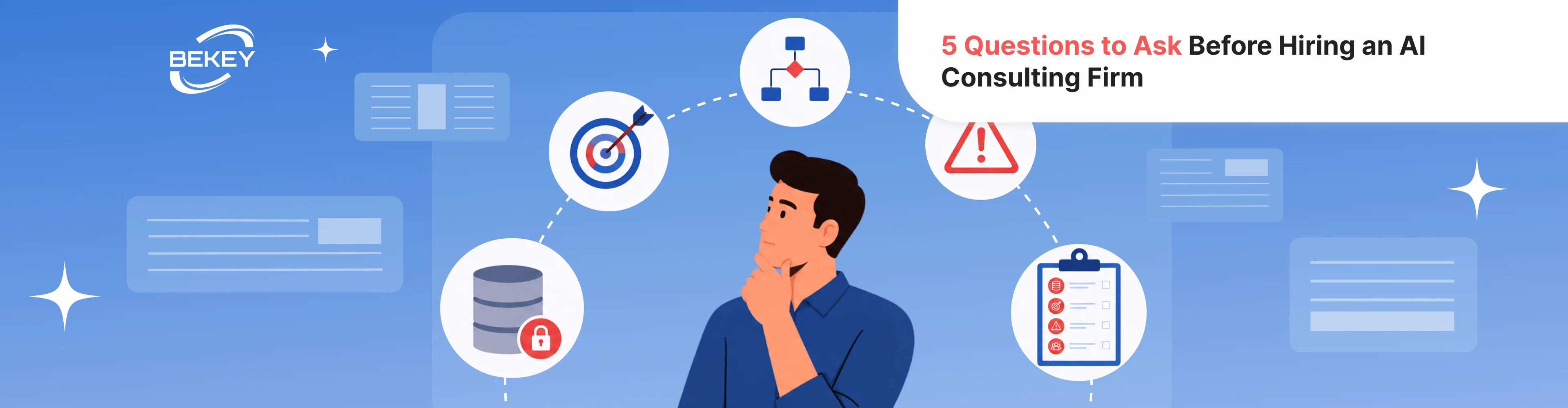
5 Questions to Ask Before Hiring an AI Consulting Firm
- 1. How will this fit into our existing workflow?
- 2. What data do you actually need, and how will you work with it?
- 3. What will success look like in practice?
- 4. What tends to go wrong in projects like this?
- 5. Who owns the system after it’s live?
- What You Are Actually Buying
- Asking Better Questions Changes the Outcome
By the time most teams start looking for an AI consulting partner, they already know roughly what they want to build.
There is usually a use case, some internal agreement, and a decision that it’s time to move from exploration to implementation. At this point, attention shifts to vendors and how to choose one without deep technical expertise.
This is where things get tricky. On paper, many firms look similar. They show relevant examples, describe a structured approach, and sound confident about delivery. It’s hard to tell how different they really are.
The differences only become clear later, once the project is already in progress.
The problem is not that teams ask the wrong questions. It’s that the most important ones are often skipped or asked too late.
This article focuses on a small set of questions that help surface those differences earlier, before decisions are locked in.
1. How will this fit into our existing workflow?
This is usually where the gap between a good idea and a working system becomes visible.
Most proposals describe what the system does, but not where it actually lives inside your process. Ask them to walk you through a real scenario. Where does the system appear? Who uses it? What step does it replace? What happens if the output is wrong?
If the answer stays at a high level, it usually means the workflow hasn’t been thought through in detail.
In healthcare, especially, workflows are rarely clean. There are exceptions, manual steps, and workarounds that have built up over time. A system that looks straightforward in a demo may not survive those conditions without changes.
You’re looking for a partner who is comfortable getting into that level of detail, not one who avoids it.
2. What data do you actually need, and how will you work with it?
Most AI projects don’t fail because of the model. They fail because of assumptions about data.
Ask where the data will come from, how consistent it needs to be, and what happens when it isn’t. In most organizations, data is spread across systems, formatted differently, and often incomplete. Any serious implementation has to deal with that early.
A good sign is when the vendor pushes this conversation deeper. They should be asking about data quality, edge cases, and access constraints. If they treat data as something that will be “handled later,” it usually becomes the main source of delays.
It’s also worth asking how much of the project depends on data being improved versus working with what already exists. That distinction often determines timelines.
3. What will success look like in practice?
It’s easy to agree that a system should “work well.” It’s harder to define what that means in your environment.
Ask how they measure success in similar projects. Is it time saved per task? Reduction in manual steps? Fewer errors? Faster turnaround? The answer should connect directly to how your team works today.
If success is only described in terms of model accuracy, that’s not enough. A system can be technically accurate and still create more work if it doesn’t fit into the process properly.
You want to understand not just whether the system performs, but whether it makes the workflow easier.
4. What tends to go wrong in projects like this?
This question usually separates teams with real experience from those without it.
Every project has issues. Integration takes longer than expected. Data behaves differently in production. Users don’t interact with the system the way it was designed. These are normal, but they need to be anticipated.
An experienced partner should be able to describe specific problems they’ve seen and how they handled them. Not in abstract terms, but in concrete examples.
If the answer is vague or overly optimistic, it often means those situations haven’t been fully encountered yet.
5. Who owns the system after it’s live?
A lot of discussions focus on getting the system built. Fewer focus on what happens after.
Once the system is in use, someone has to monitor outputs, handle edge cases, and make adjustments over time. This doesn’t require constant effort, but it does require clear responsibility.
Ask how this is usually handled. Does the vendor stay involved? Does your internal team take over? What kind of support is expected after deployment?
If this isn’t defined, the system can start strong and then slowly become less reliable as conditions change.
What You Are Actually Buying
It helps to step back and look at what you are really evaluating.
You are not just choosing a vendor or a piece of technology. You are choosing a way of working on a problem that is likely to be less predictable than it looks at the start.
AI projects rarely follow a straight path. Requirements change once real data is involved. Workflows need to be adjusted. Some assumptions turn out to be wrong. The partner you choose will influence how those moments are handled.
In that sense, the decision is less about capability and more about approach.
How does the team deal with uncertainty?
How quickly do they adapt when something doesn’t behave as expected?
Do they simplify the problem when needed, or push for a broader solution too early?
These things are difficult to evaluate from a proposal, but they tend to define the outcome of the project.
A strong partner will not remove complexity, but they will make it manageable. A weaker one will often postpone it until it becomes a problem.
Asking Better Questions Changes the Outcome
Choosing an AI consulting firm is less about finding the most impressive demo and more about understanding how a team works under real conditions.
These questions won’t eliminate risk, but they make it easier to see how a partner approaches complexity, uncertainty, and constraints. That tends to matter more than any single technical detail.
For a broader view of how to evaluate partners, see our article on choosing a healthcare AI consulting company.
If you want to go through these questions in the context of your own use case, our partner evaluation call can help clarify what to expect before you commit.

Tell us about your project
Fill out the form or contact us

Tell us about your project
Thank you
Your submission is received and we will contact you soon
Follow us