
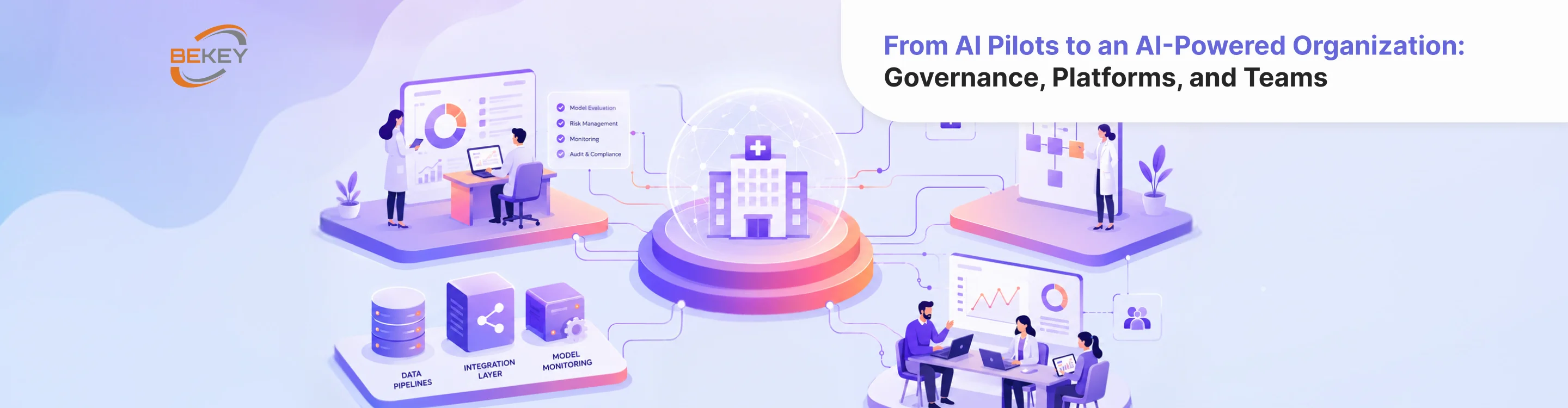
From AI Pilots to an AI-Powered Organization: Governance, Platforms, and Teams
Most organizations do not struggle to start with AI. They struggle once the number of systems, teams, and use cases begins to grow.
At the beginning, AI adoption is usually manageable. A few pilots are launched, one or two workflows are automated, and responsibility stays concentrated within a small group of people. At that stage, the main challenge is proving that the technology can create value. The problems change once AI becomes part of multiple operational processes.
Different teams start using different tools. Models are deployed in isolation. Similar workflows are rebuilt more than once because there is no shared infrastructure or governance process. What originally looked like a series of successful initiatives gradually turns into a fragmented collection of systems that are difficult to maintain, monitor, or scale.
This is the point where organizations realize that scaling AI in healthcare is not primarily a model problem. It becomes an operating model problem.
Questions that were less important during the pilot phase suddenly become central. Which systems should be shared across teams? How are models monitored over time? Who owns governance? What should be centralized, and what should remain local to individual departments? How do new AI initiatives avoid recreating the same infrastructure repeatedly?
These issues tend to appear slowly, but once they do, they shape whether AI becomes part of the organization’s long-term operating structure or remains a set of disconnected experiments.
This article looks at what changes when organizations move beyond isolated AI projects and start building for scale. It focuses on the foundations that usually matter most at that stage: governance, reusable platforms, operational ownership, and the internal capabilities required to support AI across multiple teams and workflows.
Why AI Pilots Don’t Automatically Scale
One of the most common assumptions in AI adoption is that successful pilots naturally lead to broader implementation. In practice, that transition is rarely straightforward.
A pilot is usually designed around a narrow workflow, a limited data scope, and a small number of stakeholders. That environment makes it possible to move quickly and validate whether the underlying idea has value. Many of the constraints that appear later are temporarily avoided or handled manually. Scaling changes the conditions entirely.
What worked for one workflow now has to operate across multiple teams, systems, and operational contexts. Data pipelines become more complex. Governance requirements increase. Integration work expands. Questions around monitoring, ownership, and maintenance become harder to ignore because failures affect more than a single use case.
This is why organizations often end up with multiple successful pilots that never become part of a consistent operating model.
The issue is usually not capability. It is the absence of a shared structure.
Without common infrastructure and governance, every new initiative behaves like a separate project. Teams select different tools, build overlapping integrations, and solve the same operational problems repeatedly. Over time, the organization accumulates isolated AI systems instead of building reusable capabilities.
The shift from pilot to scale, therefore, requires a different mindset. The focus moves away from proving that AI can work and toward creating conditions where multiple AI systems can coexist, evolve, and remain manageable over time.
Governance Becomes Operational, Not Just Regulatory
AI governance is often discussed as a compliance topic, especially in healthcare environments. While regulatory oversight is important, organizations that scale successfully usually treat governance as something broader and more operational.
At a practical level, governance becomes the mechanism that keeps systems usable as adoption expands.
Standardizing how systems are evaluated
During the pilot phase, teams often evaluate systems informally. Once AI is used across multiple workflows, that approach becomes difficult to sustain.
Organizations need consistent ways to assess performance, define acceptable risk, monitor outputs, and decide when systems require adjustment. Without shared evaluation standards, different teams end up measuring success differently, which makes oversight fragmented.
Managing reuse and duplication
Another governance challenge appears when multiple teams begin solving similar problems independently.
Without coordination, organizations frequently duplicate infrastructure, integrations, and workflows across departments. This increases cost and makes long-term maintenance harder.
Governance at scale, therefore, includes decisions about reuse: which capabilities should become shared services, which platforms should be standardized, and where teams should be allowed to operate independently.
Clarifying ownership
As AI systems become embedded into operations, ownership can no longer remain informal.
Someone needs to be responsible for monitoring outputs, handling failures, approving updates, and managing changes over time. In organizations where this remains unclear, systems often work initially but become unreliable as workflows evolve.
Good governance does not eliminate flexibility. It creates enough structure that growth does not turn into fragmentation.
Enterprise AI Platforms and Shared Infrastructure
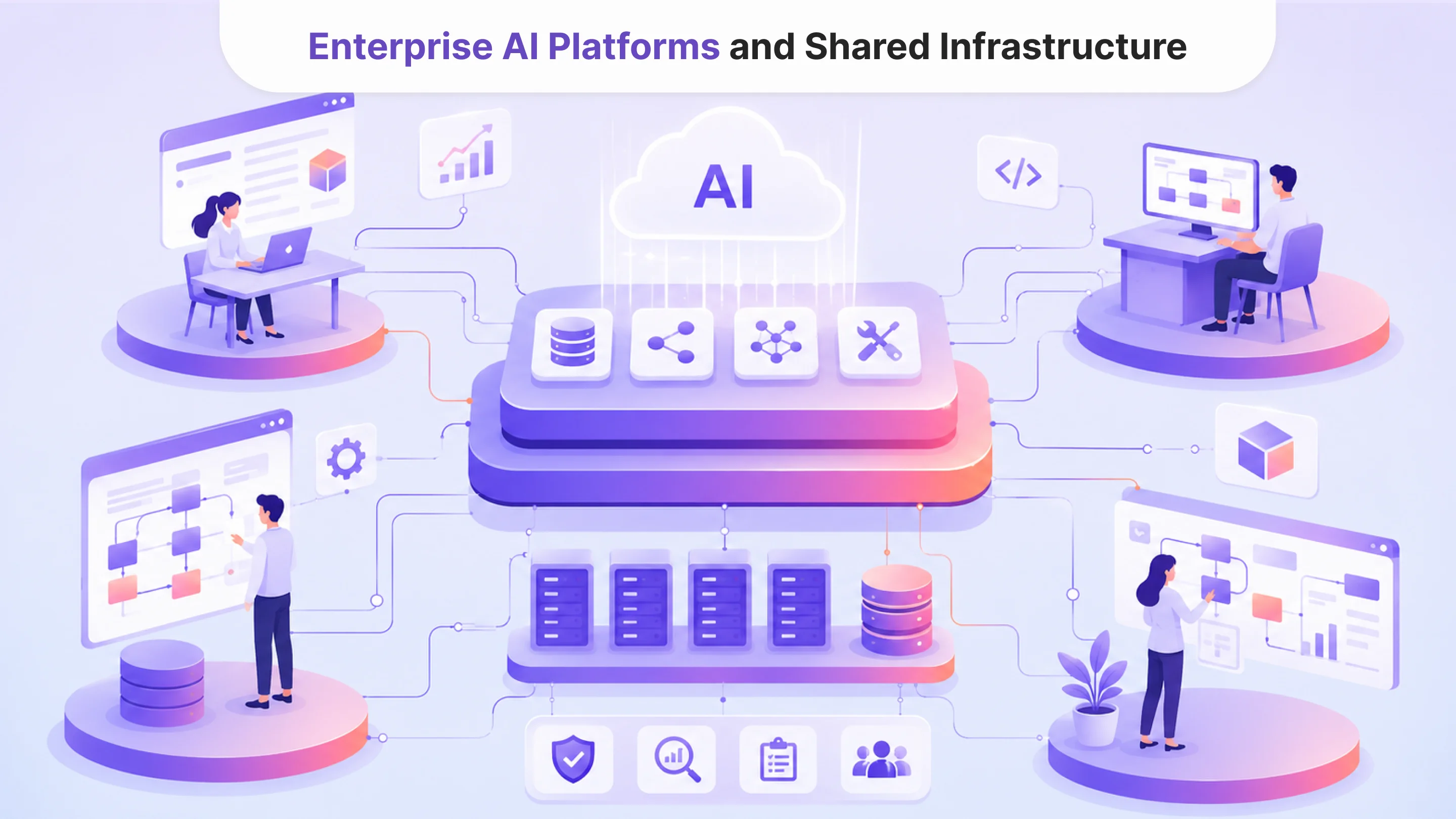
As organizations move beyond isolated implementations, infrastructure decisions become increasingly important.
During early adoption, teams can often build directly around a single use case. At scale, this approach becomes inefficient. Similar capabilities are recreated repeatedly, integrations multiply, and maintenance overhead grows faster than expected.
This is usually where enterprise AI platforms start to emerge.
Moving from projects to shared capabilities
Instead of treating every implementation as a separate system, organizations begin building reusable components that can support multiple workflows.
This may include shared data pipelines, common integration layers, model monitoring systems, vector databases, or internal tooling for deployment and evaluation. The exact architecture varies, but the underlying goal is the same: reduce duplication and create consistency across teams.
Standardization without rigidity
One of the challenges in building enterprise AI platforms is balancing standardization with flexibility.
Too little standardization creates fragmentation. Too much creates bottlenecks that slow down experimentation. Organizations that scale effectively usually separate core infrastructure from workflow-specific logic. Shared systems handle governance, monitoring, and integration, while teams retain flexibility in how AI is applied inside individual workflows.
Why infrastructure decisions matter later
Many infrastructure choices seem minor during the pilot phase because the systems are still small.
At scale, those decisions become expensive to reverse. Inconsistent tooling, duplicated integrations, and incompatible data flows create operational friction that slows future development.
This is why scaling AI in healthcare often depends less on introducing new models and more on creating a stable infrastructure that multiple teams can build on over time.
Building an Organization That Can Actually Scale AI
The transition from AI pilots to an AI-powered organization is less about deploying more models and more about creating systems that can support long-term adoption.
At a certain point, isolated implementations no longer pose the main challenge. What matters instead is whether teams can reuse infrastructure, govern systems consistently, and integrate AI into operations without creating fragmentation.
Organizations that scale successfully usually treat AI as an operational capability, not a collection of experiments. They invest in governance early, build shared foundations where it makes sense, and develop internal structures that enable multiple teams to work with AI without repeatedly rebuilding the same systems.
If your organization is moving beyond pilots and needs a clearer long-term operating model for AI, our long-term AI enablement work helps define governance, platform, and scaling strategies that can support growth over time.

Tell us about your project
Fill out the form or contact us

Tell us about your project
Thank you
Your submission is received and we will contact you soon
Follow us