
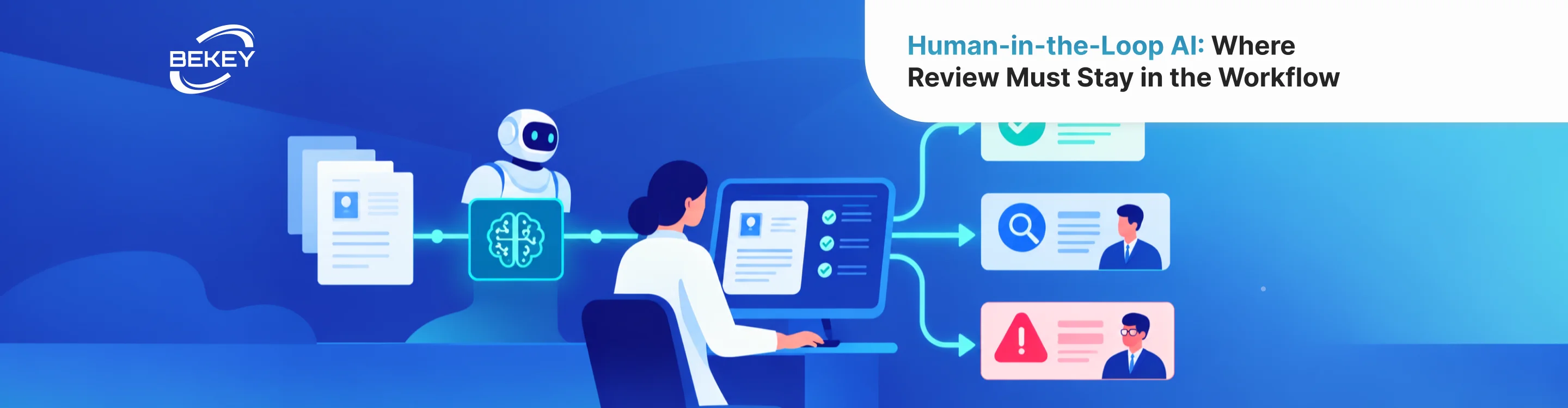
Human-in-the-Loop AI: Where Review Must Stay in the Workflow
- Why human-in-the-loop AI matters
- AI can prepare work, but humans may need to approve the action
- Where AI human review should happen
- AI can suggest, but humans should decide in high-impact cases
- When should AI outputs be automated?
- When AI outputs should be reviewed
- When should AI outputs be escalated?
- Human review should be designed for speed, not friction
- Human-in-the-loop AI is part of responsible automation
- How leaders can decide where the review belongs
- From human review to better AI workflows
Human-in-the-loop AI is often discussed as a safety principle, but in real operations, it is also a workflow design question.
Many teams know that humans should review AI output before it affects customers, patients, employees, financial decisions, compliance processes, or sensitive internal work. But knowing that a review is needed is not enough. The harder question is where that review should happen, who should perform it, what information the reviewer needs, and which cases should be escalated instead of approved.
This is especially important for healthcare, insurance, fintech, legal, HR, education, logistics, and other regulated or compliance-heavy operations. In these environments, AI can prepare, summarize, classify, route, or draft. But humans often still need to approve, decide, validate, or escalate.
That is why human review should not be added after implementation. It should be designed into the workflow from the beginning. This topic also connects to our previous article, AI Governance for Healthcare and Regulated Operations: What Leaders Need Before Scaling, where we explain what leaders should define before scaling AI across healthcare and other regulated workflows.
Why human-in-the-loop AI matters
Human-in-the-loop AI matters because AI output does not exist in a vacuum. Once it enters an operational workflow, someone may use it to answer a customer, process a document, route a case, update a record, prioritize a request, flag a risk, or make a recommendation.
If the output is wrong, incomplete, outdated, biased, or misunderstood, the impact depends on where it appears in the workflow. A weak internal summary may be low risk if someone reviews it before action. A wrong classification may be more serious if it sends a case to the wrong queue. A generated response may create legal, clinical, financial, or trust issues if it is sent without approval.
This is why human review needs to be more precise than “a person will check it.” Different outputs require different levels of control.
Some AI outputs can be automated because the risk is low and the process is reversible. Some should be reviewed because the output influences the next step. Some should be escalated because the case is sensitive, uncertain, unusual, or high-impact.
The goal is not to make humans approve of everything. That would slow the workflow and reduce the value of automation. The goal is to decide where human judgment actually matters.
AI can prepare work, but humans may need to approve the action
One of the most useful roles for AI is preparation. AI can collect information, summarize long documents, extract key fields, organize a case, identify missing details, draft a response, or suggest a next step.
Preparation is often a good place for automation because it reduces manual effort without giving AI full control over the final action. A human can still review the prepared output, make adjustments, and decide what should happen next.
For example, in a healthcare intake workflow, AI may summarize patient-submitted information or flag missing fields. But a staff member may still need to confirm whether the information is complete enough for scheduling, billing, or clinical review. In insurance, AI may organize claims documents or identify missing attachments, but a human may need to approve the next action. In customer support, AI may draft a response, but sensitive complaints may still require human approval.
The difference is simple: AI can prepare the work, but the organization needs to decide whether AI can also trigger the next step.
If the output affects a person, payment, service, record, legal obligation, compliance status, or operational priority, review should usually stay in the workflow.
Where AI human review should happen
AI human review should happen at the point where the output becomes operationally meaningful.
That may be before an AI-generated message is sent, before extracted data updates a system of record, before a recommendation is used to make a decision, before a case is closed, or before a workflow moves into a higher-impact stage.
The review point should match the risk. If AI is summarizing information for internal awareness, review may be light. If AI is drafting patient-facing, customer-facing, or legally sensitive communication, review should be stricter. If AI is flagging a compliance risk, the review process should define who validates the flag and what happens next.
A common mistake is placing the review too late. If a team reviews only after AI output has already moved through the workflow, the review becomes damage control. Another mistake is placing review too early or too broadly, which can make the system inefficient because people spend time checking low-risk outputs that do not need detailed attention.
A practical human-in-the-loop workflow should define the exact moments when review is required. It should also define what the reviewer is checking: factual accuracy, completeness, tone, compliance risk, source quality, missing data, or fit with the next step.
AI can suggest, but humans should decide in high-impact cases
AI is often useful for suggestions. It can suggest a category, priority level, next step, response draft, routing path, missing document, or possible issue. But a suggestion is not the same as a decision.
In high-impact workflows, humans should remain responsible for final decisions. This includes decisions that affect care, eligibility, coverage, employment, legal status, financial outcomes, access to services, or formal compliance actions.
For example, AI may suggest that a case looks urgent, but a trained human should decide how to escalate it. AI may identify a possible compliance issue, but a compliance specialist should determine the next action. AI may draft a response to a customer complaint, but a human should approve the final message if the issue is sensitive. AI may summarize patient information, but clinical judgment should remain with qualified professionals.
This does not mean AI has no role in high-impact work. It means its role should be clearly limited. AI can prepare context, reduce manual review time, highlight patterns, and help people see what needs attention. But the final decision should stay with the person or team accountable for the outcome.
The workflow should make this boundary visible. Users should know when AI is suggesting and when a human is deciding.
When should AI outputs be automated?
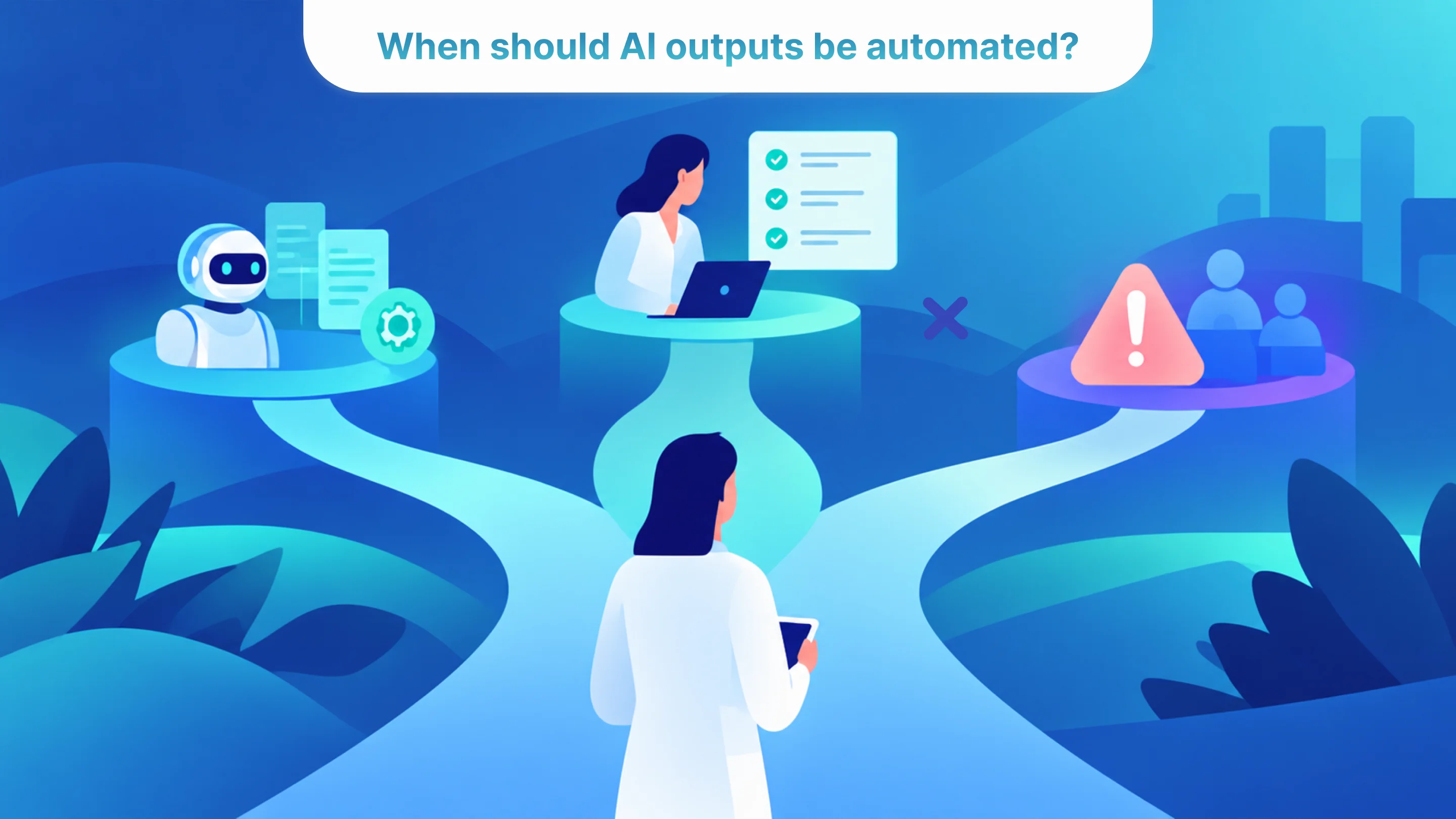
Some AI outputs can move through the workflow with little or no human review, especially when the task is low-risk, reversible, and easy to monitor.
Examples may include tagging internal documents, organizing knowledge base content, grouping low-risk support requests, creating internal summaries for awareness, detecting duplicate records for later review, or routing routine requests based on clear rules.
Even then, automation should not be completely unmanaged. Teams should define confidence thresholds, exception rules, sampling checks, and monitoring. Low-risk does not mean no oversight. It means the review process can be lighter.
A useful rule is to automate when the output does not directly create harm, does not make a final decision, does not communicate externally without approval, and can be corrected if something goes wrong.
Automation works best when the workflow is clear, the data source is reliable, the task is repetitive, and the result is measurable. If the process is messy, sensitive, or ambiguous, human review should stay closer to the output.
When AI outputs should be reviewed
AI outputs should be reviewed when they influence a meaningful next step but do not necessarily require escalation.
This includes drafts, summaries, classifications, recommendations, extracted fields, or generated reports that humans will use to act. The reviewer should not have to start from zero. AI should reduce the work by preparing the output, but the person should still verify that it is accurate enough for use.
For example, AI may extract key fields from a document, but a human reviews them before the data enters a system of record. AI may classify a request, but a team member confirms the category before routing. AI may draft a response, but an operations or support specialist edits and approves it before sending. AI may generate a report summary, but a manager reviews it before using it in a decision.
The review step should be easy to complete. Reviewers need access to source material, AI output, confidence indicators, if available, and clear approval options. They should know whether they are approving, editing, rejecting, or escalating.
If the review is too vague, people may either rubber-stamp AI output or redo the work manually. Both outcomes weaken the workflow.
When should AI outputs be escalated?
Escalation is different from review. Review means a person checks the output and decides whether it can move forward. Escalation means the case needs a higher level of attention because it is unusual, sensitive, uncertain, or outside standard rules.
AI workflows should define escalation rules before launch.
A case may need escalation if the input is incomplete, the data source conflicts with another source, the output confidence is low, the request is emotionally sensitive, the issue involves legal or compliance risk, the decision could affect access to care or services, or the workflow reaches an exception that AI should not handle.
Escalation is especially important in regulated operations because not all errors are equal. A wrong internal tag may be minor. A wrong recommendation in a high-impact workflow may require immediate review by a qualified person.
The system should make escalation simple. Users should not have to guess who owns the case. The workflow should define where escalated cases go, who reviews them, what context is included, and how the final decision is documented.
Human review should be designed for speed, not friction
A common concern is that human-in-the-loop AI will slow everything down. It can, if it is designed poorly.
If every AI output goes to a manual review queue with no prioritization, the workflow may become slower than before. If reviewers do not have enough context, they may spend extra time checking sources. If approval rules are unclear, every case may feel like a judgment call. If escalation paths are informal, cases may get stuck.
Good human review should reduce friction, not add it. The workflow should separate low-risk automation from review-required outputs and escalation-required cases. Reviewers should see the original input, the AI output, relevant sources, suggested next steps, and a clear action menu. The system should also learn from review patterns over time, so recurring corrections can improve instructions, data sources, rules, or workflow design.
Human review works best when it is specific. The reviewer should know what they are checking and why.
Human-in-the-loop AI is part of responsible automation
Responsible AI automation is not about keeping humans everywhere. It is about keeping humans where accountability, judgment, context, and risk require them.
Some tasks should be automated. Some should be reviewed. Some should be escalated. The difference depends on the workflow, data, user, output, risk level, and business impact.
This is why human-in-the-loop design should happen before implementation. If a review is added after the system is already built, teams may discover too late that the workflow has no clear owner, no easy approval step, no escalation path, no audit trail, and no practical way to monitor outcomes.
A responsible workflow starts with the question: what should AI prepare, what should a human approve, and what should be escalated?
For teams that need help designing these review points, escalation paths, and automation boundaries, AI automation services can help turn human-in-the-loop requirements into practical workflows that are ready for real operations.
How leaders can decide where the review belongs
Operations leaders, compliance teams, and product leaders should decide on review points based on risk and workflow impact.
A useful starting point is to look at each AI output and ask what happens if it is wrong. If the error is easy to detect, easy to reverse, and low-impact, automation may be appropriate. If the error could affect a customer, patient, employee, payment, record, compliance process, or business decision, review should remain in the workflow. If the error could create serious harm, legal exposure, regulatory concern, or a high-impact decision, escalation should be required.
Teams should also consider how often the case occurs, who is qualified to review it, what source material is needed, and how the final action should be documented.
The goal is to create a review model that is practical enough for daily operations and strong enough for the risk involved.
From human review to better AI workflows
Human-in-the-loop AI should not be treated as a checkbox. It should be part of how the workflow is designed.
When review is planned early, AI becomes easier to trust and easier to scale. Teams know what AI can handle, what humans must approve, what should be escalated, and how decisions are documented. Users are not left guessing. Compliance teams can see the control points. Leaders can measure whether the workflow is improving instead of simply assuming that automation is working.
The best AI workflows are not fully manual or blindly automated. They are designed around the right balance of automation, review, and escalation.
That is where human-in-the-loop AI creates real value: not by slowing AI down, but by making it safe enough and useful enough to become part of real operations.

Tell us about your project
Fill out the form or contact us

Tell us about your project
Thank you
Your submission is received and we will contact you soon
Follow us