
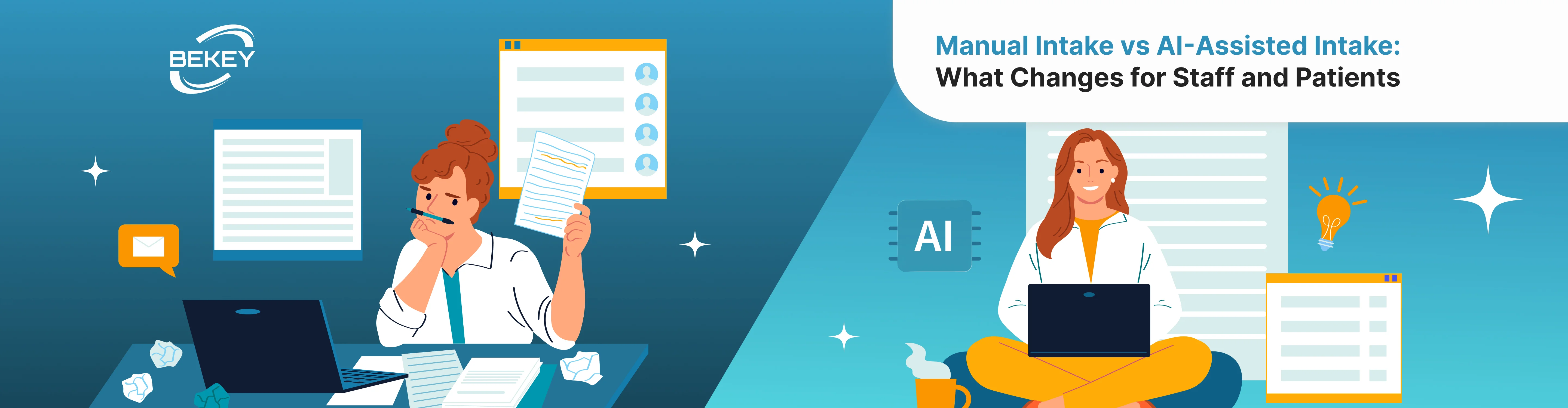
Manual Intake vs AI-Assisted Intake: What Changes for Staff and Patients
Patient intake is one of the first moments where healthcare operations either create trust or introduce friction. Before a patient reaches the first appointment, someone has to collect information, review documents, check completeness, route the request, and prepare the case for the next step.
In our previous article, “Patient Intake Automation: How to Reduce Manual Work Before the First Appointment,” we looked at why intake becomes such a common operational bottleneck and how automation can reduce manual work before care begins. This article continues that topic from a more practical comparison angle: what actually changes when a team moves from manual intake to AI-assisted patient intake?
In a manual patient intake process, much of this work depends on staff attention. A coordinator opens every form, checks every field, reviews every uploaded document, sends follow-up messages, and decides where the request should go next. This approach may work at a small scale, but it becomes harder to maintain as patient volume grows.
AI-assisted patient intake changes the workflow by reducing repetitive administrative work before staff get involved. It does not remove human review. Instead, it helps teams process intake information faster, identify missing details earlier, and route requests more consistently.
The result is a smoother patient intake workflow for both staff and patients.
What manual patient intake looks like
Manual intake often starts with a form, but the real work begins after submission. Patients may skip required fields, upload unclear documents, choose the wrong service, or provide information that needs additional review.
Staff then need to manually check what is missing, contact the patient, review documents, copy information into another system, and decide what happens next. If the workflow involves scheduling, billing, eligibility checks, referrals, or clinical triage, the number of manual steps grows quickly.
For staff, this creates repetitive work that can feel endless. For patients, it creates delays before care even begins.
A typical manual intake workflow may look like this:
Patient submits a form.
Staff manually open and review the submission.
Missing information is identified after review.
Staff sends follow-up messages.
Uploaded documents are checked manually.
Information is copied into internal systems.
The case is routed to scheduling, billing, care coordination, or clinical review.
The next team receives the case, often with limited context.
The main issue is not that staff are doing something wrong. The issue is that the workflow depends too heavily on manual checking, manual routing, and manual preparation.
What AI-assisted patient intake changes
AI-assisted patient intake shifts part of the preparation work from staff to the system. Instead of asking employees to review every submission from scratch, AI can help organize the information first.
For example, AI can check whether required fields are missing, classify uploaded documents, extract key details from forms or PDFs, summarize patient notes, and suggest where the request should go next. Staff still review the output and handle exceptions, but they start from a cleaner, more structured version of the case.
A basic AI-assisted intake workflow may look like this:
Patient submits forms and documents.
The system checks for missing information.
AI classifies documents and extracts key details.
AI generates a short intake summary.
The request is routed based on predefined rules.
Staff review exceptions, uncertain cases, or clinically sensitive information.
The next team receives a clearer case with better context.
This creates a practical difference: staff spend less time preparing information and more time acting on it.
What changes for staff
Less repetitive review
In manual intake, staff often review every submission in the same way, even when many cases follow predictable patterns. AI-assisted intake helps filter and prepare cases before staff review them.
Instead of opening every document just to understand what it is, staff can see document categories, extracted details, and missing information flags. Instead of reading long free-text answers from scratch, they can start with a summary and check the original when needed.
This does not eliminate review. It makes the review faster and more focused.
Fewer follow-up loops
Incomplete intake leads to a lot of back-and-forth communication. Staff may repeatedly ask patients for missing forms, clearer uploads, insurance details, or additional information.
AI can detect missing details earlier and prepare follow-up messages based on approved templates. This reduces the number of cases that sit in limbo because no one noticed a missing document until later in the process.
For staff, fewer follow-up loops mean less administrative noise. For managers, it means better control over intake delays.
Clearer routing
Manual routing often depends on staff experience. A team member reads the submission and decides whether it should go to scheduling, billing, care coordination, or clinical review. This can work well when volume is low, but it creates inconsistency when teams grow.
AI-assisted intake can suggest routing based on predefined logic. For example, a complete low-risk case may move to scheduling. A case with insurance issues may go to billing. A case with clinical concerns may be escalated to a human reviewer.
The system should not make sensitive decisions alone, but it can reduce the amount of manual sorting required.
Better visibility for managers
Manual intake makes it difficult to understand where time is lost. Managers may know that the team is overloaded, but not whether the bottleneck is incomplete forms, document review, routing, eligibility checks, or follow-up communication.
AI-assisted workflows can make these bottlenecks more visible. Teams can track how many submissions are incomplete, how many documents require review, how many cases are escalated, and where requests wait the longest.
This helps leaders improve the workflow instead of simply adding more staff to handle the same manual process.
What changes for patients
Faster movement through intake
Patients usually do not see the internal work behind intake. They only notice whether the process feels smooth or frustrating.
In a manual workflow, patients may wait because staff have not yet reviewed the form, noticed a missing field, or routed the request. In an AI-assisted workflow, many of these issues can be detected earlier.
This can help patients move faster from submission to scheduling, review, or next steps.
Fewer repeated requests
Patients often become frustrated when they are asked for the same information more than once or contacted days later about something that could have been flagged earlier.
AI-assisted intake can reduce these repeated requests by checking completeness sooner and helping staff communicate more clearly about what is missing.
A better intake process not only saves staff time. It also makes the patient experience feel more organized.
More consistent communication
Manual intake communication can vary depending on who handles the case, how busy the team is, and how clear the internal process is.
AI can help standardize administrative messages using approved templates and workflow rules. This makes communication more consistent while still allowing staff to review or personalize messages when needed.
The patient receives clearer instructions, and the team reduces the risk of inconsistent or incomplete responses.
Before and after: manual vs AI-assisted intake
Workflow step | Manual intake | AI-assisted intake |
Form review | Staff check every submission manually | System flags missing or inconsistent information |
Document review | Staff open and classify each file | AI classifies documents and extracts key details |
Follow-up | Staff write repeated messages manually | AI drafts follow-ups from approved templates |
Routing | Staff decide where each case goes | AI suggests routing based on predefined rules |
Staff workload | High volume of repetitive review | Staff focus on exceptions and decisions |
Patient experience | Delays and repeated requests are common | Faster, clearer intake process |
Manager visibility | Bottlenecks are hard to measure | Workflow delays become easier to track |
What should stay human-led
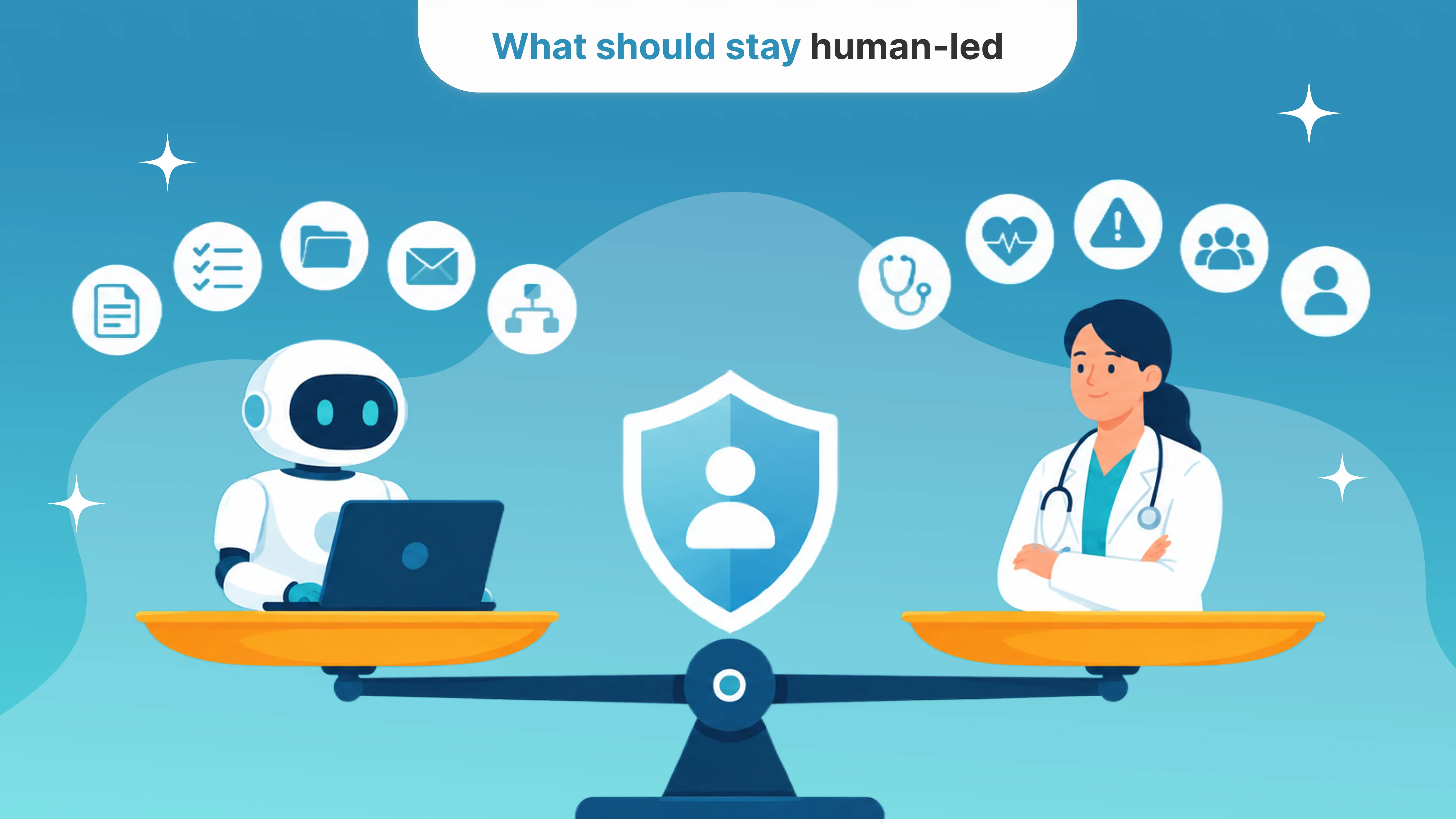
AI-assisted patient intake works best when it has clear boundaries. Some tasks are safe to automate or support with AI. Others should remain human-led.
AI can help with document classification, completeness checks, intake summaries, routing suggestions, and administrative follow-up drafts. It should not independently diagnose patients, interpret symptoms, determine medical necessity, approve treatment, or make clinical decisions.
A safe AI-assisted intake workflow should include escalation rules for urgent, uncertain, or clinically sensitive cases. It should also include human review, audit trails, and role-based access to patient information.
The goal is not to turn intake into a fully automated black box. The goal is to remove unnecessary manual work while keeping healthcare teams in control.
When AI-assisted intake makes sense
Not every intake process needs AI immediately. For some teams, improving the form or simplifying the workflow may be enough. AI-assisted intake becomes more valuable when volume, complexity, and repetition increase.
Your organization may benefit from AI-assisted patient intake if:
staff manually review every submission;
patients often submit incomplete forms;
document review takes too much time;
follow-up messages are repetitive;
requests are routed manually;
intake delays affect scheduling or revenue;
managers cannot clearly see where the process slows down.
If several of these signs are present, the intake workflow may be ready for review.
Conclusion
Manual patient intake depends heavily on staff time, attention, and coordination. It often works in the beginning, but as patient volume grows, the same process can create delays, repeated follow-ups, inconsistent routing, and unnecessary administrative work.
AI-assisted patient intake does not replace staff. It changes where staff spend their time. Instead of reviewing every case from scratch, they can focus on exceptions, sensitive cases, and decisions that require human judgment.
For patients, the difference is a smoother experience before the first appointment. For staff, it means less repetitive work and clearer workflows. For healthcare leaders, it creates a more scalable intake process.
The question is not whether intake should be fully automated. The better question is: which parts of the intake workflow are repetitive enough to support with AI, and which parts should stay human-led?
That is where the greatest improvements usually begin.
Want to understand where your intake process slows down?
Book an intake workflow review with BeKey to identify manual review points, repeated follow-up loops, document bottlenecks, and safe opportunities for AI-assisted patient intake.

Tell us about your project
Fill out the form or contact us

Tell us about your project
Thank you
Your submission is received and we will contact you soon
Follow us