

Why Most “Future of AI” Articles Are Useless for Operators
If you read enough “future of AI in healthcare” articles, they start to sound very similar.
The same directions come up every time - more automation, better decision support, personalized care, new combinations with areas like longevity or gene editing. None of that is wrong. In fact, most of it will probably happen in some form.
The issue is that this kind of writing doesn’t help much once you move from reading to actually building something.
At some point, the questions change. It’s no longer about where the industry is heading, but about whether a specific idea can be implemented in a real workflow, with the systems and constraints you already have. That’s where most of these articles stop being useful.
They describe a future state, but skip the part in between - the messy part where data is incomplete, workflows don’t quite fit, and every integration takes longer than expected.
For people responsible for delivery, that gap matters more than the trend itself.
This article is an attempt to close that gap a bit, not by arguing with the trends, but by looking at them from the perspective of execution: what actually changes once you try to build, and why that changes how these “future” narratives should be read.
Where “Future of AI” Content Breaks Down
The problem with most forward-looking content isn’t that it’s wrong. It’s that it operates at a level where constraints don’t really exist.
At that level, everything connects easily. Data is assumed to be available, systems are assumed to integrate, and workflows are treated as something that can be redesigned without much friction. The result is a clean, coherent picture of where things are going.
That picture rarely survives contact with actual systems.
Once you try to build anything even slightly similar, the constraints show up quickly. Data is fragmented across systems that were never designed to work together. Access is inconsistent. Formats don’t align. Even basic assumptions, like having a complete view of a patient or a process, turn out to be unreliable.
Then there are workflows. In most healthcare environments, they are not designed from scratch. They evolve, often with layers of exceptions, manual steps, and local adaptations. Introducing AI into that structure is less about inserting a model and more about negotiating with everything that already exists.
This is the part most “future of AI” articles leave out. Not because it’s unimportant, but because it’s difficult to generalize and harder to make sound compelling.
Why Direction Doesn’t Translate into Execution
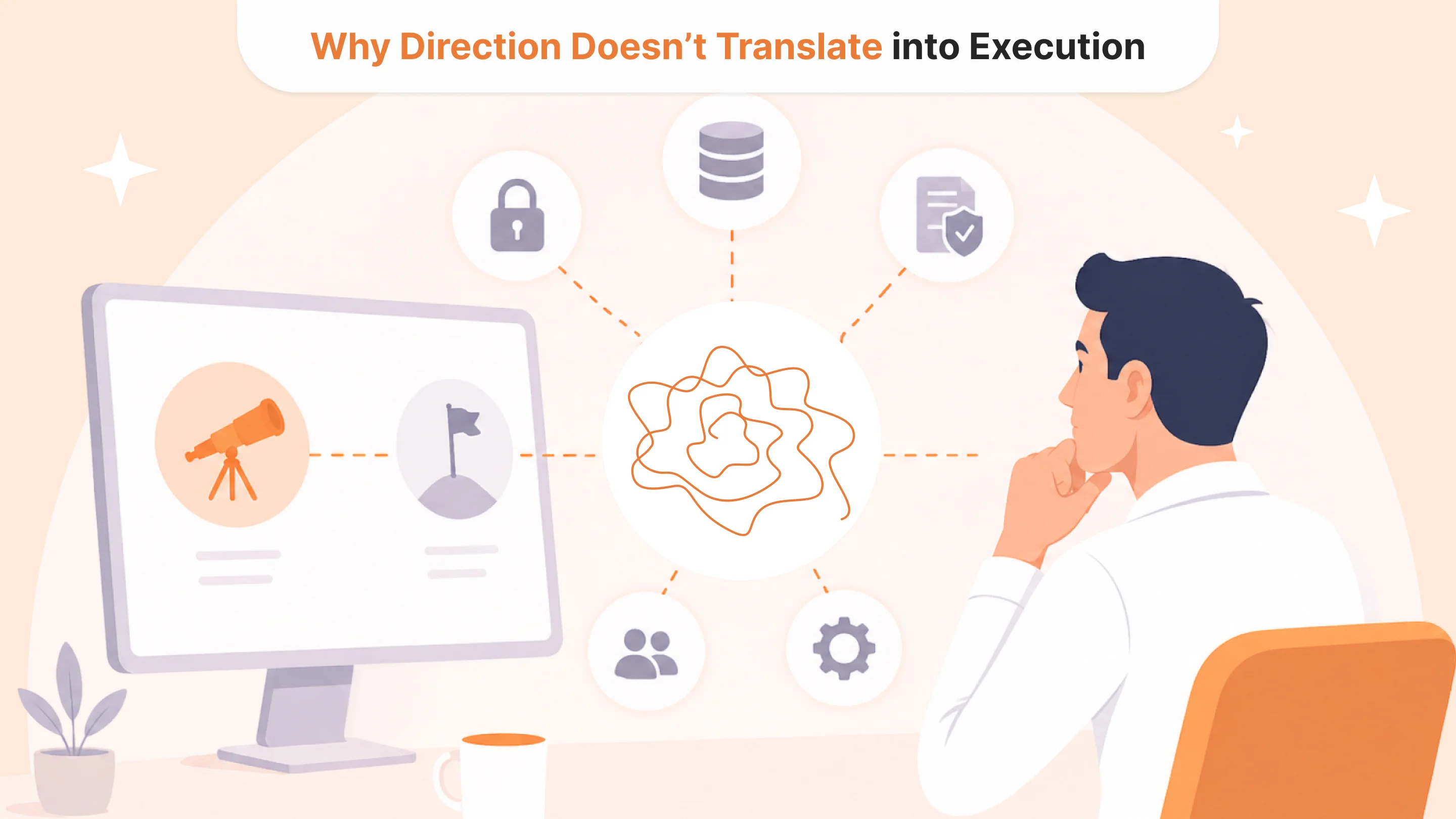
Knowing where the industry is heading doesn’t tell you much about what you can ship in the next six months.
The gap between direction and execution is mostly about dependencies. A trend might be valid in principle, but still depend on things that are outside your control - data quality, system access, regulatory clarity, or simply the willingness of teams to change how they work.
Even when the underlying models are ready, those dependencies tend to slow everything down. What looks like a straightforward use case at a conceptual level turns into a sequence of smaller problems: cleaning inputs, aligning outputs with existing formats, deciding where the system fits in the workflow, and figuring out who is responsible when it fails.
None of this is particularly visible in trend-based writing, but it’s where most of the effort goes.
There’s also a timing issue. Some ideas are simply early. They make sense, but only in environments that have already solved problems your organization is still dealing with. Trying to build them too soon doesn’t create an advantage; it just creates friction.
This is why two teams can look at the same trend and arrive at very different outcomes. One builds something that works. The other spends months trying to force it into a context where it doesn’t quite fit.
What Operators Actually Need Instead
For teams that are responsible for delivery, useful guidance looks very different from trend narratives.
Start with the workflow
The starting point is not the technology, but the workflow. Before evaluating any AI use case, it has to be clear where it would sit in an existing process and what exactly it would replace or improve. If that answer is vague, the project will likely stay at the demo stage.
Be specific about data
The second requirement is clarity around data, not in general terms, but in specifics. Where does the data come from? How consistent is it? How often does it change? Can it be accessed without introducing delays or compliance issues? Most implementation problems trace back to assumptions that were made too early at this level.
Define ownership early
Ownership is another point that tends to be underestimated. Someone has to be responsible not just for building the system, but for what happens once it is in use - reviewing outputs, handling exceptions, and deciding when adjustments are needed. Without that, even well-built systems lose reliability over time.
Decide how success will be measured
Finally, there has to be a way to measure whether the system is actually useful. Time saved, error reduction, throughput, or financial impact - the metric depends on the use case, but it needs to be defined upfront. Otherwise, it becomes difficult to distinguish between something that works in theory and something that improves operations.
None of this is particularly complex, but it requires a different mindset. Instead of asking “what can AI do here,” the more useful question is “what part of this process can be reliably improved, given the constraints we have?”
From Trends to Systems
Seen from this perspective, trends are still valuable, but they need to be interpreted differently.
Treat trends as signals, not instructions
They are signals about where capabilities are moving, not instructions about what to build next. The decision to act depends on whether those capabilities can be mapped onto real workflows, supported by available data, and maintained within existing operational and regulatory constraints.
Work across different levels of readiness
In practice, this means most organizations should be working on a mix of things at once. A small number of initiatives that are ready to be built and integrated. A few areas where targeted experiments make sense. And a larger set of directions that are tracked but not actively developed.
Align effort with reality, not visibility
What matters is that these categories are not confused.
When everything is treated as equally urgent, teams spread themselves too thin and end up with multiple partial implementations. When everything is treated as too early, opportunities are missed. The balance comes from aligning effort with readiness, not with visibility.
For a broader perspective on how to approach these decisions at a strategic level, see our Beyond the Hype article on AI + CRISPR, longevity, and VR.
If your team is working through these questions and needs a more structured way to translate trends into execution, our AI strategy advisory work focuses on defining what to build, what to test, and what to leave for later, based on actual constraints, not just direction.

Tell us about your project
Fill out the form or contact us

Tell us about your project
Thank you
Your submission is received and we will contact you soon
Follow us