

Centralized vs Team‑Owned AI: What Scaling Companies Get Wrong
As companies scale AI adoption, organizational structure becomes harder to ignore.
At the beginning, the question usually seems simple. Should AI be managed by a centralized platform team, or should individual product and operations teams own their own systems?
Most organizations eventually discover that neither model works as cleanly as expected.
Highly centralized structures often create bottlenecks. A small AI team becomes responsible for every request, every integration, and every deployment decision. Over time, delivery slows down because too much coordination depends on a single group.
Fully decentralized models create a different problem. Teams move faster initially, but systems start diverging. Similar tools are rebuilt multiple times, governance becomes inconsistent, and infrastructure grows harder to maintain across the organization.
The tension between these approaches tends to arise when AI moves beyond isolated pilots and becomes part of multiple workflows simultaneously.
This is not just a technical issue. It is an operating model issue.
The way responsibilities are divided between platform teams, product teams, operations, and governance functions directly affects how quickly systems can scale, how reusable infrastructure becomes, and how manageable AI remains over time.
This article examines why organizations struggle with centralized and team-owned AI models, where each approach breaks down, and what scaling companies tend to learn once AI adoption moves from experimental to operational.
Why Centralization Looks Attractive Early On
In the early stages of AI adoption, centralization often feels like the safest option.
A dedicated AI or innovation team allows organizations to move quickly without requiring every department to build internal expertise immediately. Governance stays relatively controlled, infrastructure decisions remain consistent, and experimentation can happen without large-scale organizational changes.
This works well during the pilot phase because the number of active systems is still limited.
A centralized team can support a handful of initiatives, evaluate vendors, define standards, and manage early integrations without creating significant friction. At this stage, the benefits of coordination usually outweigh the drawbacks.
The problems appear once demand increases. As more teams begin exploring AI use cases, the centralized group gradually becomes a dependency for everything. Product teams wait for integrations. Operations teams wait for workflow changes. Requests compete for the same limited resources.
What initially looked like a structure started turning into a bottleneck. This is especially common in healthcare environments, where workflows differ significantly across departments, and implementation details matter. A centralized team may understand the infrastructure well, but still struggle to move quickly enough across multiple operational contexts at the same time.
Why Fully Decentralized AI Creates Different Problems
In response to these bottlenecks, some organizations move toward team-owned AI models.
The logic is understandable. Product and operational teams know their workflows best, move closer to the problem, and can often ship faster without waiting for centralized approval.
In the short term, this usually improves speed. The issue is that decentralization shifts complexity elsewhere. Without shared standards, teams begin making independent decisions about tooling, infrastructure, monitoring, and governance. Similar integrations are rebuilt multiple times. Different evaluation methods emerge across departments. AI systems that solve related problems start operating on incompatible foundations.
At first, these issues seem manageable because each project works.
Over time, however, the organization accumulates fragmented infrastructure instead of reusable capability. Maintenance costs increase, governance becomes inconsistent, and scaling new initiatives becomes harder because every workflow behaves differently.
The challenge is not that decentralized teams make poor decisions. It is that local optimization does not automatically create organizational coherence.
The Real Problem Is Usually the Boundary
Most scaling organizations eventually discover that the issue is not choosing between centralization and decentralization. It defines the boundary between them.
Some capabilities benefit from central ownership because they become more valuable when shared across teams. Data infrastructure, deployment tooling, governance standards, monitoring systems, and integration layers often fall into this category.
Other responsibilities are better owned closer to the workflow itself. Product teams and operational teams typically understand edge cases, user behavior, and process-specific constraints better than centralized platform groups.
Problems start when these boundaries are unclear. If platform teams control too much, they slow down delivery and become disconnected from operational realities. If product teams own everything independently, infrastructure fragments and governance weaken.
The organizations that scale AI effectively usually separate shared infrastructure from workflow ownership. Platform teams provide common foundations and standards, while product and operations teams retain responsibility for how AI is applied inside specific workflows.
This creates consistency without forcing every implementation through a single bottleneck.
AI Operating Models Need to Evolve With Scale
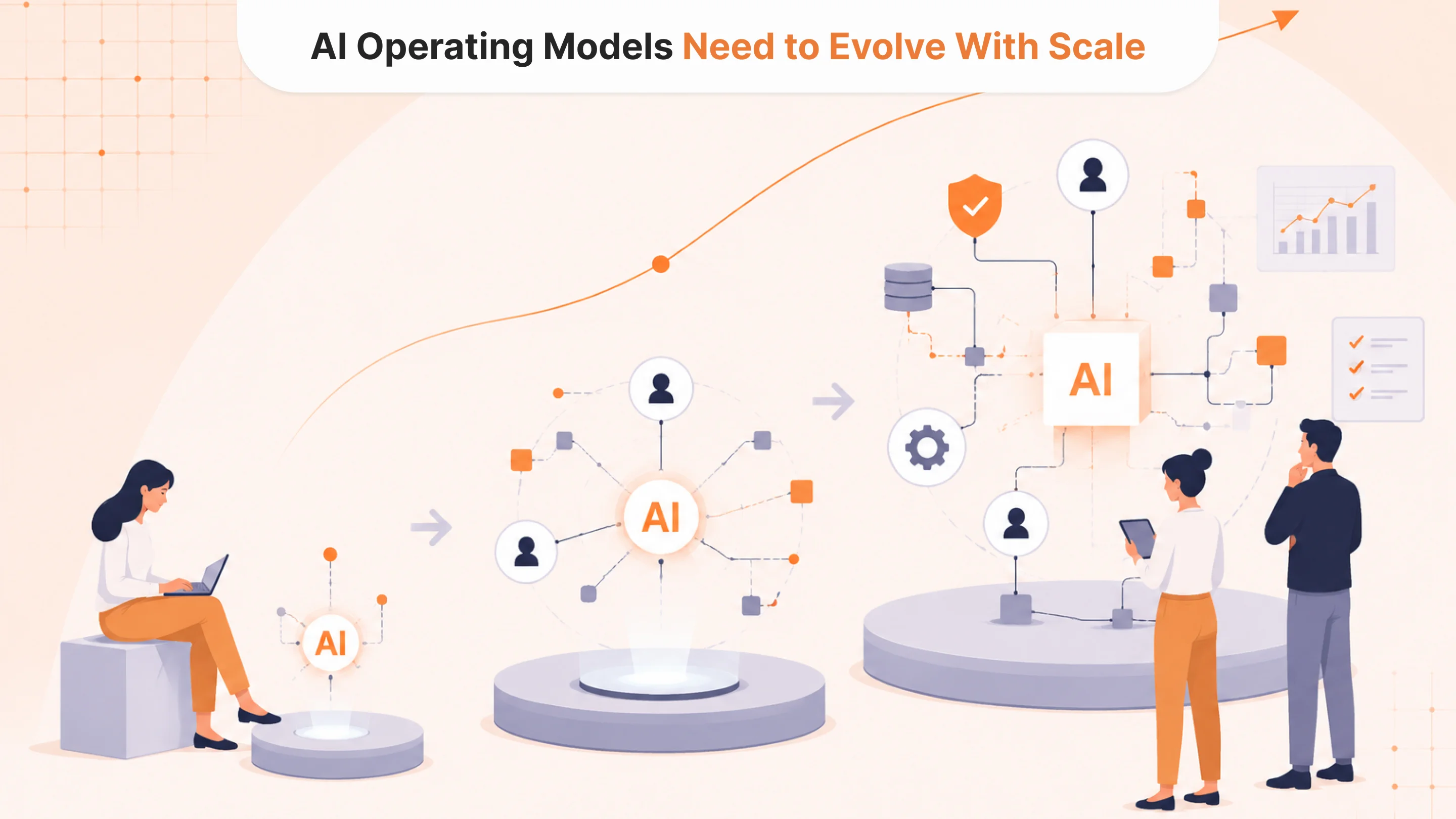
One of the reasons AI operating models fail is that organizations try to keep the same structure as adoption expands.
The model that works for two pilots rarely works for twenty production systems. As AI spreads across workflows, responsibilities need to evolve. Governance becomes more operational. Shared infrastructure becomes more important. Product teams need greater autonomy, but within clearer standards.
This transition is difficult because it requires balancing speed with coordination. Too much structure slows adoption. Too little creates fragmentation that becomes expensive later.
There is no universal model that fits every organization. The right structure depends on team maturity, technical capability, regulatory requirements, and how deeply AI is integrated into operations.
What matters is recognizing that scaling AI eventually becomes an organizational design problem, not just a technology problem.
Scaling AI Without Creating Organizational Friction
Companies that scale AI successfully tend to move away from extreme models.
They avoid fully centralized structures that turn platform teams into bottlenecks, but they also avoid complete decentralization that leads to duplicated infrastructure and inconsistent governance.
Instead, they build shared foundations where consistency matters and distribute ownership where workflow knowledge matters most.
That balance is usually what determines whether AI becomes a scalable organizational capability or a growing collection of disconnected systems.
For a broader view of how governance, platforms, and operating structures evolve during AI adoption, see our Scaling AI pillar article.
If your organization is working through platform ownership, governance structure, or AI operating model decisions, our long-term AI enablement work helps define scalable approaches that support growth without creating unnecessary operational friction.

Tell us about your project
Fill out the form or contact us

Tell us about your project
Thank you
Your submission is received and we will contact you soon
Follow us